
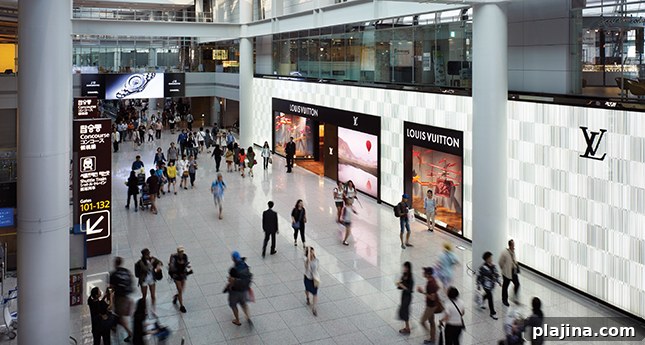
Incheon, already renowned for its duty-free offerings, was chosen for Louis Vuitton’s first airport store for several clear reasons: rapid growth into one of the world’s busiest airports and its strategic role as a gateway for travelers to and from China and Japan, two key markets for the brand.
“We are a global brand with a global link, and the design of the Incheon International Airport matched our requirements for an airport store, along with the central location and position,” said Yves Carcelle, chairman and CEO of Louis Vuitton. “The airport store will give the same service and luxury as in a downtown store.”
Situated on Airstar Avenue, the boutique is immediately recognizable by the brand’s signature checkered motif on its facade. Occupying nearly 6,000 square feet, the store channels the romance of classic air travel. The Vuitton family drew inspiration from early aviation pioneers such as Alberto Santos-Dumont, the Wright brothers and Louis Blériot. Reflecting that travel heritage, the boutique stocks trunks and luggage alongside leather goods, shoes, belts, ties, textiles, jewelry, sunglasses, watches and other accessories.
Louis Vuitton complements Incheon’s luxury retail mix, joining neighbors such as Chanel, Burberry, Christian Dior, Givenchy and Furla in the airport’s duty-free shopping precinct.
Since opening in 2001, Incheon International Airport has evolved rapidly into a world-class facility. In just a decade it has risen to become one of the globe’s top passenger airports. Its amenities go beyond the terminal: the airport complex includes a golf course, spa, private sleeping rooms, an ice rink, a casino and extensive indoor gardens.
Promoting Korean culture is a key priority for the airport. In partnership with the National Museum of Korea, Incheon operates the Korean Culture Museum to introduce transiting visitors to the nation’s heritage. The museum displays artifacts and exhibits focused on traditional arts, music and the history of printing and the Korean alphabet.
Opened in 2004 near Gate 24 in the East Wing, the Traditional Korean Cultural Experience Zone has grown into a major draw, attracting more than 100,000 visitors annually. Travelers can participate in hands-on workshops to make traditional crafts and enjoy live cultural performances.
Expansion plans continue to shape the airport’s future. The third phase of a $4.1 billion development program includes a new $1.4 billion, 3.7-million-square-foot passenger terminal. Construction was slated to begin in 2012 with completion expected in 2015; once operational, the terminal will handle roughly 18 million passengers per year, provide 37 gates and parking positions for 65 aircraft, and link to the rest of the airport by an expanded automated people mover.
The broader plan also encompasses a $2.7 billion cargo and logistics complex and a parking facility for nearly 6,000 vehicles.
Travelers between central Seoul and the airport benefit from the A’REX express train. Launched in 2007 between Incheon and Gimpo and extended to Seoul Station in December 2010, the service offers two options: a high-speed express that covers the route in about 45 minutes with departures every 30 minutes, and a local service that stops at 10 stations, departs roughly every six minutes and takes around 55 minutes.
Passengers boarding at Seoul Station can check in, drop baggage and use a dedicated outbound immigration lane, streamlining the airport experience.
Rail connectivity is set to improve further as high-speed services expand to Incheon. The Korea Train Express (KTX) is planned to reach the airport within a few years, shortening travel times and linking the airport to regional cities. By 2013, the Gyeongbu Line connection will open access from Osong, Daejeon, Dongdaegu, Ulsan and Busan; by 2014, the Honam Line connection will enable direct travel to Iksan, Gwangju Songjeong and Mokpo.
To serve medical tourists — a growing segment exceeding 30,000 visitors to Korea — a dedicated medical center for foreign patients is scheduled to open on Yeongjong Island, near the airport, in mid-2012. Located about five minutes from the terminal, the outpatient-focused facility will offer plastic surgery, dermatology, dentistry and traditional medicine, along with an on-site spa and dietary services tailored for layover patients. Staff fluent in multiple languages, plus marketing and health-insurance support, are planned to serve international visitors.
Incheon welcomed its first Airbus A380 service in 2009, operated by Emirates. Korean Air introduced its A380 to Incheon in June 2011, launching routes to New York (JFK) in August and Los Angeles (LAX) in October; the airline planned multiple A380s from the airport by year’s end. Incheon is also a major hub for Asiana Airlines.
Frequent travelers seeking a memorable airport experience will find Incheon continually expanding its amenities and attractions. Though still relatively young, the airport has already become a destination in its own right. As development progresses, travelers, airlines and global brands are watching closely to see how this dynamic hub will continue to grow.