
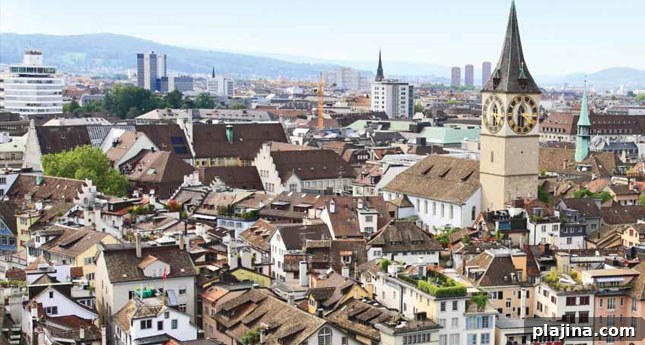
In 15 B.C., Roman soldiers—demonstrating a keen eye for strategic locations—established a customs post and tax collection station on the scenic hillside now known as Lindenhof in Zürich’s Old Town. Today the quiet, tree-shaded park invites locals and visitors to relax beneath linden trees and enjoy sweeping views of the historic quarter. Once the site of a castle and public assemblies for centuries, Lindenhof is also where the city’s first constitution was sworn in 1798.
Visitors drawn to Zürich’s chocolate shops, historic clock towers and the gentle lap of lake water may not immediately notice the city’s modern importance as a global financial center. Beyond its picturesque setting, Zürich hosts the Swiss Stock Exchange and many of the world’s leading banking and financial institutions.
Much of Zürich’s outward calm rests on Switzerland’s long-standing economic stability, rooted in neutrality and secure sovereignty. Traditional Swiss banking secrecy has evolved in recent years; regulations now make direct investment from U.S. residents far more limited. Nevertheless, many experts still view Swiss banks as a hedge amid European currency uncertainties. As rules tighten, investing through third-party money managers and advisors has become necessary for U.S. clients. For most U.S.-domiciled investors it is no longer possible to work directly with Swiss banks; instead, investments generally must be routed through an SEC-registered investment advisor or Swiss-based entities that comply with both U.S. and Swiss regulations.
“Right now,” says Otto Heuppi, managing director of Zürich-based Swiss American Advisors Ltd. (formerly Sallfort Advisors AG), an SEC- and Swiss-authorities-registered firm serving U.S. clients, “concerns about the euro and potential changes in E.U. membership have affected European banks. In response, large Swiss banks have strengthened their capital positions and reduced lending to lower the risk of a ‘too big to fail’ scenario. Smaller private banks are also subject to stricter regulations.”
Heuppi emphasizes that Swiss banks generally treat clients as individuals rather than numbers. Despite recent pressures, Switzerland’s banking system retains key advantages: a long tradition in banking and investment spanning more than two centuries, a focus on safety and security, and practices that keep precious metals backed by physical holdings. Investments and securities are typically held separately from a bank’s own assets, protecting client holdings from becoming bank collateral.
Banking isn’t Zürich’s only draw. The city boasts an extensive, efficient public transportation network of trains, trams and boats, making it among the easiest cities in Western Europe to navigate. Regularly ranked for exceptional quality of life, Zürich is known for clean water, a moderate climate, strong cultural offerings and easy access to outdoor activities and diverse dining. While the historic lakefront remains a central attraction, redevelopment of industrial districts—especially Zürich West—has expanded shopping, dining and cultural options. In Zürich, investing in quality of life is part of everyday life.
Diversions
A stroll down Bahnhofstrasse is one of the best ways to get oriented in this vibrant city. Running south from the main train station and parallel to the Limmat River, the mile-long boulevard showcases upscale shopping—from confectioners and specialty crafts to fine jewelers, watchmakers and Swiss fashion designers.
At the southern end of Bahnhofstrasse near the famous Flower Clock are the Bürkliplatz lake piers. From there you can board a graceful lake cruiser or steamboat for a leisurely tour of Lake Zürich, passing charming villages, vine-covered hills and snow-capped Alpine backdrops. After returning to the pier, wander into the Old Town with a guide from Sweet Zürich for an off-the-beaten-path chocolate tour and a lively introduction to local history and culinary highlights (tours in English and French). Then climb to Lindenhof park for panoramic views of the historic center. Along the way, refill your bottle at one of the city’s 1,200 drinking fountains and consider visiting one of more than 100 art galleries or 50 museums, including the Kunsthaus Museum of Fine Arts, the Swiss National Museum, the Rietberg Museum and the Rathaus. Notable churches include St. Peter’s, with Europe’s largest clock face; the Fraumünster, featuring Marc Chagall stained glass; and the Grossmünster with its twin towers.
Take a tram to Zürich West to explore its eclectic mix of shops, cafés, bars and galleries, including the media and art spaces in the renovated Löwenbräu complex. Evening entertainment ranges from opera and ballet to theater and concerts at venues such as the Zürich Opera House and the Tonhalle.
For a relaxing day trip, ride a short train journey to the nearby spa town of Bad Schinznach. A brief walk from the station leads to the Aquarena thermal complex, where you can enjoy massages, a buffet and a series of indoor and outdoor thermal pools, including a gentle current that carries you in a slow, soothing spiral around a large outdoor pool.
Info To Go
Zürich International Airport (ZRH) lies a little over eight miles from the city center. A main train station beneath the terminal provides direct service to Zürich and about 180 other destinations. Rail service information is available in Check-in area 3, and additional ticket machines stand in Customs Hall 2. The No. 10 Glattalbahn tram connects the airport to the main train station several times an hour. Taxis from the arrivals area take about 10 minutes to reach the center. The ZürichCARD provides access to trains, boats and trams for 24 to 72 hours, with prices starting at roughly $21.
Just The Facts
Time Zone: GMT +1
Phone Code: Country code: 41; city codes: 43 and 44
Currency: Swiss franc
Entry/Exit Requirements: U.S. citizens need a passport valid for at least three months beyond travel dates. No visa is required for stays up to 90 days within a 180-day period for business or pleasure.
Official Language: Swiss German
Key Industries: Financial and insurance services, textiles, tourism
Lodging
Alden Luxury Suite Hotel
This heritage property blends original features with high-tech elegance across 22 luxury suites near the Old Town and the lake. Splügenstrasse 2 $$$$
B2 Boutique Hotel + Spa
Set in a converted brewery, the hotel offers 51 designer guestrooms, nine duplex suites, an extensive thermal spa and a rooftop pool. Brandschenkestrasse 152 $$$$
Baur au Lac
Overlooking the lake and the Alps, this classic luxury address sits in private parkland near Bahnhofstrasse and the Paradeplatz financial district. Talstrasse 1 $$$$
Dining
Hiltl
Vegetarian-focused cuisine with à la carte and buffet options—appealing to all palates. Sihlstrasse 28 $$–$$$
LaSalle Restaurant & Bar
Located in Zürich West’s theater complex, this elegant glass-and-wood dining room serves classic French and Italian dishes for lunch and dinner. Schiffbaustrasse 4 $$$–$$$$
The Restaurant at The Dolder Grand
With two Michelin stars under Chef Heiko Nieder, the restaurant pairs exceptional cuisine with striking lake and mountain views. Closed Sunday and Monday. Kurhausstrasse 65 $$$$
Checking In With Corine Mauch
Mayor of Zürich
Some experts suggest instability in the European economy could threaten Switzerland’s currency. What is your view?
Switzerland weathered recent financial crises relatively well due to sound fiscal policies, low debt and a stable housing market. The Swiss National Bank’s adoption of a minimum exchange rate against the euro provided immediate relief and simplified cross-border price calculations. I believe the Swiss franc remains an advantage, supported by low interest rates that help sustain investment spending.
The strong franc presents a challenge for exporters and tourism, but Swiss companies typically compete on quality rather than price. High-quality and innovative products and services remain central to success in export and tourism sectors.
Refurbishing Zürich West has injected new energy into the city. What are the next steps?
The city plans to expand mainly within existing structures, emphasizing inward densification. Near the main railway station, the Europaallee project will create new residential, educational and service spaces. The Kunsthaus is set to expand under British architect David Chipperfield, and the University of the Arts will relocate to Zürich West in a converted dairy factory. The Löwenbräu Areal, another former industrial site, will open as an international hub for contemporary art.
Zürich ranks among the world’s most expensive cities. Has this affected tourism?
Zürich remains attractive to visitors seeking excellent service. High quality of life, cultural offerings and reliable infrastructure are major draws. Recent marketing in emerging markets—especially in Asia—has diversified the visitor base. In 2011 guest nights grew, driven by visitors from India, China and other emerging markets, while North American visitor numbers remained steady.
What do you recommend for visitors seeking a quintessential Zürich experience?
In summer, visit the public river and lake baths that transform into lively open-air bars with music and cultural events at night. Explore the Löwenbräu Areal and the Rietberg Museum, which showcases non-European art. These experiences capture Zürich’s blend of relaxation, culture and contemporary energy.