
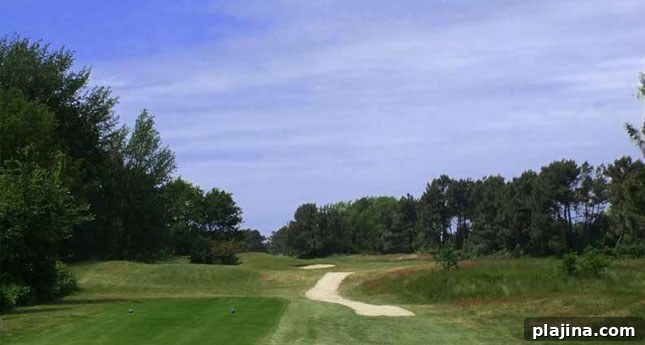
Golf was first played at Le Zoute in 1899 as an offshoot of the Bruges Golf and Sports Club. In 1909 Henry Colt redesigned the layout as the Knocke Golf Club. The club’s owners, the Compagnie du Zoute, built a clubhouse on the highest dune—so steep that it became known locally as the Monkey House.
During World War I the course was occupied by German forces, who emplaced 280mm guns to defend Zeebrugge and the Scheldt Estuary. After the war a new course, the Zoute Golf Club, was constructed and a second seaside course, Lekkerbek, was added closer to the shore. In 1925 the King of Belgium granted the club the royal title.
Le Zoute again found itself at the center of military activity in World War II, when some 40,000 German troops were stationed in the area because it was considered a possible alternative invasion point for Normandy. Remnants remain: at Hole 13 you can still see brick-lined trenches. A British plane was shot down near the sixth hole, killing six airmen, and bombing destroyed the original seaside course, which never reopened.
The Championship Course at Royal Zoute is a par-72 that follows the natural topography and dune landscape. There is also a par-64 Executive Course designed for higher-handicap players and learners. I played the Championship Course with the club president, Count Leopold Lippens; club captain Jean Croonenberghs, a retired Boeing 747 pilot; and John Louis Lindekens, vice president for North America at Brussels Airlines. The round felt steeped in history—the Lippens family founded and remained involved with the club for more than a century. Famous players such as Maurice Chevalier and King Leopold, who maintained a 4 handicap, have played these fairways.
Hole 1 | 422 yards, par 4
We waited for Count Leopold at the first tee; as mayor of Le Zoute he was attending a shopping center opening. From the tee we launched three solid drives and one exceptional shot from John Louis. My drive looked good but found one of the trio of fairway bunkers on the right, and it took two more iron shots to reach the green. Beyond those bunkers is out of bounds, so a left-center drive is the safest strategy. My partners carded bogeys; I finished with a double.
Hole 3 | 148 yards, par 3
I took an extra club and surprised my European companions with a well-struck shot that landed left of the green, safely avoiding the bunkers and awkward rough that claimed my teammates’ balls. Leopold and Jean complimented the shot. A tricky downhill putt followed, but I walked away with a respectable par.
Hole 5 | 479 yards, par 5
Notice the house along this hole built by a British colonel who spent much of his life in Punjab, India, before retiring here. This dogleg-left presents countless moguls that can create very uneven lies. My second shot settled in the rough beside a steep mound; a chip fell short into the left bunker. The green is elevated and demanding, making recovery shots difficult.
Hole 6 | 418 yards, par 4
This is widely regarded as the toughest hole on the course and it dispersed our group. The captain’s tee shot went right and under trees. I misfired into the rough, avoiding the fairway bunkers on the right. The correct line is down the middle-left to secure the best approach to a slightly elevated and challenging green. The homes surrounding this hole rank among the most valuable in Europe.
Hole 13 | 448 yards, par 4
The second-most difficult hole plays long: you must drive uphill to a fairway that doglegs left. Pause to view the German trenches nearby and imagine the thousands of troops stationed here decades ago.
On our round, after my partners’ excellent drives I launched a high shot that landed in the right rough. The safe play is to aim straight and avoid the narrow opening and vegetation left of the fairway. The hole often plays like a long par 5, where avoiding trouble and hoping to one-putt for par is realistic. My second shot came up short on a slope, and an overzealous lob wedge rolled off the green. A tidy chip saved the hole and I escaped with a bogey.
Hole 15 | 484 yards, par 5
The signature hole of the course is a short par 5 that demands precision. It’s narrow and offers many opportunities for a stray ball to find trouble. I hit my best drive of the day down the center, matching excellent shots from Jean and Leopold. John Louis, fighting jet lag, found the left rough and a wooded section. From a prime position I hit a 3-wood that left a short chip to the green which I converted for par. Beware two bunkers roughly ten yards from the green that create the illusion of a false front.
Hole 17 | 548 yards, par 5
This is a formidable hole that requires three long shots to reach the green in regulation. The tee is imposing: you must clear an area where golfers and pedestrians cross and navigate natural obstacles before the fairway opens. I drove near the out-of-bounds line and hugged the left rough, which provided an unobstructed view of the elegant homes lining the fairway. A second fairway-wood must clear the hill for the best approach. I struck a solid 3-wood and took significant distance off; from there you must position your ball to avoid the two traps guarding the front of the green.
Hole 18 | 385 yards, par 4
Royal Zoute finishes strongly. Dense vegetation occupies the first 50 yards off the tee and reappears about 150 yards out on the right. The captain recommended a left-center drive, which I followed, leaving a 150-yard approach that landed right of the green. Our group reached the green in varying numbers of shots; several traps on the right side of the fairway catch fades from the tee, and five bunkers protect the green from multiple angles. After the round we returned to the clubhouse to enjoy a bottle of Le Petit Cheval 2002 and local gray shrimp on toast, sharing stories of the course and its history.
Royal Zoute Golf Club
Caddiespad 14
B-8300 Knokke-Heist
Belgium
tel 32 50 60 12 27