
Viewing Shanghai from an upper-floor hotel room in the Pudong Financial District, a visitor sees dozens of tour boats moving along elliptical routes on the Huangpu River, their decks crowded with diners enjoying food, drinks and music. Neon strips of color pulse along the sides and up the masts. On the streets, brilliant LCD screens play music videos, pop art and advertisements while a steady flow of cars and sightseers moves late into the night.
It takes a moment to appreciate that this is not a fantasy but a real metropolis of 23 million people, one of the world’s most important financial and cultural capitals. With that energy just outside its gates, it’s easy to see how any theme park opening nearby will have to compete with the city itself.
Shanghai reinvents itself almost yearly, with hundreds of new projects either recently completed or underway. Many initiatives are replaced quickly by newer, faster developments. Still, two trends clearly shape the city’s current trajectory: money and art.
China’s State Council approved Shanghai’s first free trade zone, consolidating four existing industrial and shipping areas within a roughly 10-square-mile section of Pudong. Property owners inside the new zone stand to benefit as the district evolves into a Hong Kong-style economic hub. The tariff-free environment is expected to boost offshore trade and transform the area into a major shopping destination. Although international brands already maintain storefronts throughout Shanghai, price differences have driven many residents to shop in Hong Kong. Retailers in the free trade zone aim to offer more competitive prices, allowing locals and visitors to buy high-end goods without paying duty. With daily visitor numbers projected in the hundreds of thousands, the economic impact should be significant.
Traditional architecture in a Shanghai shopping area © Jackmalipan | Dreamstime.com
Other projects that expand Shanghai’s economic and environmental ambitions include the Green Valley Development on part of the former 2010 World Expo site. Planned as a sustainable business district along the Huangpu, the development will combine offices, retail and restaurants with hanging gardens, lush landscaping and open courtyards. “The project is designed so that, despite the monumental scale of the site, it relates to the human scale in its public spaces,” said Chris Hardie, associate partner and head of Schmidt Hammer Lassen Architects’ Shanghai office. The project was scheduled for completion in 2015.
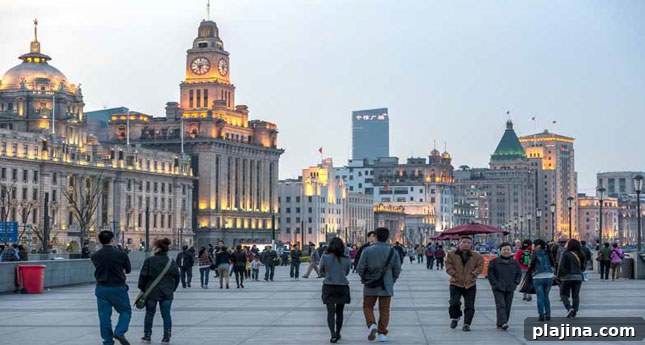
The Bund has undergone some of the most visible transformations. From 1843 through the early 20th century, this riverside strip evolved from a small port into a major international trading and industrial center. Neglected during Mao’s era, the Bund has been restored over the last 15 years, its Art Deco buildings returning as architecture showcases that host high-end hotels and restaurants. It remains one of Shanghai’s most popular visitor areas.
City officials planned a new business district and cruise port for the north Bund by 2020, proposing more than 30 glass office towers. The south Bund has seen gentrification as well, with historic buildings and wharves converted into mixed-use developments for startups, luxury residences, hotels and riverside dining, creating millions of square feet of new space.
As development in Lujiazui and other Pudong areas accelerated, the city invested heavily in cross-river transport. In recent years, more than 10 bridges and 15 tunnels were built across the Huangpu, ferry terminals were upgraded, and over 20 new metro stops in Pudong boosted the construction of corporate towers, banking centers and hotels in territory that was farmland less than two decades ago.
Signature skyscrapers are reshaping the skyline: Shanghai Tower, a spiraling 1,900-foot (121-story) structure in Lujiazui designed by Gensler as a “vertical city,” was planned to house offices, hotels, restaurants, conference facilities and retail space when completed.
Shanghai hosts about 400 regional headquarters for multinational companies, helping attract billions in foreign investment. City incentives aim to draw another wave of firms, particularly in next-generation IT, high-end machinery, new energy and biomedicine, by offering subsidies and duty exemptions to encourage headquarters and R&D centers in satellite cities.
“Shanghai has evolved into a modern, cosmopolitan metropolis, providing not only a good environment for residents to work and live, but also a strong infrastructure for businesses to thrive and prosper,” said Andrew Au, CEO of Citi China.
Other major initiatives include the Hongqiao Business Center near Hongqiao Airport, where architecturally ambitious office towers and an underground shopping center are planned, each building topped with planted green roofs and recreational space. Lingang, a former coastal wetlands area 30 miles from downtown, has become a satellite city with residential communities, duty-free outlets, theme parks, manufacturing zones and a new metro line. The large Shanghai Disney Resort, expected to open in stages, adds theme-park attractions, hotels and extensive retail and entertainment facilities to the region.
“With an increase in international flights and business growth, Shanghai has become a major meetings city,” said Patrick Chen, deputy director of the Shanghai Municipal Tourism Administration. The city expanded convention facilities and supports startups through grassroots organizations and business networks such as the American Chamber of Commerce in Shanghai.
Despite national economic adjustments and challenges—slower growth relative to previous years, concerns about housing, urban pollution and shifts in manufacturing—Shanghai’s high-tech and service sectors continue to prosper. The city’s GDP outpaces the national average, domestic consumption is rising, and new construction reshapes the skyline almost daily: hotels, offices, R&D zones, transit lines, medical centers, malls and museums all contribute to constant renewal.
“Our Rolls-Royce car owners in Shanghai are five to 10 years younger than the average age for them globally,” noted Torsten Muller-Otvos, CEO of Rolls-Royce Motor Cars, reflecting a new generation of young, successful entrepreneurs in the city. While most residents are not buyers of luxury cars, Shanghai’s business community and rising population—projected to approach 30 million by 2030—signal a long-term role for technology-driven industries and satellite-city development in China’s economy.
Shanghai Film Museum © Xankee | Dreamstime.com
Things to do in Shanghai
Modern art, film and architecture are central to Shanghai’s cultural transformation. Hundreds of museums have opened in recent years, and the Shanghai Film Museum highlights the city’s cinematic history. Shanghai now has more movie theaters than any other Chinese city and is recognized as the birthplace of China’s film industry. Box office sales and festival activity have grown, and many museum collections are accessible to international visitors.
The Power Station of Art, housed in a former 1897 power plant, showcases contemporary Chinese and international work within a dramatic industrial shell; its preserved neon-lit chimney recalls Shanghai’s industrial past. Nearby, the China Art Palace occupies the former Expo 2010 pavilion and offers expansive exhibition space, including a large animated installation inspired by an ancient Chinese scroll.
New galleries and institutions across the city include the Museum of Contemporary Art Shanghai, Rockbund Art Museum, Minsheng Art Museum, island6 and many venues clustered in the M50 Art District. The Long Museum and the Shanghai K11 Art Mall are further examples of the city’s rich and growing arts infrastructure.
Notable postmodern buildings include Arata Isozaki’s Himalayas Centre in Pudong, home to an art museum, theaters, a hotel and dining venues, and the Shanghai Museum of Glass, where a former glassworks now hosts contemporary glass art in a distinctive exhibition space.
Shanghai Glass Museum © Angela Ostafichuk | Dreamstime.com
Checking in with Lucas Englehardt
Founder and CEO, Delivery Hero China
Is Shanghai a good place for a young entrepreneur who wants to start a new business in China?
Lucas Englehardt, who launched an online restaurant delivery site that later became Delivery Hero China, says Shanghai’s dense business districts and upscale markets make it an ideal location for startups, especially those focused on online delivery or consumer services. While competition is intense and success requires local understanding and long-term commitment, the city offers strong networks and incentives that support new firms.
Was it risky to launch a startup in Shanghai, given regulatory complexity and competition?
Englehardt advises that businesses seeking only low labor costs will struggle in Shanghai. Firms that commit to operating locally, hire Chinese managers who understand consumer preferences, and apply global best practices can thrive despite complexity and government involvement.
Shanghai Info to Go
Pudong International Airport (PVG) is about 27 miles from People’s Square. The high-speed Maglev train connects PVG with Longyang Road station in Pudong in about eight minutes; from there passengers can transfer to metro line 2 to reach downtown. Alternatives include the metro line 2 (direct, without Maglev), airport buses and taxis.
Hongqiao Airport (SHA), nearer to the city center, mainly serves domestic flights and has quick metro and taxi connections to downtown hotels.
Shanghai: Just the Facts
Time Zone: GMT +8
Phone Code: Country code: 86, city code: 21
Currency: Chinese yuan renminbi
Official Languages: Chinese (Mandarin widely used). English is commonly understood in high-end hotels, restaurants, tourist areas and corporate offices.
Key Industries: Finance, software and information technology, services, chemicals, shipbuilding, automobile manufacturing, tourism
Where to Stay in Shanghai
Mandarin Oriental Pudong, Shanghai The hotel in Lujiazui’s financial district features rooms and suites overlooking the Huangpu, multiple dining venues, a spa and meeting facilities. 111 Pudong Road S., Pudong $$$$
The PuLi Hotel and Spa A design hotel near Jing’an Temple and the French Concession, offering refined interiors, a notable bar and a spa. 1 ChangDe Road, Jing’an $$$$
Pudong Shangri-La, East Shanghai A full-service property with extensive guest rooms, club-level facilities, conference space and several restaurants. 33 Fu Cheng Road, Pudong $$$$
Restaurants in Shanghai
Jade on 36 Fine dining with panoramic views from the 36th floor of the Shangri-La’s Grand Tower. Chef-driven menus often spotlight local produce. Pudong Shangri-La, 33 Fu Cheng Road, Pudong $$$–$$$$
Mercato Jean-Georges Vongerichten’s Italian-influenced restaurant blends rustic and modern elements and offers everything from wood-fired pizzas to refined seafood dishes. Three on the Bund No. 3, Zhong Shan Dong Yi Road $$–$$$$
Y2C2 Located in the refurbished Wharf District, this restaurant serves classic and contemporary Cantonese dishes with river and skyline views. 5F, 579 Waima Road, Huangpu $$$$
Read more about Shanghai’s shikumen neighborhood.