For more than 800 years, Frankfurt has been the commercial heartbeat of a country rich in history, culture and landscapes that shaped modern Europe. Each year the city welcomes over 11 million visitors, many using it as a gateway to explore Germany. A significant share, however, come specifically for business: Frankfurt is one of Europe’s foremost destinations for commerce and professional events.
“Seventy percent of visitors who come to Frankfurt are business travelers,” said Jutta Heinrich, director of the Frankfurt Convention Bureau. “This makes the MICE industry an extremely important economic factor for our city.” Business-related events accounted for 67.5 percent of all gatherings in Frankfurt in 2024, with many international organizers coming from the United States, Great Britain and Switzerland.
With 255 event venues already operating and more on the way, Frankfurt’s capacity for meetings and conferences is growing. Several new hotels with meeting and conference facilities are expected to open by the end of 2025 and throughout 2026, while ongoing investments in infrastructure aim to support the steady influx of visitors to a city that is also a global finance hub.
“The Frankfurt hotel landscape is continuously growing, with unusual locations joining the city’s portfolio,” said Heinrich, who has more than 25 years’ experience at the conventions bureau. She has witnessed the city’s transformation into an attractive international destination and notes that development continues: new multifunctional venues are planned, and Terminal 3 at the airport is scheduled to open in 2026, further improving air access to the city.
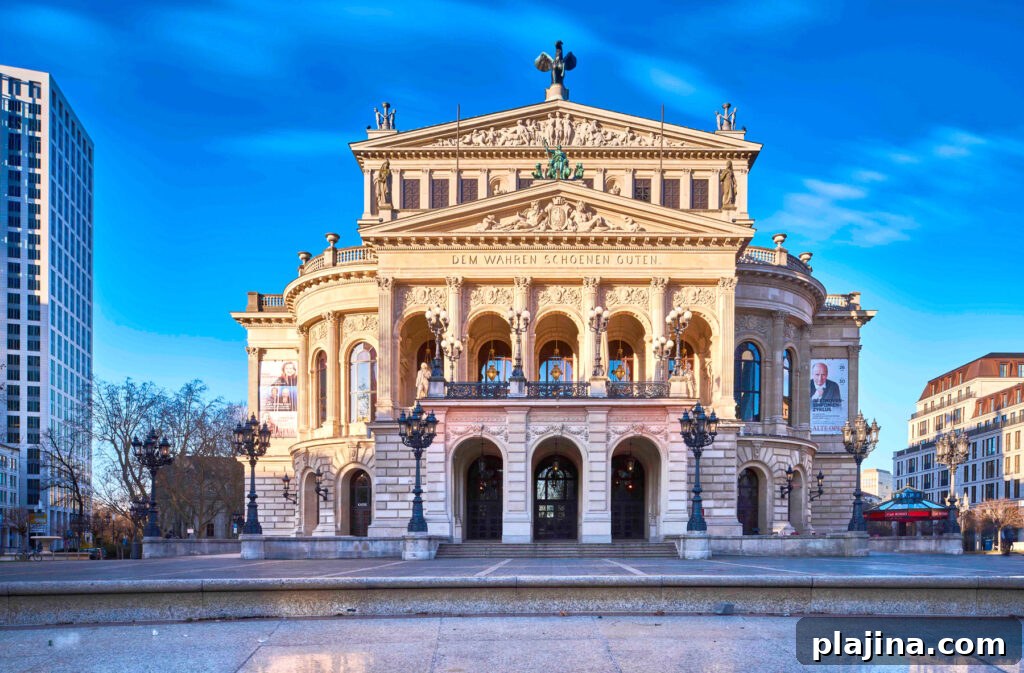
© Alte Oper Frankfurt /Norbert Miguletz
Accessibility is a cornerstone of Frankfurt’s MICE success, and sustainability has become integral to how the city manages business tourism. By 2024, about 48 percent of local businesses had adopted sustainability measures, and another 38 percent were developing plans to do so. All new construction, including hotels and event spaces, must comply with the city’s Open Space and Climate Design Regulations, ensuring environmental considerations are part of future growth.
Frankfurt also embraces technological innovation. The city is above the German average in adopting AI: roughly 30 percent of MICE service providers in Frankfurt use AI in daily operations. Tools such as chatbots help organizers plan and manage events more efficiently, improving the experience for attendees and hosts alike.
To streamline event planning, the Frankfurt Convention Bureau offers the FRM Meeting Guide, an online resource that centralizes the city’s venues and services. Organizers can explore hotels, meeting rooms and larger exhibition spaces in one place, simplifying the search for suitable locations and service providers. As AI and sustainability practices become more widespread, Frankfurt’s MICE landscape will continue to evolve, blending technology and green standards to strengthen the city’s position as a premier European business destination.
Klassikstadt © Meinzahn | Dreamstime.com
UNIQUE VENUES
Frankfurt offers a diverse mix of venues that combine historical character with modern amenities. Palais Frankfurt, situated on the bustling Zeil shopping street, pairs traditional German architecture with contemporary services and is well positioned for easy access to the city’s central attractions and business districts.
The Gesellschaftshaus Palmengarten, set within the lush Palmengarten botanical gardens, provides sustainable banquet options and can host up to 2,000 guests, making it suitable for intimate meetings as well as larger conferences and trade shows.
Alte Oper Frankfurt occupies a restored historical façade while offering modern event facilities. Originally built in 1880 in the Italian Renaissance style, the cultural landmark includes two music halls, four parlors and four foyers, with total capacity up to 3,000 people.
Klassikstadt highlights a different cultural facet of Frankfurt. Housed in a large red-brick building that evokes the city’s industrial past, it functions as a classic car museum and storage facility with various indoor event spaces and rooftop patios, offering unique activation possibilities within a larger event framework.