
Etosha National Park, an arid, salt-white expanse in northern Namibia, is home to some of the continent’s largest elephants. Size becomes real only when you stand beside one. At Olifantsrus Camp I found myself face to face with a full-grown bull elephant — and the reason I wasn’t flattened was simple: a pane of elephant-proof glass separated us. From the hide, the elephant drank at the waterhole on the other side of the window, drawing vast amounts of water into his trunk and then funneling it into his mouth. He seemed aware of my presence, but thirst held his attention. I watched, spellbound.
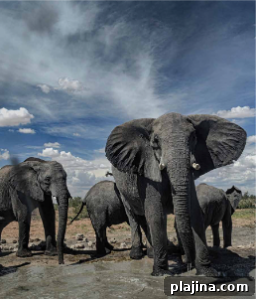
PHOTO: © RICHARD NEWTON
My lifelong passion for wildlife has taken me across the globe and led to many memorable encounters, but few have felt as immediate as that moment behind the glass. When you venture into wild places there are two non-negotiable priorities: disturb animals as little as possible and protect your own safety. A well-designed hide lets you get close without compromising either priority.
From the hide’s upper level later that day we looked directly down on a lioness as she drank. We heard every lap of her tongue and watched her tawny flank ripple as flies buzzed nearby. Birdsong provided a gentle soundtrack while the sun sank and shadows lengthened. The lioness padded away into dusk as an elephant herd approached the water with cautious steps — the perfect close to an unforgettable day.
People travel for many reasons: business, relaxation, curiosity. Experiencing new places and cultures broadens the mind, but wildlife travel adds something else — unpredictability. Nothing is guaranteed. You can scan a landscape for hours with nothing to show for it, or you can be rewarded with a once-in-a-lifetime encounter. That uncertainty is part of the appeal.
On one trip to Alaska I flew by floatplane to Kaflia Lake in Katmai National Park. We coasted to the shore and I stepped from the floats onto the beach, intending to hike to an overlook where grizzly bears often gather to catch salmon. It was early September, peak season for bears fattening up before winter. My companions stayed on the plane while I began up the beach. One of them pointed ahead — a grizzly was approaching.
The golden rule with dangerous wildlife is never to run. Separated from the plane and my companions, I held my ground. The bear closed to about 30 feet, then paused to sniff the air and detoured around me. Only when his massive shape receded did I allow myself to breathe. It was a tense, humbling reminder of how small we are compared with some wild animals.
Not all close encounters are so dramatic. In the Galápagos Islands, a two-hour flight west of mainland South America, the wildlife often shows little fear of people. You end up watching your stride to avoid stepping on lava lizards, marine iguanas or seal pups. While photographing a Galápagos hawk, a mockingbird landed on my head and stayed for a minute as if it belonged there.
The apparent tameness of Galápagos animals extends into the sea. Off the island of Bartolomé I was snorkeling above a busy reef when a feathery shape tore past, trailing bubbles — and then did so again, brushing my arm. A Galápagos penguin was clearly playing, weaving circles through the water and engaging with me as if I were part of the reef life.
Humans have given wild animals many reasons to be wary, so most sightings remain distant and fleeting. Yet sometimes trust can be rebuilt, as I experienced at Tswalu Kalahari Reserve in South Africa. One cold dawn my wife and I waited in scrubby Kalahari terrain near a cluster of burrows. As sunlight hit the entrances, one head popped up, then another, and soon about 50 meerkats emerged and stood upright to warm themselves. Drowsy pups tried to copy the adults but kept collapsing back into the sand. For twenty magical minutes the meerkats behaved as if we were part of their group, then they melted away to forage.
There have been many other extraordinary moments. My wife and I spent three months self-driving through South Africa’s Kruger National Park, a reserve the size of a small country. Based in the central region, we learned the territories and habits of several leopards, following their routines as they hunted and, more often, slept. Observing them over time made each sighting as thrilling as the first.
In Uganda I trekked into the dense Bwindi Impenetrable Forest for an hour with a family of mountain gorillas. Mostly they ignored us, but two youngsters grew bold; one approached and tapped my lower leg before bounding off with a delighted squeal. That quiet intimacy remains one of the most powerful wildlife experiences I’ve had.
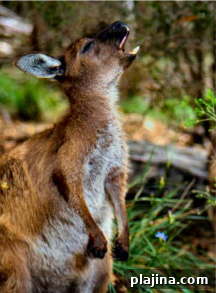
PHOTO: © RICHARD NEWTON
In Australia I adapted to a cast of marsupials — kangaroos, wallabies, koalas and wombats, and lesser-known species such as pademelons, quolls and bilbies. In northwest Tasmania I crept within a few feet of a wallaby carcass and watched two Tasmanian devils fiercely contest it through the aperture of a hide. Madagascar, which I visited nearly thirty years ago, offered an island of endemics: lemurs, unique birds and reptiles. I recall handling a Malagasy tree boa that curled around my arms and slipped briefly down the back of my shirt before I gently coaxed it out.
Encounters with wild animals are at their best when they happen on the animals’ terms. Modern life often prioritizes control, but in the presence of wild creatures we surrender that illusion and rediscover our place within the natural order. Those moments — quiet, unpredictable and raw — are why I keep returning to the wild.