
PHOTO: ©Pmudu/Dreamstime.com
“Where are we?” Shane Connolly asked. I scanned the small parking pull-out: ledges falling toward Galway Bay on one side and a rising hill on the other. There was no map or “You are here” sign to help.
Shane answered in a flowing brogue: “The town is Murrough, in the parish of Ballyvaughan, in the old kingdom of The Burren, which is in the county of Clare, which is in the province of Ulster.” He paused, tapped with his walking stick and added with a grin, “Down there is Morocco, over there is Berlin. Now you need to know that, because that’s the way we work in Ireland.” He handed me a stick and we began climbing.
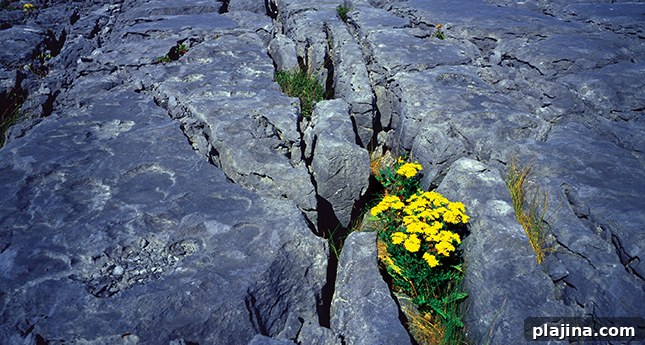
The Burren is not the stereotypical emerald isle; the name itself means “a rocky place.” Its terraces and treeless slopes, shaded a silvery purple at times, sit above a vast subterranean limestone labyrinth carved by water over millennia. A Cromwellian general once called it a place with “not water enough to drown a man, wood enough to hang one, nor earth enough to bury him.” Even so, the region is striking—both stark and hauntingly beautiful.
Roads—marked and unmarked—wind past castles, holy wells, ancient forts and penitential stations. The landscape is at once barren and spiritual. On my first visit I wandered without guidance; this time I wanted to learn the land’s story, its plants and animals. I needed a guide who knew the place from the inside out.
“You want Shane,” said Simon Haden, owner of Gregans Castle Hotel, a Georgian manor tucked below Corkscrew Hill in Ballyvaughan. Simon arranged a half-day ramble with Shane Connolly of Burren Hill Walks. A farmer by trade with deep local roots, Shane holds diplomas in archaeology and regional studies and blends formal knowledge with local lore.
From the first steps it was clear this walk would be different. Shane mixes practical farming experience with wit and a wide knowledge of geology, flora and history. He led us up the hillside briskly, moving easily over uneven ground. The footing demanded attention: loose rocks, fissures and occasional animal dung required careful steps. We paused within minutes and Shane began to explain The Burren’s origins.
“Three hundred and sixty million years ago this was a tropical sea,” he said. “Ireland looked like the Great Barrier Reef. Shells and skeletal remains formed the limestone beneath our feet. Turn over a rock and you’ll find fossils.”
He jumped forward millions of years to explain how deltas, shale and granite formed other features, and how tectonic uplift and glaciation molded the plateau into the rounded, terraced hills paved with limestone cobbles we see today.
When a light rain started, Shane told an old joke: “Noah invited an Irishman on the ark. When told it would rain for 40 days and nights, the Irishman said that sounds like a shower.” We hopped across limestone pavement and climbed stone walls with no obvious trail to follow.
“Even though Ireland is wet, there are no rivers here or lakes,” Shane said. “All the water is underground—this is a sieve.” Underneath The Burren, caves and fissures channel water; in heavy rain they overflow into turlochs, seasonal dry lakes.
He paused and listened. “Hear that?” A cuckoo called. That led into talk of wildlife and plant migration. Until about 8,000 years ago a land bridge connected Ireland with England, allowing many species to spread. As Shane joked, St. Patrick didn’t banish snakes—they never made it here.
The Burren supports an unusual mix of plants more commonly associated with the Mediterranean, the Alps and the Arctic. Botanists attribute this patchwork to glacial movements and shifting climates rather than a single cause. Shane pointed out species as we walked: the bright yellow hoary rockrose, also found in the Pyrenees; an Irish orchid among the white blooms; spring gentian, milkwort and wild sage; and mountain avens, a survivor from glacial times more associated with Arctic regions.
As we climbed, views opened across Galway Bay to Connemara and the Aran Islands. The treeless landscape offers uninterrupted panoramas, though Shane redirected me to a small circle of stones. “That’s a cow dung enclosure,” he said. Dung was long collected and dried for fuel where trees were scarce.
People have lived in The Burren for at least 6,000 years. Shane explained how early inhabitants felled trees and grazed animals, eroding thin soils and reshaping the terrain. “When you study the flowers, walls or archaeology, remember the landscape has been changed by agriculture,” he warned. Early settlers lived above valley floors in stone homes because metal tools weren’t available to cut large trees; medieval remains cluster on the valley floors while older archaeology sits higher up.
Farming here is challenging but enduring. Patches of green pasture stitched by stone walls show how generations made a living. Limestone’s heat-retaining quality allowed farmers to graze livestock on higher ground in winter and move them to valleys in summer. During the Great Famine the local population was far larger; today only a fraction remains, and as people retreated the hills have slowly begun to regrow trees.
“Limestone is alkaline and rain is acidic,” Shane said, pointing to a pocket of green where thorn, hawthorn, hazel and willow were taking root. Over time ash, birch and sycamore follow. It’s a gradual recovery that plays out across generations.
When I pointed to a nearby enclosure, Shane explained the common structures often called ringforts. There are thousands across Ireland; some served as churchyards or royal sites, but most were homesteads—places of daily life more than defensive strongholds.
I tried picturing families and livestock gathered in those simple enclosures against wind and rain. When Shane signaled it was time to descend, I followed, pleased to return to the comforts of Gregans Castle and certain I had earned my dinner after a morning spent learning the layered history and resilient beauty of The Burren.
Info To GoShannon International Airport (SNN) is about 36 miles south of Ballyvaughan (roughly an hour’s drive). Dublin International Airport (DUB) is about 145 miles east (around 3.5 hours by car). A standard half-day walk with Shane Connolly of Burren Hill Walks typically costs €15 per person; private tours and group rates are available. Gregans Castle Hotel offers two- and three-night packages that include breakfast, one six-course dinner and a half-day guided walk. |