Earlier trips to Nanjing left me unimpressed, but a recent visit revealed a city transformed. Once defined by its imperial history, Nanjing now pulses with contemporary energy—blending modern developments, thriving arts scenes, upscale shopping and trendy cafés. The result is a city that makes business trips more enjoyable and client entertainment easier than ever.
Strategically located in the lower Yangtze River Delta, Nanjing is East China’s major commercial center after Shanghai. Its position on the national high-speed rail network—linking Beijing, Shanghai and Wuhan through one of Asia’s largest railway stations—has attracted steady foreign investment. On average two foreign firms establish operations here every day, and the downtown core is reshaping rapidly with new high-rise complexes and commercial projects.
Getting around is straightforward thanks to the efficient Nanjing Metro, the best way to avoid frequent traffic congestion. The No. 2 subway line, completed in 2010, runs through the city center with extremely low fares (about 2–4 yuan). Frequent travelers should consider a Jinlingtong IC card (about 80 yuan), a stored-value pass accepted on subways, buses, river ferries and some taxis. Taxis are convenient for shorter trips and don’t require tipping.
Nanjing sprawls across many districts south and east of the Yangtze and its Qinhuai tributary. Three downtown areas stand out for business meetings and client entertainment, each offering a lively mix of dining, shopping and sightseeing.
Northwest of the center lies the Drum Tower District (Gulou) near scenic Xuan Wu Lake. Its most prominent landmark is Zifeng Tower, a 1,480-foot skyscraper that houses the InterContinental Nanjing. The InterContinental occupies the tower’s upper floors, offering 433 well-appointed rooms with separate showers and tubs, work desks and internet access, plus sweeping views of the city and lake. In service, amenities and location it ranks among Nanjing’s top hotels, with other international chains nearby.
The Horizon Café on the 45th floor of the InterContinental is a standout for power breakfasts and business breakfasts, combining an extensive international buffet with panoramic views. For lunch in the same area, Five Zen5es at The Westin Nanjing serves Cantonese and Huaiyang specialties—dishes such as braised king prawns and regional signatures—accommodating groups in several private dining rooms for set menus or à la carte meals.
The Drum Tower area also features Hunan Lu Dining and Shopping Street, a lively six-block pedestrian boulevard. Divided into sections that showcase regional specialties, international options and Chinese cuisine, it includes the celebrated Shizi Qiao segment, a local favorite for food-focused outings.
In the city center, Hanfu Lu is a newly developed food street near the historic Nanjing Presidential Hall. Each café specializes in cuisine from a particular Chinese region, offering everything from Sichuan spice to Shanghai flavors. Nearby Xinjiekou functions as Nanjing’s commercial heart—an energetic avenue of department stores, fashion outlets, brand boutiques and an underground mall filled with dining choices for various budgets.
For upscale business lunches and evening entertainment, Nanjing 1912 is an appealing option. This revitalized complex of early 20th-century gray-brick buildings evokes the era of the Chinese Republic and features trendy restaurants, pubs, nightclubs, teahouses and more—an atmospheric setting for hosting clients.
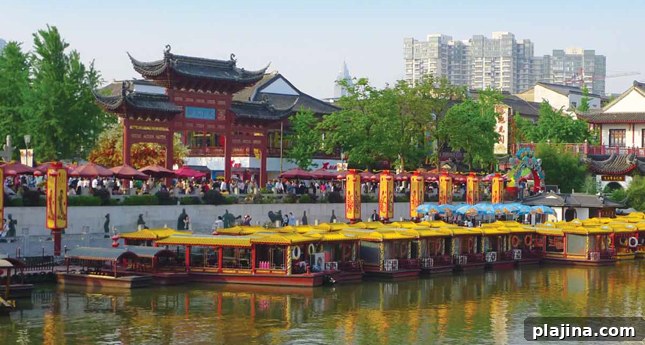
South of the center, Fuzimiao—anchored by the colorful Confucius Temple—is ideal for casual strolls and informal dining. The area’s open-air bazaars and Gongyuan Street offer abundant Chinese pastries and street snacks, creating a lively, shareable dining experience. Within the temple complex, Lao Zhengxing cafeteria serves a range of dumplings and other simple dishes suitable for a relaxed business stop.
For river views, head to Ming Xuan outside the central core. The Hilton Nanjing Riverside Hotel overlooks the Yangtze and serves Cantonese and Huaiyang cuisine in an elegant setting on its top floor—an excellent venue for client lunches with a panoramic backdrop.
Nanjing’s historic role as a capital under successive dynasties and regimes now coexists with modern attractions. Museums and restored mansions detail the city’s past, including the wartime era that is gaining broader attention through contemporary culture. Nanjing today is a city where history and modernization meet, offering rich options for business travelers and visitors alike.