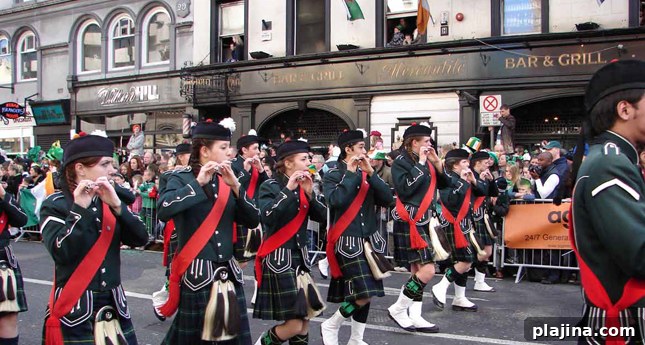
In Chicago, the river is dyed green each year for St. Patrick’s Day. In New York City, Fifth Avenue becomes a rolling sea of green as up to two million spectators line the 1.5-mile parade route. In Boston, where neighborhoods like “Southie” still carry a strong Irish identity, the annual wearing of the green remains an enduring tradition.
Today’s often lively St. Patrick’s Day celebrations in the United States grew out of more restrained observances established by 18th-century Irish settlers. Founded in Boston in 1737, the Charitable Irish Society began marking March 17 with worship services and fundraising to support newly arrived Irish immigrants. Comparable efforts in other American cities combined charity, religious observance and remembrance of the homeland to create broader public recognition of the day.
Those quieter rituals mirrored the customs in Ireland, where St. Patrick’s Day long remained a holy day. Until the 1970s, pubs in Ireland typically closed on March 17. It was not until 1995 that the Irish government launched an official St. Patrick’s Festival in Dublin to promote Irish culture internationally. What began as a one-day event on March 17, 1996, expanded over the years into a multi-day festival showcasing music, performance and heritage.
In recent years the festival has adopted themed programming that explores Ireland’s identity through time. One multi-year initiative used “Past, Present and Future” to trace Irish cultural development: earlier editions highlighted folklore and history, while subsequent themes celebrated contemporary Irish life and anticipated cultural directions for the next century.
Dublin’s St. Patrick’s Day parade draws more than half a million people to the capital, and the surrounding festival schedule attracts many more from across Ireland and abroad. The program typically includes music and dance, street theater, fireworks, exhibitions, walking tours and food and craft markets — a broad celebration of Irish arts, heritage and community.
While Dublin remains the focal point for national festivities, cities and towns across the island host their own events. Major celebrations take place in Cork, Galway, Killarney, Kiltimagh, Limerick and Sligo, and there are important gatherings in Northern Ireland as well, including Armagh, Belfast, Downpatrick and Holywood.
All are invited to join the festivities. Céad míle fáilte — a hundred thousand welcomes!