
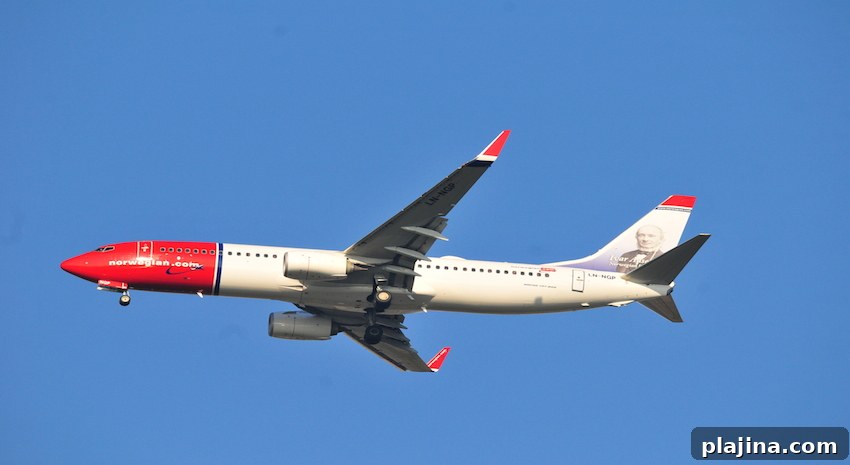
Norwegian Air set a new record for the fastest transatlantic passenger flight by a subsonic aircraft on a recent service between New York (JFK) and London Gatwick (LGW).
The flight on January 15 used a Boeing 787-9 Dreamliner and completed the route in 5 hours and 13 minutes, surpassing the previous record by three minutes. Strong tailwinds, which peaked at about 202 mph, helped the aircraft reach a top groundspeed near 776 mph and enabled the flight to land at Gatwick 53 minutes ahead of schedule.
“The 787 Dreamliner is a pleasure to fly and it’s a great feeling to know that we have set a new record in this aircraft,” said Captain Harold van Dam of Norwegian. “We were actually in the air for just over five hours and, had it not been for forecast turbulence at lower altitude, we might have completed the crossing even faster.”
This record highlights how modern long-range, fuel-efficient airliners like the Dreamliner can take advantage of favorable upper-atmosphere conditions to shorten transatlantic journey times. While supersonic travel remains separate from commercial airline operations, optimized routing and powerful jetstreams can produce remarkable subsonic speeds on specific flights.
Operational factors that contributed to the fast crossing included precise flight planning to maximize benefit from the jet stream, efficient climb and cruise performance of the 787-9, and favorable weather conditions across the North Atlantic corridor. Airlines monitor jetstream forecasts and may adjust routings and altitudes to take advantage of stronger tailwinds, which can reduce flight time and fuel burn when safely achievable.
Although individual flight times can vary widely depending on weather, routing, and air traffic control constraints, this event serves as a reminder of how unpredictable atmospheric conditions can significantly influence journey duration. For passengers, such exceptional tailwinds can mean earlier arrivals and more efficient operations, while airlines can benefit from improved on-time performance and reduced fuel consumption on select sectors.
Norwegian’s announcement drew attention both for the raw speed achieved and for the broader capabilities of modern widebody aircraft on long-haul routes. The 787-9 is designed for long-range efficiency and passenger comfort, and flights like this one demonstrate how contemporary jetliners can perform when meteorological conditions align.