
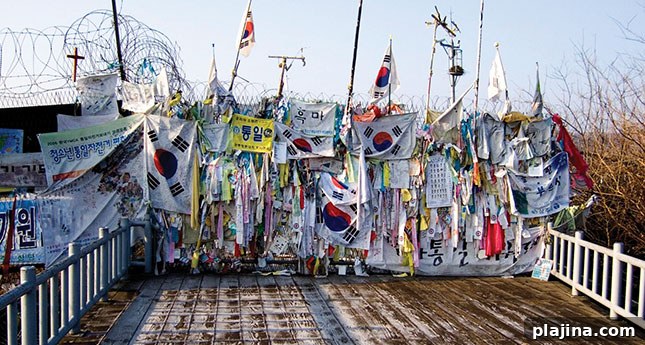
I am not surprised by the coils of razor wire, the rifle‑carrying soldiers, the concrete bunkers and the seemingly endless lengths of chain‑link fencing.
I expect passport checks, photo restrictions, stern surveillance by guards in camouflage and the mandatory military shuttle for the final mile or two.
What surprises me — and stays with me — is the incongruous, almost festive atmosphere once you reach certain DMZ sites: children’s amusement rides, cartoonish statues and souvenir stalls selling T‑shirts, paperweights and other trinkets.
This is the Demilitarized Zone that has separated North and South Korea since 1953. Parts of it, only about 30 miles northwest of Seoul, have become major tourist destinations. Visitors arrive by private car, tour bus or—even if they have a long layover—via airport pickup from Incheon International.
In the city I’ve enjoyed a wide range of Korean culture: eel and oxtail dishes, traditional mask dances and performances at Korea House, and browsing antiques in Insa‑dong. I know to visit Namdaemun and Dongdaemun markets for nearly anything you can imagine. I’ve explored Gyeongbokgung Palace and the National Folk Museum, learning about royal life and the many regional styles of kimchi.
All of that is authentically Korean and worthwhile, but nothing matches the emotional impact and ingenuity of a DMZ tour.
Tours have been offered since the 1960s, and today they are far more extensive. The DMZ stretches roughly 155 miles, with barbed wire following the Han and Imjin rivers for the initial third. Expect to set aside at least five hours, including travel, and to visit four or five distinct stops on a modern tour.
Imjingak Park blends whimsy and wartime memory: amusement rides and carousels sit beside tanks and memorials. I pass a rollerblade team in bright yellow uniforms joking at the foot of a war monument as I head toward the wooden Freedom Bridge.
Once a link to North Korea’s Mangbaedan, the Freedom Bridge now ends abruptly. Its fence links are stuffed with ribbons, scraps of cloth and paper bearing pleas for peace and reunification in many languages. “We can go anywhere in the world, except North Korea,” our Seoul guide says with quiet frustration; his father still lives in the North. The last documented crossing of this bridge was to exchange prisoners of war.
I don’t see the actual demarcation line on this trip because we don’t stop at Panmunjeom, the village where the armistice was signed. The Joint Security Area there is the only place where North and South troops stand face to face and where the military demarcation line literally runs through conference tables.
Elsewhere, the demarcation line sits inside the DMZ, a roughly one‑mile buffer on each side that is effectively impenetrable. Left largely untouched by humans for decades, this no‑man’s‑land has become a refuge for wildlife and plant diversity, a surprising ecological outcome of the conflict. On a gray day the landscape can look bleak, but the area supports species that have vanished elsewhere. Occasionally a fisherman’s boat drifts into restricted waters and gunfire warnings follow.
Our shuttle approaches only as far as the Civilian Control Zone, a buffer that surrounds the DMZ where about 7,000 people live. These residents are mostly descendants of those who remained after the war and continue to farm rice, ginseng and other crops.
For the Third Tunnel, I’m given a choice of safety helmets: yellow if you plan to walk, white if you prefer the tram. The tunnel tour descends into a damp, narrow one‑mile passage discovered in 1978. The tram ride down is brief but eerie; darkness and tight confines make the minutes stretch. I leave the tram for the final 50 yards and crouch along a short, steep tunnel to a bolted gate where the public must stop.
Although this tunnel is less than seven feet in both height and width, it was reportedly designed to move up to 10,000 soldiers an hour with gear—one of four such tunnels discovered beneath the DMZ. Only this tunnel is open to visitors.
At Dora Observatory, perched on Mount Dora, visitors get the clearest civilian view into North Korea. I feed coins into a pay telescope and peer toward Gaeseong, the North’s second‑largest city, hoping to spot movement or buildings. Hazy air and distance limit what I can see, and a yellow line painted on the pavement marks where photography is no longer allowed. Soldiers enforce that rule strictly, even for small point‑and‑shoot cameras.
Before returning to Seoul’s bustling streets, the bus stops at Dorasan Station, less than 800 yards from the DMZ. Built in 2003 as a symbolic gateway for future reunification, the station is an empty but poignant reminder of separation. Visitors can walk along the barricaded four‑lane highway and examine vacant toll booths. On most days you can collect a Dorasan Station passport stamp, though it is symbolic only—you cannot travel north with it.
What feels like a surreal zone out of a novel could change in an instant if North and South Korea ever decide to reconnect. Should that day arrive, the DMZ’s unusual blend of military history, ecological sanctuary and tourism would likely evolve, offering new and unexpected experiences to visitors.