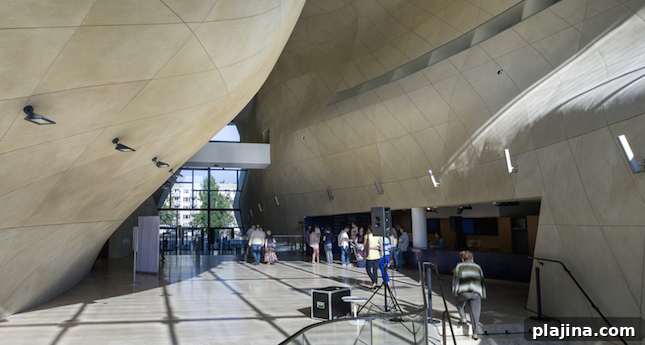
The Museum of the History of Polish Jews opened in April 2003 in the historic center of Jewish Warsaw, near the Monument to the Ghetto Heroes. The striking building was designed by the Finnish studio Lahdelma & Mahlamäki Architects and won the Chicago Athenaeum International Architecture Award in 2008 while still under construction. In 2014 the project was honored with the Finlandia Prize for Architecture awarded by the Finnish Association of Architects.
The museum’s concrete structure features flowing curved walls and vaulted ceilings, clad on the exterior with alternating bands of laminated glass and pre-patinated copper mesh. The combination creates a proud, dramatic presence that responds sensitively to the surrounding urban fabric.
Inside, the museum hosts a broad program of cultural activities: concerts, theatrical and dance performances, lectures, workshops, film screenings and public debates. A recently launched Core Exhibition presents a comprehensive, chronological narrative of Jewish life in Poland across roughly a millennium. Beginning with the arrival of traveling Jewish merchants to Po‑lin and continuing through modern times, the exhibition was developed by a team of about 120 international scholars. The presentation is organized into eight distinct galleries, each dedicated to a different chapter of social, cultural and political history, and together they offer a layered and engaging account of community life, traditions, challenges and contributions.
Beyond the permanent galleries, the museum’s temporary exhibitions and public programs explore diverse topics—memory, identity, artistic expression and everyday life—connecting historical scholarship to contemporary conversations. The institution also functions as a center for research, education and outreach, inviting visitors of all ages to discover the complex, often overlooked dimensions of Polish Jewish history.
Architecturally and institutionally, the museum combines rigorous historical interpretation with accessible public programming. Its design and exhibitions aim to create a space for reflection, learning and cultural exchange, while preserving and presenting the memories and experiences that form an integral part of Poland’s past and present.