
Just how many nicknames does one city need? Stumptown. City of Roses. Bridgetown. Rip City. Beervana. Portland, Oregon’s largest city (about 600,000 residents and more than 2 million in the greater metro area), has accumulated many alternative monikers since its mid-1800s incorporation, some more flattering than others.
Portland also collects accolades. The city routinely ranks high for livability, public transportation, sustainability and green initiatives. With more than 500 food carts it topped U.S. News & World Report’s list of the World’s Best Street Food in 2011, and it was named one of USA Today’s 2012 10 Best Beer Cities in the World. Forbes ranked the Pearl District among the best hip neighborhoods, and The New York Times called Portland “the capital of West Coast urban cool.” The city’s reputation goes beyond plaid shirts and bicycles.
It’s difficult to reduce Portland to a single defining trait. Historically a manufacturing center—from World War II liberty ships to today’s athletic gear and technology manufacturing—the city benefits from a deep freshwater port at the meeting of the Willamette and Columbia rivers, plus major rail and interstate connections. A temperate climate and easy access to rivers, mountains and coastline position Portland as a hub for outdoor activities, from golfing and windsurfing to skiing and fishing. Visitors come for shopping, museums, restaurants and food carts, summer festivals and more breweries per capita than most cities. Emerging from the 2008 recession, Portland is working to broaden its economy into more knowledge-based and diverse industries.
Portland’s transit network—four MAX light rail lines, TriMet buses and the Portland Streetcar—combined with an orderly street grid and pedestrian-friendly scale, make the city easy to navigate. Portland International Airport, linked to downtown by the MAX Red Line, is known for strong on-time performance, free Wi-Fi and locally themed dining and shopping. With the rail line right outside the main terminal, the airport offers one of the best rail connections of any U.S. city.
Portland streetcar © Robert Crum | Dreamstime.com
Downtown’s heart is Pioneer Courthouse Square, often called the city’s “living room.” Adjacent blocks contain most major hotels, office towers, cultural and government institutions, and flagship retail stores. The Pearl and Northwest districts extend from downtown with art galleries, boutiques featuring local designers and unique shopping. Oregon’s lack of a sales tax adds to the city’s appeal for shoppers.
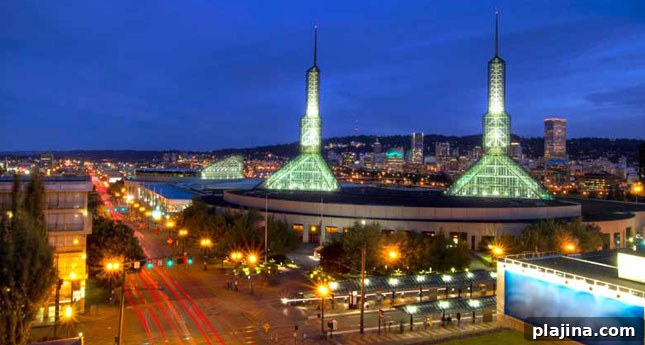
Across the river, the Oregon Convention Center rises with twin glass spires. Opened in 1990 and expanded in 2003, the center offers extensive LEED Silver-certified meeting and exhibit space and emphasizes sustainable operations, including locally sourced menus from its on-site caterer. The venue attracts technology and health care conventions as well as lifestyle events that align with Portland’s distinctive culture.
Planned additions include a 600-room hotel adjacent to the convention center to address logistical concerns for larger events. Convention planners have indicated that a headquarters hotel would make Portland a more viable option for major conventions, and local leaders see that hotel as the missing piece needed to attract bigger meetings.
Opposite downtown, the Central Eastside—an old industrial warehouse district—now hosts a mix of traditional manufacturing, design and creative firms, software companies and start-ups. The contrast between the grittier Central Eastside and the more polished Pearl District provides a range of environments for businesses: companies seeking an urban, walkable neighborhood gravitate to the Pearl, while firms looking for an edgier atmosphere find a community in the Central Eastside. Both sides of the river continue to draw development and interest.
The South Waterfront district, on the west bank just south of downtown, represents one of the city’s most significant redevelopment opportunities. A former brownfield site, the area’s first phase included residential towers, parks and growing retail options. Anchoring the neighborhood is the 16-story Oregon Health & Science University Center for Health & Healing, with the main OHSU campus above on Marquam Hill connected via the Portland Aerial Tram.
The Portland Streetcar links South Waterfront to downtown, and new light rail extensions have supported further growth. OHSU’s plans for a large life sciences building in partnership with other universities signal more institutional and commercial development to meet demand for office space and research facilities. Over the next decade, continued residential development is expected to round out the neighborhood’s mix.
Reflecting the broader city, South Waterfront and surrounding districts will likely fill with restaurants, food carts, brewpubs and entertainment venues. Portlanders are quick to recommend local favorites for business meals or casual outings—popular breakfast spots, buzzy restaurants on S.E. Division Street, acclaimed chef-owned eateries and food cart pods—along with numerous breweries, a local distillery scene and intimate wine bars.
Local leaders link Portland’s culture and lifestyle to its economic outlook: a collaborative, people-focused business environment helps attract entrepreneurs and talent. Many newcomers cite the city’s cooperative spirit and community-oriented approach as a key difference from other metropolitan areas, and that mindset supports growth across a range of industries.
SCENIC DRIVES
A short drive west of downtown leads to Washington Park, a more-than-400-acre urban green space with attractions including the International Rose Test Gardens, the serene Japanese Garden, the Oregon Zoo, the World Forestry Center and 12 miles of trails in Hoyt Arboretum. Nearby Pittock Mansion, a 1914 French Renaissance residence, offers panoramic city views from its perch about 1,000 feet above downtown.
Head east about 20 miles on Interstate 84 to access the Historic Columbia River Highway and the Columbia River Gorge. Vista House at Crown Point provides sweeping views roughly 700 feet above the river, and a short drive farther brings you to Multnomah Falls, a 620-foot year-round cascade with trails leading to the top for hikers seeking a stronger workout.
A 90-minute drive west on U.S. Highway 26 reaches the Oregon coast, where sandy beaches and charming seaside towns invite visitors to explore galleries, sample fresh seafood, walk the bluffs and enjoy coastal scenery. Beachcombing and local treats are fitting ways to end a coastal day trip from Portland.