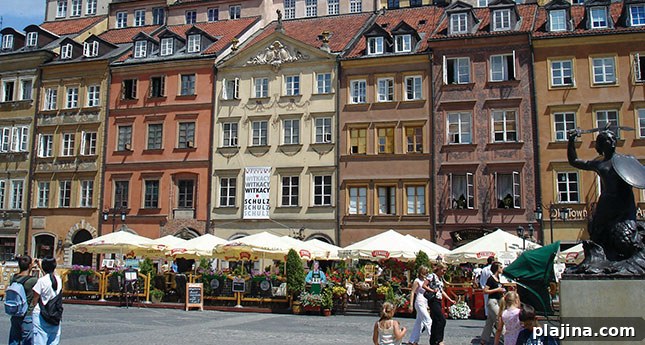
On any summer weekend in Warsaw it often feels as if much of Poland’s young entrepreneurial class pours onto Nowy Świat, Trzech Krzyży Square and Krakowskie Przedmieście to celebrate life — with good vodka, vibrant music and lively private parties that stretch late into the night.
When my son Aaron and I wandered through Warsaw’s buzzing entertainment districts, the crowd included more than local residents. Trendy cafés, wine bars and restaurants were filled with visitors from across Europe: boisterous stag parties from England, fashionable Milanese lingering along Foksal Street until dawn, and German couples consulting tourist maps as they explored Warsaw’s UNESCO-listed Old Town. Boutiques and gourmet restaurants, priced in Polish złoty, often offer attractive value to those spending euros or dollars.
This sprawling capital, scarred by the devastation of World War II, has rebuilt itself into a modern 21st-century European city. Warsaw today attracts enterprising people who want to start businesses, prosper, enjoy their leisure time and contribute to a city with seven centuries of history. Intelligence, creativity and a good sense of humor now matter more than ideological labels.
Two residents who personify the city’s resurgence are Magda Gessler and Michelle Smith. Gessler returned to Warsaw in the late 1980s after years abroad, drawn by fresh cultural and commercial opportunities that suited her artistic vision. Smith, a Canadian who moved to Warsaw in 2002, recognized demand for high-quality English-language content and built a successful small business while establishing a family and a life in Poland.
As Poland shifted westward after communist rule, Warsaw experienced a renaissance: communist-era buildings were renovated, the picturesque Old Town was rebuilt, and private enterprise gained momentum. Gessler applied her culinary and design talents to become a respected caterer and restaurateur. She serves as the primary interior designer and menu planner for AleGloria and other popular venues, creating distinctive dining spaces and inventive dishes while preserving elements of traditional Polish cuisine.
“Things were very different in Warsaw right after communism,” Gessler recalls. “There were only a few private firms and few places to eat well. Now there are many excellent restaurants and strong competition across industries. If you work hard and stay persistent, there’s money to be made here, but it’s not easy, especially with the recent economic slowdown.”
At AleGloria in Trzech Krzyży Square, sleek European cars pull up as Warsaw’s well-to-do arrive for evenings of imaginative “Polish culinary fusion.” The menu can pair bold combinations — deep-fried carp ribbons with wasabi and horseradish, chicken with baked apple preserve and truffle oil — while staples such as freshly made pierogi, classic soups, bigos and whole baked fish remain central.
Poland’s NATO accession in 1999 and EU membership in 2004 brought the country fully into Europe’s mainstream. Warsaw draws both local and international investors who anticipate eventual adoption of the euro in place of the złoty, even as the currency fluctuates amid broader economic trends.
Michelle Smith’s WordSmith Promotion provides high-quality English-language print and digital content for Polish and international businesses seeking to connect with English-speaking audiences. “Good English matters more than ever,” she says. “With events like Euro 2012 on the horizon, businesses can no longer rely on imperfect English. Printed materials and websites must communicate clearly and professionally.”
The city’s infrastructure has improved dramatically since 1989. With a little practice recognizing station names like Ursynów, Świętokrzyska and Dworzec Gdański, Aaron and I found Warsaw’s single-line subway — inaugurated in 1995 and gradually expanding — easy to use as it extends to meet the needs of growing neighborhoods.
Districts such as Mokotów and Saska Kępa now bustle with cafés, galleries and independent boutiques where once-gray early 20th-century buildings have been refreshed. In Żoliborz and Kabaty, tree-lined residential areas offer calmer alternatives, attracting young professionals into desirable apartments near parks.
A visit to the sites connected to the World War II Warsaw Ghetto left a deep impression. Established by Nazi authorities in 1940, the ghetto confined nearly 400,000 Jewish residents in worsening conditions before most were deported to extermination camps like Treblinka. After a brief but heroic uprising, the ghetto was destroyed.
Today only a fragment of the ghetto wall remains at 55 Sienna Street. The city, together with the Jewish Historical Institute, has created a “ghetto trail” marked by plaques and multilingual information boards that trace the former boundaries and document the history. Roughly 2,000 Jews live in Warsaw now, and Jewish-owned businesses are present across the city. “Israeli entrepreneurs are coming to Warsaw,” says Piotr Kadlcik of the Jewish community. “There is little discrimination here, and Jews participate in the city’s economic life.”
Planned to open on the site of the former ghetto, the Museum of the History of Polish Jews will offer a permanent multimedia exhibition dedicated to Jewish life in Poland. The Warsaw Uprising Museum, opened in 2004 to commemorate the 1944 Home Army effort, remains a compelling destination for visitors exploring the city’s wartime history.
Throughout Warsaw one encounters the city’s emblem, the Warsaw Mermaid, on coats of arms and signage, and the wide Vistula River flowing through the center and out to the Baltic Sea. The contrast between the mermaid’s mythic cheer and the river’s real, steady commerce mirrors Warsaw itself: a city where residents embrace life and the rewards of freedom while working hard to sustain growth.
INFO TO GO
Frederic Chopin International Airport (WAW) lies under seven miles from the city center. A taxi ride takes about 20 minutes and costs roughly $20–25; shuttle buses run around $10, while the local city bus is just over $1. Trains also connect Warsaw with Berlin, Vienna and Prague several times daily.
LODGING
HILTON WARSAW HOTEL AND CONVENTION CENTRE
The Axis bar offers an extensive vodka selection and the convention center caters to corporate events. Close to Old Town. $$
Grzybowska 63
tel 48 22 356 5555
POLONIA PALACE HOTEL
This grand 1913 Parisian-style hotel across from the Palace of Culture and Science is beautifully maintained and appointed. $$$
Aleje Jerozolimskie 45
tel 48 22 318 2800
RADISSON SAS CENTRUM HOTEL
Convenient central business-district location with a health and fitness club and a Latino/Polish brasserie. $$
Grzybowska 24
tel 48 22 321 8888
DINING
CZTERY PORY
Sirloin and roasted salmon are specialties at this refined restaurant with 1930s-style décor. Good drink selection. $
Marszałkowska 140
tel 48 22 692 8676
DOM RESTAURACYJNY KROKODYL
Magda Gessler’s restaurant in the Old Town features an eclectic menu, 18th-century chandeliers and a cozy fireplace. $$
Rynek Starego Miasta 21
tel 48 22 635 1515
RESTAURACJA STUDIO BUFFO
Chef Maciej Kurzyna (note: name updated to reflect common references) serves notable beef and fish dishes in a popular spot frequented by local artists and celebrities. $
Konopnickiej 6
tel 48 22 626 8907