
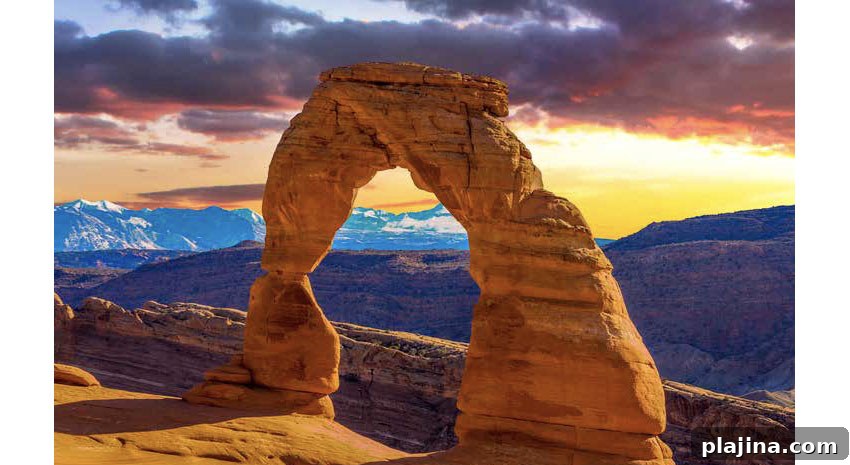
My first view of the desert near Moab, Utah, appears as the sun rises and slips across layered red rock. A light dusting of snow leaves ice crystals that glitter on the stone, briefly catching the morning light and lending the scene an almost otherworldly quality. It’s one of those moments when the landscape feels both elemental and magical.
The spectacle intensifies in nearby Arches National Park. Although the rocks are best known for their rust-red hues, variations in iron content and geological history produce flashes of green, black, orange and even purple across the formations. The result is a constantly changing palette that rewards close attention.
Arches is sculpted from sandstone and contains more than 2,000 natural arches and windows. Erosion from wind, rain, snowmelt and the freeze-thaw cycles that pry open cracks continues to shape the park, meaning new arches form and others evolve over time.
Beyond its famous arches, the park displays an impressive variety of landforms: towering pinnacles and domes, honeycombed tafoni cavities, surreal hoodoos and enormous boulders balanced atop narrow pedestals—most famously the more-than-3,500-ton Balanced Rock. Because these features span vast areas and took millions of years to develop, seeing everything in one visit can be overwhelming, which is where local guides and outfitters can be invaluable.
“Pre-tour custom designing is imperative, especially due to the distances between destinations around Moab,” says Brian D. Murphy, CEO and founder of Utah Luxury Tours (a division of Luxus Travel, Inc.). “We cater to travelers who expect concierge-level planning and private, fully escorted touring from arrival to departure.”
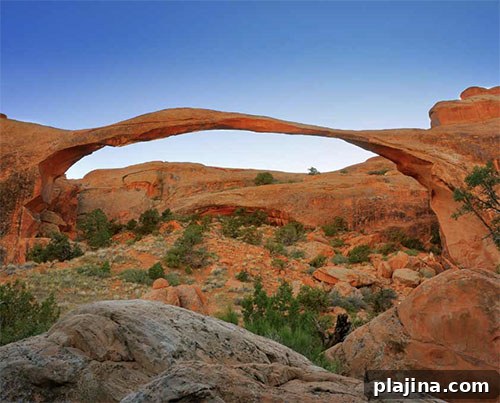
Landscape Arch © NUVISTA – DREAMSTIME.COM
Murphy’s team of guides are local experts, including his business partner Lukas Sigmund, the company’s original tour designer and lead guide. For visitors who want to experience highlights such as Delicate Arch, Tunnel Arch, the Devils Garden and the Petrified Dunes, a tailored itinerary removes logistical concerns like parking and navigation so guests can focus on the scenery.
Whether guided or exploring independently, Murphy recommends including lesser-known spots that are often missed. One example is the Grandstaff Trail, an easy-to-moderate hike that crosses a small stream several times and ends at Morning Glory Natural Bridge, the sixth-longest natural rock span in the United States.
He also suggests driving the 28-mile La Sal Mountain Loop Road to gain a contrasting perspective of the high-altitude desert, or taking the Park Avenue trail for a roughly one-mile walk through impressive high-desert formations.
Delicate Arch is a perennial favorite for first-time visitors, but Landscape Arch is sometimes overlooked because parking at Devils Garden can be limited. Still, it’s worth making the effort to see Landscape Arch; though the trail beneath it is closed due to rockfall, the span remains one of the longest natural arches in the world.
As for timing your visit, April and May are ideal: depending on winter snowfall and spring moisture, the desert can erupt in spectacular wildflower displays. October is another excellent choice, with cooler temperatures and smaller crowds making hiking and sightseeing more enjoyable. Keep in mind that Arches is an active landscape—Wall Arch collapsed in 2008—and other formations may change unexpectedly over time, so it’s wise not to delay a trip you’ve been planning.
INFO TO GO
The closest major airport to Arches National Park is Salt Lake City International Airport, roughly a four-hour drive to Moab. Closer regional options include Grand Junction Regional Airport in Colorado, about 1.5 hours away via Interstate 70, and Canyonlands Field Airport, approximately 18 miles from Moab. These regional airports have more limited service and some connections to Salt Lake City. Rental cars are available from all three airports, and the drives between them and Moab traverse scenic terrain. If you’ve arranged travel with a local outfitter, check about pick-up and drop-off services as part of your itinerary.