
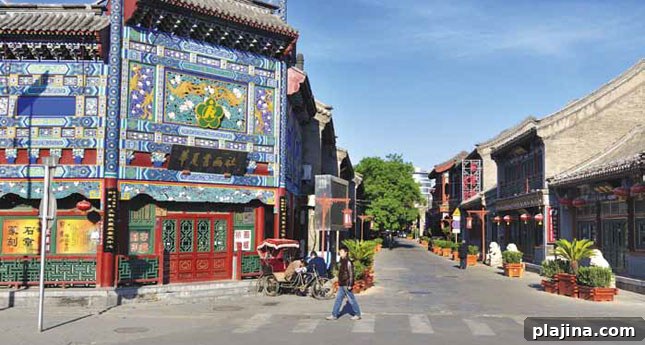
About half a mile long, Liulichang Culture Street in Beijing’s Xuanwu District is famous for its traditional teahouses, calligraphy, Chinese paintings, art galleries, curios and classic bookshops. Although the buildings share a unified look of gray tiles and brickwork, brighter elements of Chinese decor appear throughout: carved dragons, vibrant reds, yellows and greens, and guardian foo dogs at many entrances. Located just south of Xuanwu Peace Gate, Liulichang takes its name from a colored glaze factory that operated here beginning in the Yuan Dynasty (1271–1368). During the Qing Dynasty (1644–1911), the area became an established gathering place for artists and scholars.
Mark Huang first encountered Liulichang in the early 1980s while studying at Peking University. At that time the street was undergoing a significant renovation that emphasized its artistic character. Huang now serves as director of operations for Access China Tours, a partner of Zicasso, and says he regularly brings clients to the famed street.
“Liulichang suits visitors who appreciate the literati atmosphere rather than hard-core bargaining,” Huang explains. “The exterior of the shops and the quieter street traffic create a distinct mood. Visitors tend to be local scholars or educated tourists searching for the right scroll or piece for their study.”
Bibliophiles should visit The China Bookstore at 115 Dongxi Liulichang Jiedao. The shop often feels like a treasure hunt, with foreign-language editions, reproductions of Chinese classics, secondhand volumes on calligraphy and art, postcards and photography collections. It’s an ideal stop for anyone interested in literary or visual records of China.
For those drawn to calligraphy, head to the western end of Liulichang to find Rongbaozhai at 19 Liulichang Xijie. This shop stocks the four treasures of the scholar’s study—ink slab, ink stick, paper and brush—and is well known for woodblock prints, carved items, seals and handmade paper. Allow time to explore Rongbaozhai’s extensive collection. Antique hunters should look for Baoguzhai, at 63 Liulichang Xijie. Known as the “Studio of Precious Antiquity,” it is respected for its paintings and curated antique pieces.
Take time to browse the smaller vendors and shops along the street. Many visitors miss the unique finds hidden at both ends of Liulichang, particularly on the west side where distinctive items can often be found at reasonable prices. Huang advises shoppers to give themselves extra time for scouting before entering negotiations, so they can identify what they truly want and assess fair value.
After a morning or afternoon immersed in traditional Chinese arts and cultural artifacts, consider sampling a classic Beijing dish nearby. Liulichang is within walking distance of Hepingmen Quanjude Peking Duck Restaurant at 14 Qianmen Xidajie. This bustling, expansive restaurant can serve thousands of meals daily and is best known for its traditional sliced Peking duck, prized for its thin, crispy skin. If you prefer something different, Quanjude offers roughly 80 other duck-based dishes, including preparations using offal, wings and other parts.
Liulichang Culture Street remains a distinctive destination for visitors who value art, history and refined craftsmanship. Its blend of bookstores, specialty shops, galleries and food nearby offers a rich, walkable experience that connects visitors to Beijing’s artistic traditions and scholarly past.