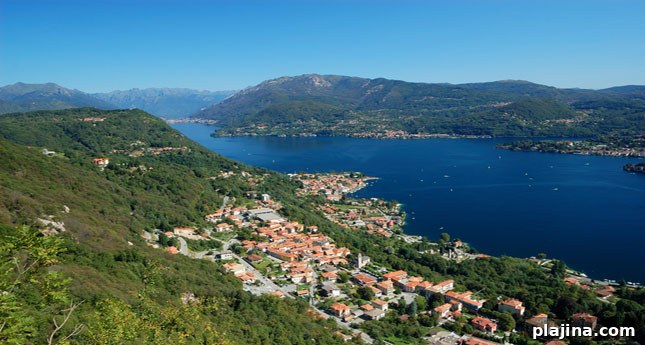
Often overlooked and overshadowed by the glamour of Italy’s larger lakes, Lake Orta is a small, tranquil body of water measuring roughly seven miles long and one mile wide. Tucked away west of Lake Maggiore and largely removed from the usual tourist routes, the lake is surrounded by forested hills that create a peaceful, intimate atmosphere. On its southern shore lies the medieval town of Orta San Giulio, a charming village of gray-stone buildings and leaning balconies. Motor vehicles are banned from its narrow streets, which converge on the lively waterfront square, Piazza Motta. From this square, frequent boats cross the water to the single island at the lake’s center.
Isola San Giulio is ringed by moss-covered stone buildings where waves lap at the foundations. Dominating the island is the 12th-century Basilica di San Giulio. Local legend holds that Saint Giulio drove away the island’s snakes and even a dragon before founding the church. The saint’s tomb lies within the basilica, which also houses an outstanding carved marble pulpit. A solitary stone lane known as the Way of Silence winds through the island, creating an especially atmospheric setting among the ancient structures.
Back in Orta San Giulio, visitors can climb from Piazza Motta up to the Sacro Monte, a devotional complex of 20 chapels and a church dedicated to Saint Francis of Assisi. These chapels are set within a protected natural area of beech, linden, and pine trees and contain more than 300 terracotta figures arranged into sculptural scenes that narrate episodes from the saint’s life. The Sacri Monti tradition—mountainside sanctuary complexes featuring chapels with statuary and frescoes—is distinctive to this region of northern Italy. This particular Sacro Monte is one of nine such sites recognized as a UNESCO World Heritage site for its cultural and spiritual significance.
Lake Orta and Orta San Giulio together offer a quieter, more contemplative alternative to the busier lakes in the area. The combination of medieval architecture, serene waters, wooded hills, and sacred art provides a compact destination that rewards slow exploration. Whether strolling the car-free streets of the village, crossing to the island to visit the basilica, or ascending the wooded path to the Sacro Monte, visitors will find a place that feels removed from the rush of modern travel and rich in history and natural beauty.