
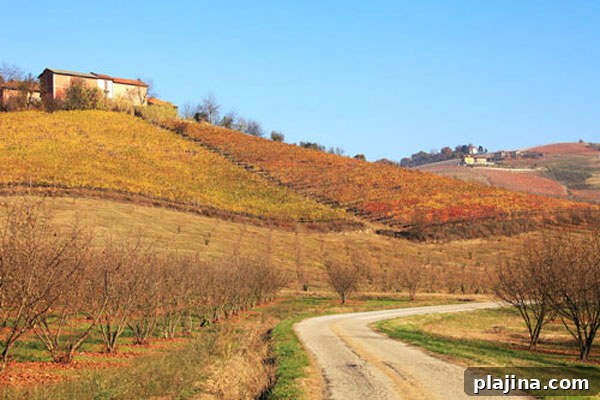
Through an oak forest in Italy’s Langhe Hills, I followed a non-descript little mongrel named Erculo. Though his parentage was uncertain, Erculo was no ordinary mutt. He had earned a degree — from the Università dei Cani da Tartufo — and in Piemonte that training is often more valuable than a pedigree. He is, above all, a skilled hunting dog.
I moved through fallen oak leaves after Erculo, whose keen nose from the truffle dog school was hot on the scent, accompanied by the school’s headmaster, Giovanni Monchiero. As Erculo bounded from tree to tree, busy sniffing the ground, Giovanni spoke in his deep Piemonte accent about the school he runs: the University of Truffle Hunting Dogs.
Giovanni explained that while pigs can find many kinds of truffles, the rare white truffle is best detected by dogs. That’s why we were in the woods on that brisk November afternoon — truffle hunting, hoping to come away with a few precious ounces of the so-called “white diamonds.”
From October through January the area around Alba becomes consumed with Tuber magnatum pico, the most prized of truffles. During that season, trifolai — truffle hunters like Giovanni — search the hills for the gnarly, aromatic tubers that chefs will pay handsomely to shave paper-thin over a signature dish. The market can be extreme: in 2007 a 3.3-pound white truffle fetched $330,000.
With that possibility in mind, I watched closely as Erculo began to dig eagerly beside a large oak. Giovanni kept a careful eye on the dog so he could pull him away at the right moment and avoid damaging any truffle. When the dog indicated a find, Giovanni gently brushed back dark soil with his fingers and the end of a stick until the treasure was revealed.
Erculo’s discovery that day wasn’t the three-pound jackpot that sometimes makes headlines, but it was substantial enough to infuse our evening risotto with an ethereal scent of autumn woods. The remaining slices transformed the next morning’s fried eggs into something near ambrosia.
The practice of training truffle dogs is meticulous and rooted in local tradition. Schools like Giovanni’s focus on teaching dogs to recognize the subtle aroma of Tuber magnatum pico, to work patiently among tree roots, and to ignore other earthy scents that might lead them astray. Handlers learn timing and restraint, ensuring the dog’s enthusiasm doesn’t damage the delicate fungi beneath the soil.
In Piemonte, truffle hunting is both livelihood and ritual. Hunters and their dogs move through mixed woods of oak, hazel and beech, reading the landscape for the right microclimate — limestone soils, specific tree species, and certain levels of humidity — that favor white truffles. The search can be slow and exacting, but when the bond between handler and dog pays off, the reward is more than monetary: it is a taste of place and season that connects field and table.
Walking the Langhe that day, watching Erculo at work and listening to Giovanni describe the craft, I came away with a deeper appreciation for the quiet expertise behind each prized fungus. Truffle hunting blends practical skill, local knowledge and a long-standing partnership between human and animal. Even modest finds carry the region’s flavors and stories, turning simple meals into memorable experiences grounded in the landscape of Piemonte.