
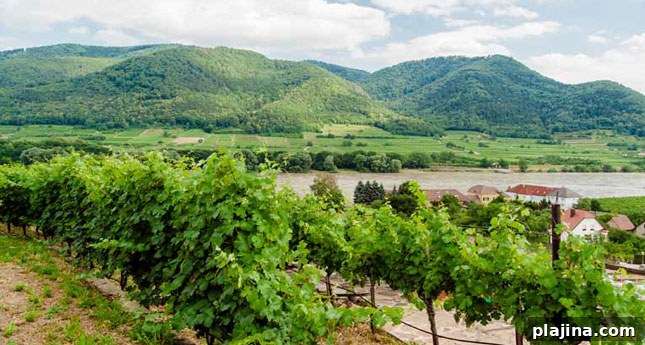
Never mind Strauss’s waltz about the “beautiful blue Danube.” Is it beautiful? Yes. Blue? Not really. The wines along the river, however, display striking shades of red, gold and amber. These bottles are the products of nine winemaking countries the Danube passes on its nearly 1,800-mile journey from Germany to the Black Sea.
Some of those wines are familiar to American drinkers; others, long hidden behind the Iron Curtain, have only recently begun to appear in the United States. On AmaWaterways’ newest ship, AmaCerto, I cruised north from Budapest to Germany, sampling wines from each country whose shores we passed.
In Hungarian waters we enjoyed native varieties. One noteworthy white was made from Olaszrizling, Hungary’s most widely planted grape. Dry and fragrant, it often offers green-apple aromas and a crisp fruit character. Frequently labeled Welschriesling and unrelated to Germany’s Riesling, Olaszrizling is cultivated in six of the Danube’s wine-producing countries.
For red, Egri Bikavér—Hungary’s best-known example—remains a standout. Translated as “Bull’s Blood,” this wine lives up to its name with deep color, full body and robust flavors, making it an ideal partner for beef dishes such as the tenderloin served alongside it.
Hungary is also celebrated for Tokaji dessert wines, whose sweetness is traditionally measured in puttonyos; a six-puttonyos bottling is among the richest. Whenever you have the chance to taste a Tokaji of this caliber, take it.
Crossing into Austria, we found strong regional identities. Austria’s best red varieties are grown in Burgenland, about 40 miles southeast of Vienna. North of the capital, vineyards produce the country’s signature white, Grüner Veltliner—the name used for both grape and wine. Elegant examples we tasted, such as those from Lagler and Johann Donabaum, are already available in the U.S. and showcase the grape’s peppery, citrus and stone-fruit notes. Grüner Veltliner is also planted in other Danube countries. Among Austrian reds discovered aboard AmaCerto, Bründlmayer’s Zweigelt stood out for its balance and approachability and can be found in many markets.
Although most of Germany’s wine regions lie along the Rhine rather than the Danube, Germany’s Rieslings were highlights while we navigated the country’s Danube corridor—offering bright acidity, floral aromas and vivid minerality that pair well with local cuisine.
Beyond these central European stops, other Danube cruises touch Slovakia, Croatia, Serbia, Romania, Bulgaria and Ukraine. Each of these countries has made notable strides in modern winemaking, blending indigenous grapes and renewed techniques to produce distinctive, high-quality wines. For adventurous wine lovers, the Danube’s route is a rich itinerary of discoveries—white, red and sweet—reflecting centuries of regional tradition and an encouraging wave of contemporary innovation.