
While many Southeast Asian cities have traded historic charm for modern skylines, Cambodia’s capital, Phnom Penh, still preserves much of its French colonial architecture and a complex, sometimes painful history. The city’s original name, Krong Chaktomuk — “City of Four Faces” — referred to its location at the meeting point of the Mekong, Bassac and Tonlé Sap rivers and reflects the diverse sides of its character.
Phnom Penh offers a mix of experiences: sobering historical sites such as the Killing Fields at Choeung Ek, serene Buddhist temples like Wat Phnom, and a lively nightlife. One of the most active stretches is Sisowath Quay, which runs along the west bank of the Tonlé Sap River and is lined with restaurants, bars, boutique shops, upscale hotels and several of the city’s key attractions.
The Royal Palace, situated beside Sisowath Quay, dates back more than a century and remains the residence of Cambodia’s king. The palace complex includes several notable buildings: the ceremonial Throne Hall of Prasat Tevea Vinichhay; the Chan Chhaya Pavilion, used for traditional dance performances; the king’s official residence, the Khemarin; the Napoleon Pavilion; and the Silver Pagoda, which takes its name from the 5,000 silver tiles that cover its floor. Inside the temple are around 1,650 art objects, including a life-size Buddha crafted from solid gold.
Demons in a wall painting of the Ramayana at the Royal Palace © Henriette Sulmann | Dreamstime.com
North of the Royal Palace, the National Museum of Cambodia, opened in 1920, houses a comprehensive collection spanning from the pre-Angkor period (around the fourth century) through the post-Angkor era (about the 14th century). The museum’s holdings include sculptures, ceramics and frescoes that bring to life scenes from the Khmer rendition of the Ramayana.
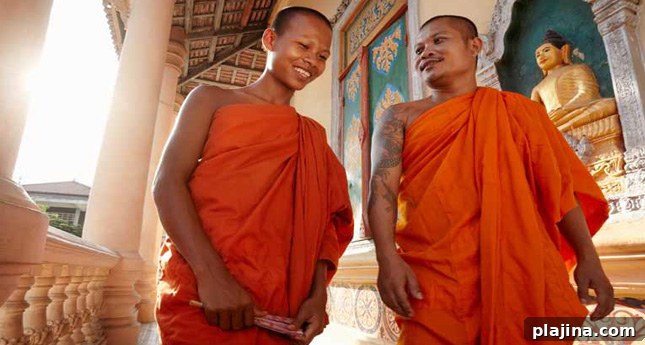
Also on the riverfront is Wat Ounalom, founded in 1422 and one of Phnom Penh’s original five monasteries. The country’s head monk is based at this pagoda, which historically served as the library of the Buddhist Institute. Behind Wat Ounalom, the neighborhood attracts visitors with a variety of bars and restaurants, making it a lively area to explore.
Close by, Street 178 — commonly known as Artists’ Street — is home to several noteworthy shops and galleries. Kravan House offers an array of Cambodian silk products, while the Happy Painting Gallery, established in 1995 by French-born Canadian artist Stéphane Delaprée, has become a fixture in the local art scene. The gallery operates from the historic building that once housed the Foreign Correspondents’ Club, displaying Delaprée’s distinctive works.
The Foreign Correspondents’ Club (FCC) remains a popular destination for tourists, expats and aid workers. Perched on the riverfront, the FCC is known for its rooftop terrace, live music and views over the water. The venue serves both Khmer and Western dishes alongside a selection of signature cocktails, making it a favored spot to unwind after a day of sightseeing.