
For Colombia, which is experiencing a renewed interest from both domestic and international tourists, Caño Cristales is a relatively new and fragile attraction. Visitors often find themselves alongside other foreign travelers, Colombian medical teams on humanitarian missions, and off-duty military personnel in this lesser-known part of the country.
Do it right: Familiarize yourself with the recent history of the area, including the former demilitarized zone that was ceded to the FARC (Revolutionary Armed Forces of Colombia) during President Andrés Pastrana’s administration (1998–2002). Avoid drawing quick conclusions and try to understand the complex social and political context surrounding the region.
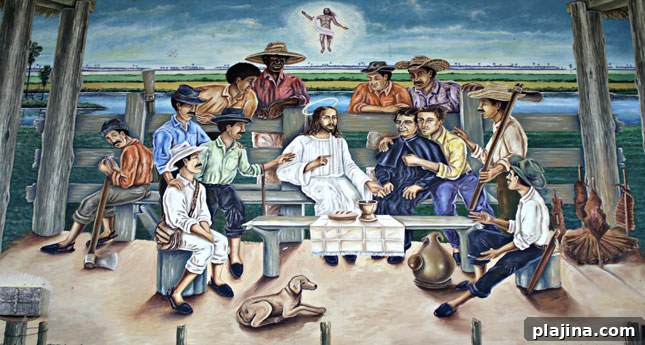
The nearest town to Caño Cristales is La Macarena, roughly 170 miles south of Bogotá. La Macarena once served as a headquarters for the FARC secretariat and remains marked by that past. A local story claims the mural in the church was originally commissioned by the guerrillas and showed campesinos (farmers) carrying rifles in support of the guerrilla movement. According to the tale, when government forces returned to the area, the images were altered to replace weapons with traditional farming tools.
While the legend is compelling and makes for a vivid anecdote, local experts and several sources familiar with La Macarena have disputed this version of events. The precise origins and alterations of the mural are therefore uncertain, and the story should be treated as folklore rather than established fact.
Visitors to Caño Cristales should approach the region with respect for its cultural and historical sensitivities. Learning about the local narrative, listening to community members, and engaging responsibly with guides and authorities will provide a more accurate and humane understanding of the place. The area’s beauty is intertwined with a complex past, so travel there with curiosity, humility, and awareness.