
When Lara Booth, senior marketing manager at Genesys Telecommunications Labs EMEA, finalized plans for G-Force Vienna — the company’s flagship event for EMEA customers — she understood the potential logistical challenges. The three-day conference would host about 1,000 attendees across multiple hotels and restaurants, culminating in a large reception at a historic palace.
“This was the first time we used Vienna for this event,” Booth said from Genesys’ U.K. office in Frimley, Surrey. “The event spanned three days and we were spread across several hotels located near our convention venue. We mainly used the Radisson Blu and Arcotel Kaiserwasser as our primary hotel properties, booked the Hofburg Palace for a 1,000-guest party, and arranged dinners at a variety of restaurants around the city for the first night.”
Austria Center Vienna © IAKW-AG Marius Hîfinger
Initial concerns about logistics eased after Booth contacted the Vienna Convention Bureau. “The team there was extremely helpful during the early planning stages, when we were determining what the city could offer for a large group,” she said. “Vienna’s beauty attracted our delegates — customers, partners and prospects — and its central location within the EMEA region made attendance more convenient.”
Genesys’ smooth experience in Vienna reflects effective local support and the city’s many strengths. The Vienna Convention Bureau, part of the city’s efficient tourist board, has seen growing interest from global corporate planners in recent years as travel managers recognize Vienna as a politically stable, economically sound venue for international meetings.
“We are seeing more U.S. multinational companies choose Vienna for meetings,” said Manfred J. Weinschenk of U.S. Commercial Services at the U.S. Embassy in Vienna. “Companies cite the city’s high security, well-developed infrastructure, quality conference facilities and the attractive surroundings as reasons to bring events here.”
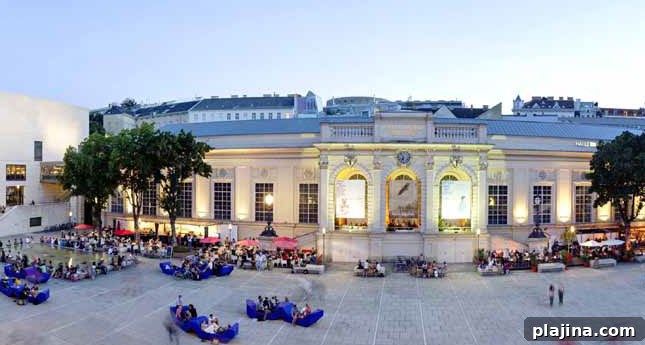
The U.S. Embassy itself uses Vienna’s cultural venues for diplomatic and public events. Its annual concerts by The United States Air Force Band, for example, take place at the MuseumsQuartier — a lively cultural district with museums, cafés and galleries that appeal to both locals and visitors, according to Roland Fuchs, the embassy’s public affairs officer.
In the last year, Vienna hosted more than 3,300 congresses and corporate events, contributing over $1.2 billion to Austria’s gross domestic product and supporting roughly 17,500 year-round jobs. The meetings, incentives, conventions and exhibitions sector is growing, particularly in areas such as medical conferences, the arts and IT/telecommunications. “We have a very strong reputation in medicine, a well-known history in music and the arts, and growing expertise in green meetings — a competitive advantage for younger IT planners,” said Christian Mutschlechner, director of the Vienna Convention Bureau.
Vienna’s convention infrastructure includes three major centers. Austria Center Vienna offers about 236,000 square feet of space with 180 breakout rooms and nine cafeterias, and is served by nearby hotels such as the 4-star ARCOTEL Kaiserwasser Wien and the 253-room Meliá Vienna. The Hofburg Vienna is one of Europe’s most distinctive MICE venues: originally constructed in 1259 as an imperial residence, the Baroque complex now provides convention facilities with roughly 182,000 square feet and seating for up to 4,900 guests, with the city center and thousands of hotel rooms within walking distance.
Messe Wien Exhibition & Congress Center, with its modern glass façade, offers Vienna’s largest total floor space at about 788,000 square feet, including extensive exhibition halls. Opened in 2004 just outside the city center, it is well connected by public transport and suits large-scale trade shows and conferences.
While Vienna’s classic luxury hotels — such as the Sacher, Imperial and Bristol — remain popular, recent years have seen growth in contemporary, design-focused properties. In 2010 the Jean Nouvel–designed Sofitel St. Stephansdom introduced a modern high-rise option, and the first Ritz-Carlton in Austria opened in Vienna in 2012, offering luxury rooms and meeting spaces within landmark buildings on the Ringstrasse.
A wave of new upscale hotels followed, including the boutique Sans Souci Wien near the MuseumsQuartier, the Palais Hansen Kempinski in a restored 1873 building with expansive meeting facilities, and The Guest House Vienna, a center-city boutique that appeals to upscale business travelers and small corporate groups. The Meliá Vienna, occupying the lower floors of the DC Tower 1 on the Danube, added further capacity at four-star level. Additional projects slated around this period promised to raise the city’s total hotel capacity significantly.
Vienna’s public cultural venues also host off-site MICE activities. The MuseumsQuartier houses the Leopold Museum and MUMOK (Museum of Modern Art) alongside galleries and dining options. Concert halls, historic palaces, the Vienna State Opera and the Prater amusement park are all conveniently close to hotels and convention centers. Unique to Vienna, the city’s vineyards produce wine within city limits, and nearby wineries and Danube riverboats provide attractive settings for receptions and corporate gatherings.