
Photo: Javiergil, Dreamstime
Alone in the desert, staring at dunes barely outlined against the night sky, I finally understood what the word “timeless” means.
It wasn’t the same as calling a piece of jewelry or a dress “timeless.” In that moment I felt connected across eras — to those who had crossed this landscape millennia ago and to the people who would pass through it in the future.
Despite being roughly 185 miles from Amman’s modern commerce and much closer to the Dead Sea resorts and the port of Aqaba, for a few minutes I felt entirely present with the land.
Then I turned and walked back to camp.
I was in Wadi Rum, southwestern Jordan. T.E. Lawrence — better known as Lawrence of Arabia — described it as “vast, echoing and Godlike.” The desert covers some 280 square miles of sand and is punctuated by towering sandstone monoliths. Archaeological finds such as stone tools, arrowheads and rock inscriptions indicate human presence as far back as the Paleolithic era. Today the area remains home to Bedouin tribes — traditionally nomadic people who still herd livestock and increasingly guide visitors through the desert.
While many Bedouins have moved to cities in recent decades, some southern tribes maintain their nomadic heritage. At the same time, entrepreneurial members of these groups have adapted, trading camels for 4x4s and herding tourists rather than sheep.
My journey began at the Rest House, a concrete-block outpost where the paved highway gives way to desert tracks. Known locally as the “Valley of the Moon,” Wadi Rum’s Rest House once functioned as the de facto base for desert excursions.
It has since been supplemented by an official visitors’ center near the Seven Pillars of Wisdom, the dramatic rock formation that inspired the title of Lawrence’s account of his experience during the Arab Revolt of 1916–1918. The new center offers facilities, interpretive exhibits, restaurants and craft shops, and it serves as the main gateway to the protected reserve for visitors arriving by 4×4. The old Rest House still operates as a secondary base with a small restaurant, campground and rental equipment including tents and bedding, along with showers and basic facilities.
I had pre-booked an overnight camping package that included a guided 4×4 tour, camping equipment, meals and evening entertainment. Travelers who prefer more spontaneity can also arrange tours on arrival at the visitors’ center or the Rest House. Activities range from rock climbing and day trips by 4×4 or camel to overnight and multi-day itineraries.
We piled into our 4x4s and plunged into the desert, barreling over dunes and across salt flats beneath an almost surreal landscape. Our guide made sudden stops at rock faces, leading us through narrow crevices to examine Paleolithic graffiti and ancient carvings. At other moments, we photographed Bedouins riding camels across the sand.
By late afternoon we were sunburned, thirsty and tired, but there was one more ritual to observe: sunset. Watching the sun set is a daily event in Wadi Rum, so much so that the Jordan Tourism Board’s map even designates official sunset sites for winter and summer.
As the sun sank, people converged on the ledges — camel riders, climbers and jeep-borne tourists — and began to climb the rocks. The crowd was a blend of Western visitors in shorts and T-shirts and locals in traditional dishdasha and head coverings. I remember a simple, striking image: two men standing side by side watching the sun fade — one a shirtless, suntanned Westerner with sunglasses pushed up on his head, the other a dark-haired local in a flowing white robe.
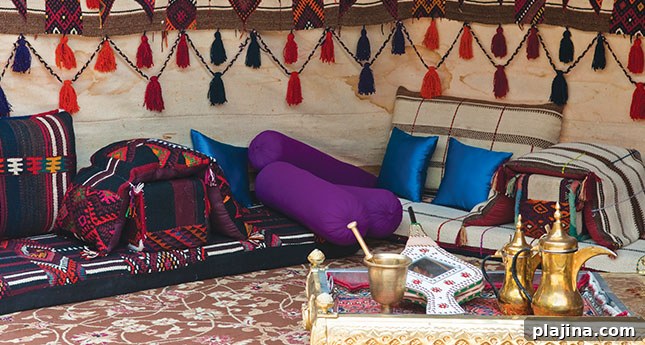
When the sun disappeared, we climbed down and rode a short distance to camp, where guides had set up a Bedouin enclave. “Palace” may be an overstatement, but our overnight site was comfortable: individual tents furnished with rugs, blankets, pillows and sleeping bags arranged in a semicircle around a larger Bedouin-style shelter. That communal tent was layered with handmade rugs, cushions, lanterns and a narghilè (traditional water pipe). A softly lit path led to simple, screened outhouses.
While the guides prepared our evening meal, we relaxed in the communal tent and shared stories of the day. After a generous spread of grilled meats and vegetables, we sank into pillows as the notes of a rababah — a small bowed instrument — drifted through the tent.
Warmed by the fire, full from dinner and soothed by music, I accepted an offer to try the narghilè. Reclining on cushions in a Bedouin tent, under a star-filled sky, inhaling the smooth tobacco from a water pipe, I felt connected to tradition and to those who came before and after me.
Info to Go
Queen Alia International Airport (AMM), 20 miles south of Amman, is the main international gateway. The drive from Amman to Wadi Rum via the Desert Highway takes about four hours. Flights from Amman to Aqaba (AQJ), less than an hour south of Wadi Rum, take roughly 45 minutes.