
To paraphrase the legendary Liverpool coach Bill Shankly, who was speaking about football, sport is not a matter of life and death — it is more important than that.
Sport spans the globe and reaches across centuries. Some disciplines are universal; others belong to a particular place. Some have been invented within living memory, while others trace unbroken lineages back to prehistory.
Over the years my Games & Sports column explored that diversity. The approach has been largely personal. I have loved sport for as long as I can remember. I was born into a sports-loving family and one of my first gifts was a hand-knitted romper in the red and white of my local team, Sunderland. I have remained a supporter through good times and bad.
During a childhood spent in Africa and South Korea and throughout my travels as a writer, sport has always accompanied me. It is a reliable icebreaker with strangers. I have watched televised matches in noisy bars, attended professional events on every continent and joined impromptu games of soccer, cricket and volleyball — and tried sports that were completely new to me — in backstreets, on beaches and even in a hotel dining room.
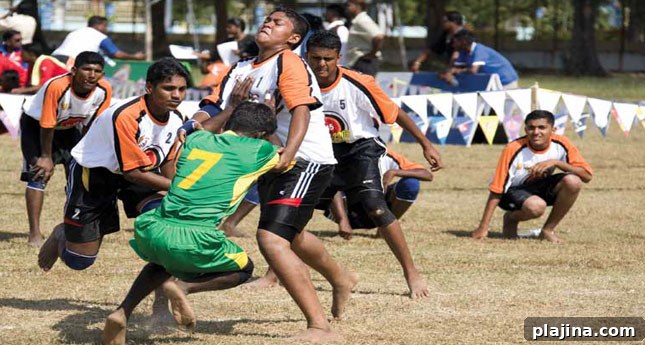
That last episode involved the Indian sport of kabaddi and ranks among the most surreal moments of my life. Curious about a match I had seen during a city tour in Nagpur, I asked the hotel manager to explain. He used salt and pepper shakers to illustrate the rules, then ordered the staff to clear the dining area to create a playing field. Before long I was chanting “kabaddi” and attempting to evade capture by a chain of hand-holding waiters.
A German couple who entered at that moment probably recognized little of what was happening; the shock on their faces said it all. I wrote about the incident in a November 2009 column, and I suspect a rather different version of the story has circulated back in Germany ever since that awkward hotel-dining-room encounter.
Like many fans, I often wonder how I would fare against professionals. In 2000, on the Greenbrier golf course in West Virginia, I had the chance to find out — a memory I revisited in a May 2008 piece.
I was invited to play two holes with Nick Faldo and Sam Snead. Faldo was still near the top of his game and Snead, at 87, was still posting respectable rounds.
“Let’s see what you’ve got,” Faldo said as I stepped to the tee. My heart raced. With two legends watching, I focused on the basics: keep the head still, eyes on the ball, a firm but relaxed grip, weight shifting through the swing. Thwack. Both of them tracked the ball’s flight.
“Well, you hit the fairway,” Faldo observed. “The wrong fairway, but never mind.” That exchange set the tone. My companions moved smoothly from tee to green while I zigzagged through rough patches, often watching them from a distance.
On the final green they were deep in conversation, trading tips. That was the day’s greatest lesson: with 13 major championships between them (six for Faldo, seven for Snead), they were still seeking improvement. To reach the top in any sport you cannot merely play — you must be possessed by it.
Excellence in sports like golf can bring fame and fortune, but many other disciplines reward extraordinary skill without broad recognition. Over the years the column covered dozens of relatively obscure games: Valencian pilota (similar to tennis but played with the hand), wushu (a Chinese martial art), sepak takraw (a Southeast Asian form of volleyball played with the feet), pétanque (French boules) and Finnish wife-carrying, to name a few.
Each of these requires natural talent and hours of daily practice to reach the elite levels — wife-carrying perhaps being the exception when beer gets involved.
Although I was once selected for the Botswana junior tennis team, a story I wrote about in September 2008, I accept my modest place in the sporting hierarchy. As a participant I will remain an enthusiastic amateur. As a fan, however, I continue to experience the highs and lows, triumphs and tragedies, almost as vividly as the players themselves.
Sport has been a constant in my life, woven into many personal milestones. My first kiss, for example, is forever linked to a sporting setting.
When I was eight and living on the Kenyan coast, I slipped into the empty spectator gallery of a squash court with a classmate, an eight-year-old blonde girl. A match was underway; the players were absorbed and barely noticed us. Tennis shoes squeaked, racquets swished and the rubber ball pinged against the walls. There, in that charged atmosphere, I experienced my first kiss and, in my mind at least, formed an indelible association between squash and that moment.
These small personal experiences add to the vast communal pot of sport. Across every country and through history, sport has shaped lives, kindled passions and left enduring marks on culture. Nations rise and fall, lives are lived and lost, but sport goes on.