
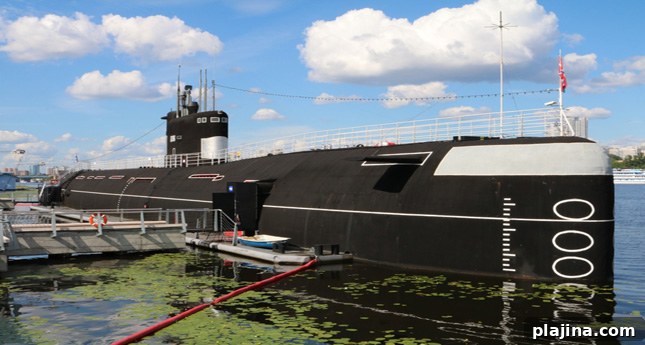
Cloaked in mystery and intrigue, submarines have played a decisive role in naval warfare since World War I. Today visitors to the Moscow Naval Museum can tour the diesel-electric B-396 submarine, a Tango-class boat built in 1980 and decommissioned in 1998, on display at the museum since 2006. The U.S.S.R. developed the Tango class during the Cold War to monitor the Northern Fleet and to operate across the Mediterranean, the North and South Atlantic, the western coast of Africa, and the Barents and Norwegian seas.
Compared with its predecessor, the Foxtrot class, the Tango class featured improved battery capacity, enabling the B-396 to remain submerged for over a week before needing to snorkel. Combined with bow sonar arrays similar to those installed on Soviet nuclear attack submarines, this made the Tango class well suited to ambush tactics against Western nuclear submarines.
Our tour began with a retired Soviet submarine commander who led the presentation in Russian while a guide translated into English for the group. He pointed out the torpedo tubes and described the practical challenges of life aboard a submarine: meal preparation, laundry, first aid, confined living quarters, and ways the crew found entertainment. As expected, the environment was spartan rather than glamorous, but the presentation gave an honest view of daily routines and operational procedures.
Visitors are allowed to move through most compartments and view the exhibits up close. The full tour typically lasts 60–90 minutes, depending on how many questions the group asks. After touring the B-396, our group was escorted to the adjacent building to experience the Russian A-90 Orlyonok simulator. A static display of the actual A-90 rests perpendicular to the submarine, providing context before the simulator session.
Seated inside the simulator, we experienced a series of dramatic maneuvers that simulated low-altitude flight and attack profiles. Visual effects and simulated motion enhanced the realism, creating an immersive demonstration of the ekranoplan’s capabilities. The A-90 Orlyonok, introduced in 1979 and retired in 1993, ranks among the most successful ekranoplans—vehicles that blend characteristics of airplanes and hovercraft and exploit ground effect.
Ground effect allows the ekranoplan to fly at very low altitudes with improved fuel efficiency and greater payload capacity compared with conventional aircraft. The Orlyonok could operate at wave-skimming heights, sometimes as low as 16 to 32 feet above the water, which reduced radar visibility. At roughly 140 tons and about 190 feet in length, the A-90 could reach speeds near 250 mph while carrying heavy loads, making it an intriguing example of Cold War-era innovation in maritime and air-sea operations.
Visiting the B-396 and the Orlyonok display offers a compact but informative look at Soviet naval technology and the practical realities of service life aboard specialized craft. The museum’s combination of preserved hardware, firsthand explanation from a former commander, and interactive simulator experience provides a clear sense of how these platforms were designed for the strategic and operational demands of their time.