
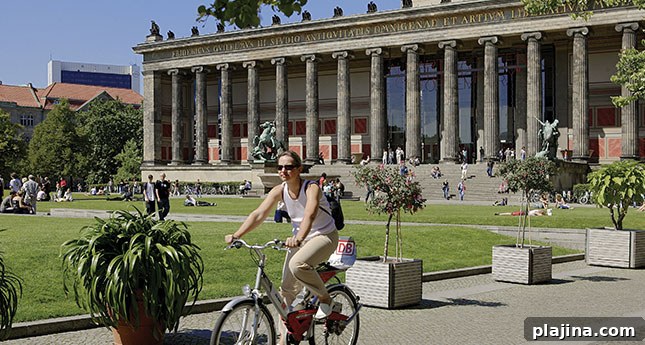
The first time I visited Berlin in the early 1960s, few families came to the divided city. The Berlin Wall had just been erected, and most visitors who crossed East Germany traveled on organized motor coaches — there were not many of those. West Berlin then ended at the Brandenburg Gate, where concrete barriers, barbed wire and DDR guard towers sealed off entry to East Berlin. When the city was reunited in 1989, the Brandenburg Gate reopened, and today both pedestrians and vehicles pass through the historic 18th-century monument. Thousands of cyclists also weave through and around it on their way across town.
For people who remember the Wall, pedaling through the former “no man’s land” around the Brandenburg Gate still feels almost miraculous. Younger Berliners and visiting cyclists relish the flat, spacious area surrounding the monument, where a lively atmosphere prevails day and night.
I have returned to Berlin many times, alone and with family, and we always head straight to Berlin on Bike (Knaackstrasse 97) to rent bicycles from friendly, helpful staff. Unless snow covers the ground, cycling is the best way to see Berlin. The city is largely flat, which suits older riders, protected bike lanes run along main roads making routes safer for children, and extensive trails wind through parks, forests and along waterways. Berlin boasts more designated green space than most European cities, adding to its appeal for riders of any age. One particularly notable route is the Berlin Wall Bicycle Trail, which follows the Wall’s original footprint and features historic markers, maps and photographs.
On a recent summer visit with my brother Robbie, who was living in Bavaria, we rode through former East Berlin neighborhoods and stopped for a beer at the outdoor patio of Nola’s am Weinberg, a relaxed café overlooking a park. Located on one of the city’s few small hills, the climb to the restaurant is gentle — Berlin’s landscape may hide wild-looking countryside within its urban fabric, but you can pedal for hours without facing steep inclines.
My daughter, Risa, who bicycled with me in Amsterdam when she was nine, prefers Berlin. She remembers Amsterdam’s slippery cobblestones and rainy July weather; by contrast, Berlin offered warm summer days and comfortable riding in T-shirt and shorts. “In Berlin, around every corner, there is always a story to be told,” she said after our ride.
While cycling on Rosenthalerstrasse, we noticed a modest sign for the Museum Blindenwerkstatt Otto Weidt, the former workshop where Otto Weidt employed and protected blind Jewish workers during the Holocaust. The restored space and accompanying photographs tell a moving story of courage and compassion.
Bicycles are ideal for exploring the tucked-away corners of former East Berlin, where small museums and independent bookstores share sidewalks with trendy restaurants, galleries, boutiques and music clubs. Since reunification, East Berlin has seen a resurgence: modern architecture stands beside carefully restored historic buildings, and quirky, privately owned enterprises give neighborhoods character — for example, a combined café, museum, gallery and bookstore devoted to the Ramones.
Riders can take bikes on Berlin’s efficient U-Bahn and S-Bahn trains to reach leafy suburbs and peripheral trails. These surface and underground lines are fast, frequent and offer various fares that include bicycles and family tickets.
On any given day you will see cyclists speeding through the modern Potsdamer Platz, gliding slowly through the Tiergarten, parking outside the Reichstag while visitors tour the Norman Foster–designed glass dome, pedaling along the Kurfürstendamm shopping boulevard, or riding out to Sanssouci Palace in Potsdam, a 30–40-minute S-Bahn trip from the city center.
The Berlin Wall Bicycle Trail is the crown jewel for many cyclists: a roughly 96-mile route encircling former West Berlin along the path of the East German fortifications. The trail is divided into 14 manageable sections, each between four and twelve miles long, so families can choose segments that suit their interests and abilities. Mini GPS devices are available to help follow the trail as it winds around streams, dead-end streets and bustling neighborhood centers. Along parts of the route, remnants of the Wall remain — pieces hidden in underbrush or small blocks of concrete repurposed in playgrounds. Though much of the barrier was dismantled, finding the remaining fragments adds an element of discovery to the ride.
Families enjoy the Wall Trail as much as solo visitors. It is common to see children riding in backpacks or trailers behind their parents. If the central sections get crowded, take a train to outer stretches like the Hermsdorf to Wollankstrasse segment. North of the Tegeler Fließ stream, the trail leads to the 13th-century village of Lübars, the only village inside Berlin’s city limits — a peaceful, rural-feeling spot that feels far removed from the downtown bustle.
Bicycle popularity in Berlin has grown rapidly: more than 30 rental outlets now operate across the city, many clustered in the eastern districts or near the family-friendly Zoological Garden in the west. Hundreds of three-wheeled pedicabs offer rickshaw-style rides for visitors who prefer not to pedal, often featuring all-weather enclosures that make them popular with families and older travelers.
According to the Berlin Department for Transportation and Urban Development, the city has over 780 miles of streets with parallel bike paths, and plans are underway to expand urban and suburban cycling routes. The Berlin Wall Bike Trail remains a favorite activity for locals and visitors alike, offering a memorable way to combine exercise, history and exploration.
Info To Go
Tegel Airport (TXL), about five miles from central Berlin, offers frequent buses and taxis to downtown, as well as car rentals. The airport is set to close when the larger Berlin-Brandenburg International Airport (BBI) opens. The modern Berlin Central Station provides high-speed rail links across Europe.
Lodging
Arcotel John F Berlin
Named for President John F. Kennedy, this 190-room hotel sits near attractions in eastern neighborhoods and features the Foreign Affairs restaurant with a German/Austrian menu. Werderscher Markt 11, tel 49 30 40 5046
Cosmo Hotel Berlin Mitte
A member of Design Hotels, Cosmo offers high-tech rooms with goose-down duvets and flat-screen TVs; the restaurant showcases Chef Ottmar Pohl’s aroma cuisine. Spittelmarkt 13, tel 49 30 5858 2222
Amano
This stylish boutique hotel in Mitte has a summer roof garden, free Internet, on-site bicycle rental and a trendy bar. Auguststrasse 43, tel 49 30 809 4150
Dining
Nola’s Am Weinberg
A 1950s-era East Berlin café with an outdoor patio, known for Swiss-influenced dishes and a satisfying German-style business lunch. Veteranenstrasse 9, tel 49 30 440 40766
Pasternak
A Russian-Jewish restaurant in Prenzlauer Berg offering blini, hearty soups and caviar; indoor and outdoor seating available. Knaackstrasse 22/24, tel 49 30 441 3399
Restaurant Florian
An unassuming yet refined restaurant in business for decades, known for attentive service and a menu that benefits from reservations. Grolmanstrasse 52, tel 49 30 313 9184