
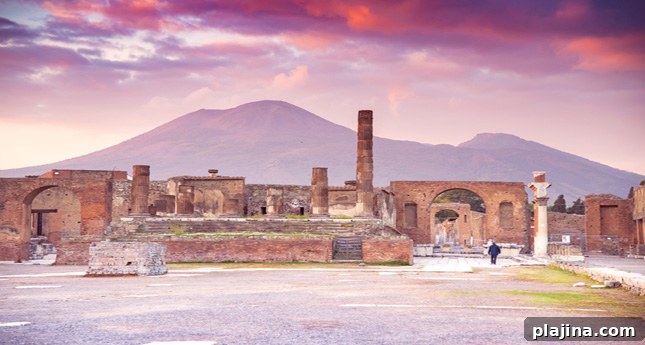
From Naples, Italy, visitors can easily visit two of the best-preserved cities of the classical world: Pompeii and Herculaneum, both destroyed by the eruption of Mount Vesuvius in 79 CE. A short ride on the Circumvesuviana train brings you past commuters to the modern towns of Ercolano and Pompei. At the station you’ll even see the sign Pompeii–Villa dei Misteri, named for the stunning frescoes in the House of the Mysteries that portray initiation rites for the cult of Dionysus (Bacchus) in vivid Pompeiian reds.
Herculaneum, closer to Naples at about eight miles away, is smaller and more compact than Pompeii but often better preserved. The town was buried by volcanic mud rather than only ash, which sealed and protected organic materials such as wooden beams and furnishings. The MAV Museum (Museo Archeologica Virtuale) offers immersive reconstructions of the town before and after the eruption, including simulated seismic effects that help convey the dramatic impact of 79 CE.
Pompeii was a thriving resort city with an estimated population between 10,000 and 20,000 people. Its streets were lined with aristocratic villas, public baths, shops, brothels and what is the oldest surviving Roman amphitheater. Walking through the excavated streets and homes gives a vivid sense of daily life in a Roman city frozen at the moment of catastrophe.
Both archaeological areas are well served by local hotels and restaurants, making it easy to plan extended visits that combine site exploration with time to rest and dine nearby. Many of the finest artifacts recovered from Pompeii and Herculaneum are housed in Naples’ Museo Archeologico Nazionale. Visiting the museum alongside the open-air ruins enriches the experience: museum displays provide context and highlight delicate objects that cannot be left exposed, while the sites themselves offer the scale and atmosphere of ancient urban life.
Whether you start from Naples as a day trip or base yourself nearby, the contrast between the open ruins and the museum collections makes a visit memorable. Herculaneum’s preserved structures and organic remains reveal details of domestic life, while Pompeii’s extensive streets and public buildings capture the social and cultural diversity of a prosperous Roman town. Together they form an unparalleled window into antiquity, easily accessible from Naples by a short and simple train journey.