Whether you’re exploring the English countryside for historic castles, beautiful gardens or scenic landscapes, the United Kingdom is also home to another intriguing attraction: crop circles. These distinctive formations, rich in mystery and folklore, appear across the country with an average of around 30 reported formations each year, making them a noteworthy stop for visitors interested in the unusual alongside traditional tourist sites.
Some people think crop circles trace ancient pathways or relate to Earth energies, while others attribute them to modern-day hoaxes, artistic endeavors or even extraterrestrial activity. Many of these formations appear in large, open fields often close to roads and near ancient monuments such as Stonehenge and Avebury, adding another layer of curiosity to regions already steeped in history.
To identify where crop circles are most commonly found, researchers compiled records dating back to 2005. Monique Klinkenbergh, founder and researcher at the Crop Circle Visitor Centre & Exhibition, collaborated on this effort to highlight counties with the most recorded formations and to help visitors plan where to see them.
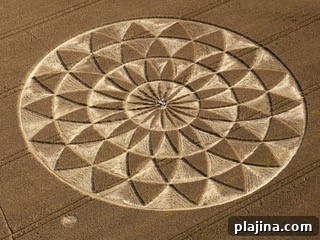
© Andreas Müller
Which county leads the list? Wiltshire tops the rankings with an impressive 380 crop circles recorded since 2005. The most recent notable formation in Wiltshire appeared in May 2023 near Broad Hinton and was described as a six-fold spinner featuring standing extensions within a circular motif. Wiltshire’s numerous archaeological sites and ancient monuments seem to attract crop-circle activity, reinforcing local theories that link these formations to long-standing features of the landscape.
“Crop circles seem to be attracted by ancient sites such as stone circles, long barrows, hill forts and other archaeological sites, for which Wiltshire is famous,” Klinkenbergh observed. “One of the earliest theories for this attraction is the idea that what has been built by our far ancestors on ancient sites, marked by what has always been part of the landscape: Earth Energies.” This view reflects one thread of thought among many that seek to explain why certain locations repeatedly host formations.
Following Wiltshire, Hampshire ranks second with 51 recorded crop circles. A formation near Chilcomb in July 2022 drew attention for its pattern of laid circles and rings situated within a narrow outer ring. Oxfordshire takes third place with 35 documented crop circles, including a recent discovery at Uffington Castle. These counties together show how the phenomenon clusters in parts of southern England that are rich in history and open farmland.
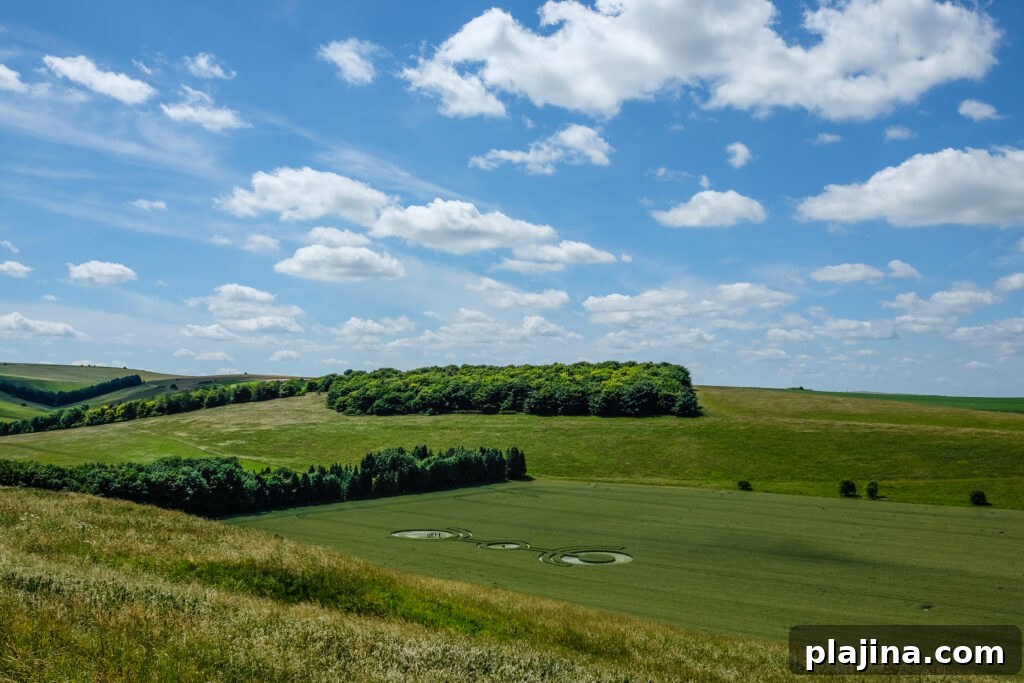
© Rebeccahgriffiths | Dreamstime.com
Visiting these counties to view crop circles also offers the chance to explore many other attractions. In Wiltshire, situated in southwest England, travelers can combine crop-circle visits with trips to Salisbury Cathedral, Stonehenge and a range of ancient and medieval sites such as the Cherhill White Horse and Malmesbury Abbey. The blend of modern mystery and ancient heritage makes Wiltshire a particularly rich destination.
Hampshire, home to the historic city of Winchester—once the capital of Anglo-Saxon Wessex—features the impressive Winchester Cathedral and Abbey, Jane Austen’s House Museum and Highclere Castle, known to many as the setting of Downton Abbey. The county’s rivers, abbeys and grand houses provide plenty to see beyond crop circles.
Oxfordshire, neighboring Wiltshire, contains some of England’s most picturesque towns and parts of the Cotswolds. Visitors here can enjoy historic and cultural highlights such as Chipping Norton, the UNESCO World Heritage site of Blenheim Palace and Garden, and the Ashmolean Museum in Oxford. These attractions make Oxfordshire an appealing base for anyone combining cultural tourism with a curiosity about crop-circle phenomena.
Whether you approach crop circles with skepticism or fascination, the sites where they appear are often set within some of the United Kingdom’s most visually and historically interesting landscapes. Exploring these counties offers a chance to enjoy both the countryside’s natural beauty and a unique cultural mystery that continues to capture public imagination.