
When considering major urban business hubs, three broad categories emerge: the intensely fast-growing centers such as Shanghai and Dubai; the perennial global stars like New York and London; and the quieter but steady performers—important cities that sometimes fly under the radar.
That description fits Brussels well. As Belgium’s capital and largest city, Brussels also serves as the political heart of the 27-nation European Union and hosts NATO. Its international character shows in demographics: roughly one quarter of the city’s 1.1 million residents were born abroad. Strategically located, Brussels is within three hours of most European capitals by air, road and rail. Location remains a powerful advantage.
Despite its geographic and political importance, Brussels sometimes suffers from a reputation for being dull—people ask: after the meetings, what is there to do? Founded in 979 and historically a trade crossroads, the city has been unfairly reduced to images of slow-moving Eurocrats and conservative bourgeois life.
In reality, Brussels offers much more. The city boasts fine Art Nouveau and Belle Époque architecture, a number of notable cultural attractions and a strong culinary scene. The Musée Magritte, opened in 2009, honors the Brussels-born Surrealist René Magritte. The dining scene spans lively bistros and top-tier restaurants, while traditional “brown cafés” pour handcrafted specialty beers in warm, lived-in settings.
Brussels’ political weight and central location make it a key destination for executives doing business with the EU or based in multinational operations. Approximately 900 U.S. companies operate in Belgium, and firms such as Deloitte, FedEx, 3M, McKinsey & Company, Cisco Systems and Ernst & Young maintain a presence in or near Brussels. Like Washington, D.C., Brussels hosts many lobbyists working to shape trade and business policy. The private sector leans heavily toward services, finance and professional firms. Although the city contains about 9 percent of Belgium’s 10.5 million population, it contributes roughly 19 percent of national output.
Belgium’s complex linguistic and political landscape places Brussels at the center of national tensions. The Brussels metropolitan area is one of Belgium’s three federal regions, alongside French-speaking Wallonia and Dutch-speaking Flanders. Once majority Dutch-speaking until the mid-20th century, Brussels shifted to a predominantly French-speaking population after World War II, creating a French-speaking enclave within Flanders.
Despite domestic divisions, Belgium and Brussels remain attractive for investment and international meetings. The country ranks among the top recipients of foreign direct investment and is a popular venue for conventions. Brussels is not inexpensive, but living costs are generally lower than in cities such as Paris or Rome.
For visitors and expatriates, Brussels is compact and easy to navigate, with many locals speaking English. The city of 1.1 million (1.8 million in the metro area) feels manageable yet lively. Brussels Airport is about 20 minutes from the central city by train. Metered taxis are available, trams run reliably, and the Metro—opened in 1976—remains efficient, multilingual and straightforward to use.
The city divides into the Upper Town and the Lower Town, the latter preserving the medieval core. While Brussels bears reminders of postwar rebuilding and occasional modern eyesores, traces of classical elegance persist, particularly in the Lower Town around the Gothic Cathedral of Saints Michel and Gudule and the Galeries Royales Saint-Hubert. The European Quarter, with its glass-fronted EU offices, sits in the Upper Town alongside the Royal Palace and several major museums.
The Galeries Saint-Hubert, inaugurated in 1847, is an elegant covered arcade crowned by glass and iron. Often cited as one of Europe’s oldest shopping arcades, it offers a serene contrast to the more lively streets outside. Inside, polished marble floors, refined shop windows and high-ceilinged cafés create an atmosphere of calm and sophistication. The arcades invite leisurely browsing and people-watching along their three intersecting passageways.
Among the arcade shops, Neuhaus stands out as a major Belgian chocolatier (Galerie de la Reine 25–27). Neuhaus claims to have invented the praline in 1912. Belgian chocolate is widely celebrated for its fine cocoa grind, high-quality ingredients and careful craftsmanship. Many chocolatiers present dramatic displays of flowing chocolate, and confections are a popular souvenir alongside delicate Belgian lace.
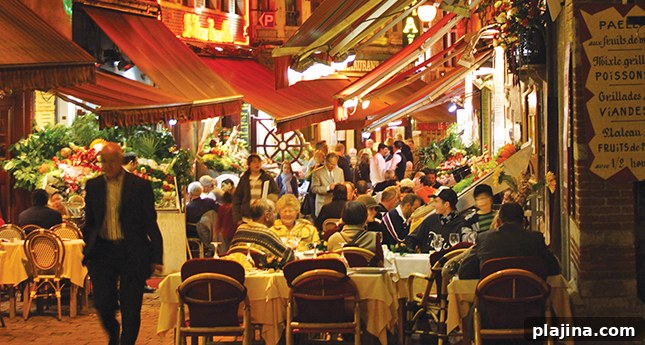
A network of narrow lanes lined with restaurants extends from the Galeries Saint-Hubert. Touts and sidewalk vendors create a bustling scene where oysters are shucked and seafood is displayed on ice. These streets come alive in the evening and are ideal for trying local dishes such as moules-frites (steamed mussels with fries) or enjoying a warm Belgian waffle dusted with powdered sugar and topped with fresh fruit.
The historic heart of Brussels is the Grand-Place, a remarkable square framed by restored medieval guild halls. From the center of Grand-Place, visitors can sense the city’s rich past: ornately detailed stonework and gilded façades evoke old Europe. Nearby stands the Hôtel de Ville (City Hall), a Gothic landmark with a soaring spire. The City Hall’s interior courtyard remains a symbolic focal point of Brussels and of Belgium.
Brussels also feeds the mind. A large mural downtown depicts Tintin, reflecting Belgium’s deep affinity for comics. The Belgian Comic Strip Center, housed in a converted 1906 department store, celebrates that tradition. The Musée Magritte displays a striking collection devoted to René Magritte, who lived in Brussels for many years. Fans of architecture should visit the former home of Art Nouveau master Victor Horta.
After closing a deal, unwind in a historic brown café and sample Belgian beers. These timeworn establishments—some centuries old—have interiors darkened by generations of tobacco smoke. Enjoy a Trappist ale or a lambic, an unpasteurized, spontaneously fermented beer often barrel-aged for months or years, and appreciate the city’s rich brewing heritage.
Info to Go
The most convenient transfer between Brussels Airport (BRU) and the city center is the train, about 20 minutes. Eurostar services connect Brussels Midi Station with London and Paris. For visitor information, consult official tourism resources.
Diversions
On the northern edge of town stands one of the world’s most unusual structures: the Atomium (Metro line 6, Heizel Station). Built for the 1958 World’s Fair, the Atomium is a 335-foot-high, three-dimensional model of an atom. Restored and updated with a stainless-steel exterior in 2006, it offers a nostalgic, futuristic experience.
Inside the Atomium, visitors can take an elevator and escalator to an observation deck and a café, and move between the nine interconnected spheres. One sphere hosts overnight school visits with metallic sleeping pods suspended from the ceiling. Informational displays show images from the fair’s construction in the 1950s and document notable visitors from that era.
Lodging
Conrad Brussels
Hilton’s upscale 5-star brand with generous marble interiors and spacious rooms in the Lower Town. Ave. Louise 71, tel 32 2 542 42 42, $$$$
Hotel Amigo
A restored heritage property in Sir Rocco Forte’s collection, offering classic luxury and attentive service. Rue de l’Amigo 1–3, tel 32 2 547 47 47, $$$$
Thon Hotel Bristol Stephanie
A well-appointed 4-star hotel on fashionable Avenue Louise within walking distance of major attractions. Ave. Louise 91–93, tel 32 2 543 33 11, $$$
Dining
Ala Bécasse
A historic brown café that serves hearty lunches like sausages with hot mustard and Belgian lambic beer. Rue du Tabora 11, tel 32 2 511 00 06, $$
Belga Queen
Set in a former bank, this opulent restaurant and martini bar operates beneath a vaulted stained-glass ceiling and focuses on Belgian wines and beers. Rue Fossé aux Loups 32, tel 32 2 217 21 87, $$$$
Restaurant Vincent
A traditional eatery with interior frescoes, lively atmosphere and solid meat and fish dishes. Rue des Dominicains 8–10, tel 32 2 511 26 07, $$$