
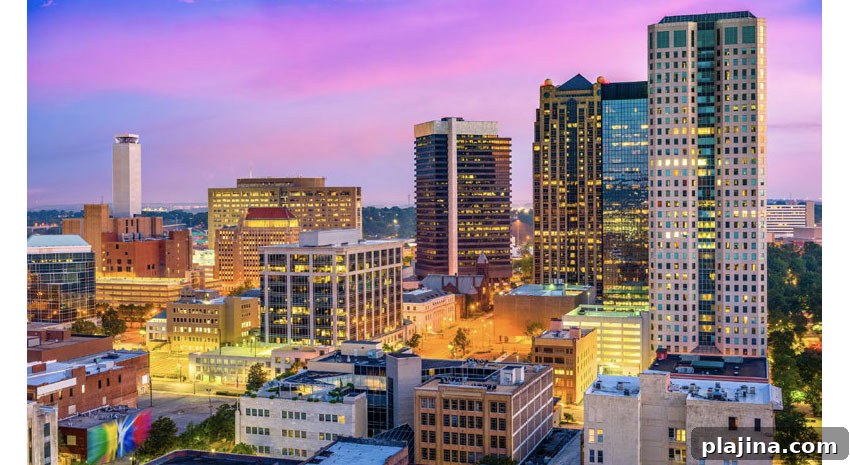
The largest city in Alabama, Birmingham was founded in 1871 where two major railroad lines crossed. In its early decades the city produced so much steel that it earned the nickname “the Pittsburgh of the South,” and it grew so rapidly that locals called it “The Magic City.” After the decline of heavy industry, health care and finance emerged as leading sectors. Today Birmingham is cultivating a growing technology scene and aspires to a new identity: the Silicon Valley of the South.
“Tech has always been a part of Birmingham,” says Jon Nugent, vice president of innovation and technology for the Birmingham Business Alliance. “When Birmingham was a steel city, steel was technology.”
Health care naturally spurs innovation, Nugent notes, and since the 1980s—and particularly in the past decade—Birmingham has seen a meaningful rise in advanced businesses. Much of this momentum traces back to the University of Alabama at Birmingham (UAB), a Tier One research university that draws talented undergraduates, graduate students, faculty and researchers. Many who arrive for education stay to work, launch companies, or both.
One example is Weida Tan. A former exchange student from China who returned to UAB for undergraduate and graduate studies, Tan pursued a Ph.D. in computer science and founded Fledging to address needs in the computer peripherals market. He credits UAB, the Birmingham Business Alliance and local support networks for making the venture possible.
XpertDox offers a similar origin. Developed by UAB medical doctors, XpertDox helps patients locate specialists for specific conditions. The founders chose Birmingham because the university community and local ecosystem provided the attention and resources they needed without getting lost in a larger city.
Mixtroz, a social networking app that helps meeting planners manage large events, moved from Nashville to Birmingham. Cofounder Ashlee Ammons described at Birmingham Innovation Week how the company achieved in 13 weeks the progress that took a year and a half in their previous city—largely thanks to local support.
Birmingham’s entrepreneurial scene isn’t limited to tech. Many startups focus on craftsmanship, food and design. Alabama Sawyer crafts modern furniture from reclaimed wood sourced from the city’s fallen trees, while Big Spoon Creamery produces small-batch artisan ice cream—both operating from MAKEbhm, a makerspace in Avondale.
A central pillar of Birmingham’s startup ecosystem is the Innovation Depot. Housed in a renovated former Sears building in downtown, the Depot is one of the nation’s leading business incubators and hosts more than 100 member companies. According to the Innovation Depot’s recent economic impact report, its member companies have generated $1.66 billion in economic output and created over 1,000 jobs in the last five years.
“Birmingham today is a more exciting version of Silicon Valley because there are more companies here with different focuses,” Nugent says.
He points to several competitive advantages. Birmingham is affordable—the cost of living is about 90 percent of the national average—making it attractive for entrepreneurs and startups. The city is vibrant, with a growing population of young, highly educated professionals. It also offers a strong quality of life, with cultural institutions like the Birmingham Civil Rights Institute and the Barber Vintage Motorsports Museum, which houses a vast motorcycle collection. For outdoor enthusiasts, nearby hiking and mountain biking opportunities are easy to access.

Dolester Miles holding her famous coconut pecan cake © CARY NORTON
Birmingham has also become a destination for food lovers. Highlands Bar & Grill won the 2018 James Beard Award for Outstanding Restaurant, and its pastry chef, Dolester Miles, took the 2018 James Beard Award for Outstanding Pastry Chef. Downtown storefronts have been repurposed into restaurants, and older department stores and office buildings have been converted into lofts, contributing to a lively urban fabric.
Nugent expects that many of today’s tech firms and startups will play an increasingly important role in Birmingham’s economy over the next decade, similar to how Shipt—a home delivery service—has influenced the local landscape. Shipt was acquired by Target for $550 million with the stipulation that it remain headquartered in Birmingham. If other startups follow that path, the city’s reputation as a southern tech hub will continue to strengthen.
SCENIC DRIVES
Nestled in the foothills of the Appalachian Mountains, Birmingham is surrounded by picturesque landscapes. The Talladega Scenic Drive, about an hour east on SR 281, winds 26 miles through Talladega National Forest and includes Cheaha Mountain, the highest point in Alabama. The one-hour route is a pleasant drive—consider visiting Cheaha State Park while you’re there.
The Selma to Montgomery March Byway traces important civil rights landmarks, including First Baptist Church and Brown Chapel in Selma, and follows the route of Dr. Martin Luther King Jr. and marchers to the Edmund Pettus Bridge. The byway continues to Montgomery, where King later delivered his “How Long, Not Long” speech. This 54-mile drive pairs meaningful history with rolling Alabama countryside.
For a longer day trip, take US 20 east toward Atlanta. The roughly 2.5-hour drive passes Logan Martin Lake, skirts Talladega National Forest near Cheaha Mountain, and goes by Sweetwater Creek State Park before reaching Atlanta. It’s an easy route for a day excursion and allows a return to Birmingham by evening.