
In a city renowned for soaring Gothic churches, grand Baroque palaces and formidable 19th-century stone buildings, can a visitor with just one day discover minimalism in Vienna?
In Austria’s elegant capital — where even the pastries are intricately layered with whipped cream, powdered sugar and marzipan — you can indeed find architectural sites that reflect Le Corbusier’s maxim, “less is more.”
Begin your day with breakfast at the Scottish Abbey (tel 43 1 534 98 900), a former 12th-century Benedictine monastery transformed into a calm, affordable hotel. The large rooms feature simple built-in wood furniture, and the buffet breakfast offers cold cuts, cheeses, homemade bread and jams, muesli and fresh fruit. The Abbey’s gentle bells and peaceful courtyard garden create a soothing retreat in the heart of the city.
After breakfast, stroll to the Haas-Haus at Stephansplatz, a mixed-use glass, concrete and marble building designed by Austrian architect and Pritzker Prize laureate Hans Hollein. Completed in 1990, the Haas-Haus sparked debate because it sits directly opposite St. Stephen’s Cathedral, Vienna’s iconic 14th-century Romanesque and Gothic landmark. The modern façade reflects the cathedral, creating a delicate visual dialogue between old and new. Inside Haas-Haus you’ll find a hotel, a restaurant and office spaces, and the building’s juxtaposition with the medieval cathedral highlights Vienna’s architectural diversity.
Nearby, the Austrian Museum of Architecture (tel 43 1 522 3115) showcases permanent and rotating exhibitions that trace Vienna’s postmodern architecture. The museum highlights other notable and controversial projects, such as the 2004 T-Center, a sprawling “horizontal” office complex in the Sankt Marx district, and the 2005 Zaha Hadid housing complex at Spittelauer Lände — a striking, multi-angled white concrete structure elevated on stilts beside the Danube Canal. Zaha Hadid, the Iraqi-born British architect, remains the only woman to win the prestigious Pritzker Prize.
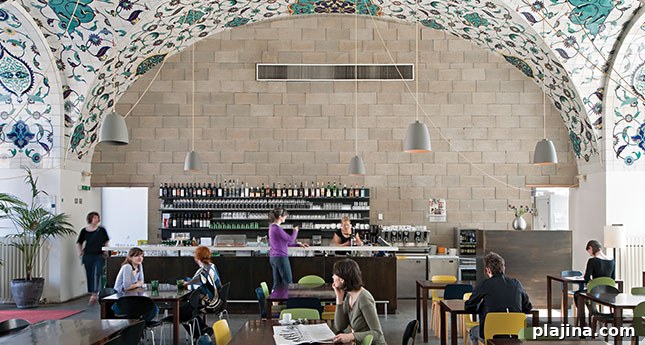
Before you leave the museum, have lunch at the Café-Restaurant MILO, designed by French architects Anne Lacaton and Jean-Philippe Vassal. The café features a vaulted ceiling clad in Asian-inspired tiles and large floor-to-ceiling arched windows that bathe the minimalist dining space in natural light.
One of Vienna’s most intriguing transformations lies in the Simmering district, a short subway ride from the center on the A3 line. Four enormous late-19th-century gas storage tanks were repurposed into mixed-use towers featuring apartments on the upper levels, offices in the middle and shops and entertainment at street level. Known as the Gasometers, these red-brick cylinders were redeveloped in the late 1990s by several prominent architects, including Jean Nouvel and the Viennese firm Coop Himmelb(l)au. Standing about 230 feet tall with their original brick exteriors preserved, the Gasometers now form a surreal postmodern enclave, home to roughly 1,600 residents living in 500 apartments within the historic shells.
Return to central Vienna for the afternoon and visit the Museum Moderner Kunst Stiftung Ludwig Wien (MUMOK) at Museumsplatz 1 (tel 43 1 525 00). Housed in a striking cubist, monolithic building clad in basalt lava, MUMOK presents a broad range of art from Classical Modernism and Nouveau Réalisme to Fluxus, Pop Art and Viennese Actionism. The museum’s bold exterior and its collection of modern and contemporary works offer a compelling counterpoint to the city’s historic architecture.
With careful planning, a single day in Vienna can reveal a quieter, restrained side of the city — where modern lines, thoughtful materials and restrained interiors sit comfortably alongside centuries of ornate history.