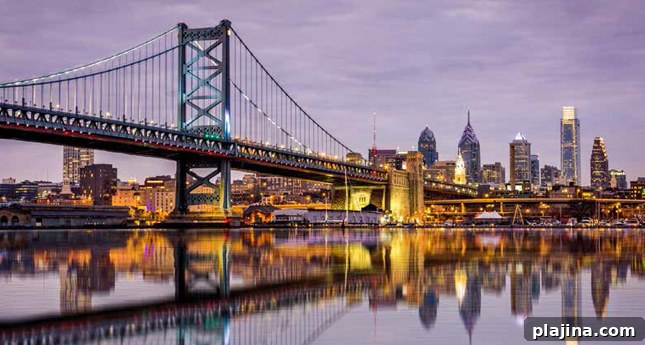
Some say Philadelphia is hotter than ever. After hosting Pope Francis last September and earning a UNESCO World Heritage City designation in fall 2015, the city is again in the spotlight this summer as it welcomes presidential hopefuls and supporters to the 2016 Democratic National Convention, July 25–28. The convention’s tagline, “Let’s Make History Again,” fits the City of Brotherly Love, and planners have added a historic twist: Politicalfest will run daily July 22–27 from 10 a.m. to 9 p.m., occupying 125,000 square feet of nonpartisan exhibits that explore the history of government, the road to the White House and more.
Philadelphia’s tourism marketing has leaned into its historic character. Although many visitors don’t spend much time in the historic district, Visit Philadelphia received two $1 million grants from H.F. Lenfest and the State Department of Community Economic Development to change that. The initiative highlights the historic district — from the Delaware River to Seventh Street and Vine to Lombard streets — with enhanced programming, a Historic Philadelphia Pass and the Once Upon a Nation storytelling program, all designed to draw more attention to the city’s rich past.
Airport developments have also raised Philadelphia’s profile. Qatar Airways began service to Philadelphia International Airport in 2014 and in January 2016 placed Philly among the first U.S. cities to receive the Airbus A350. New PHL CEO Rochelle Cameron has outlined priorities aimed at improving the passenger experience, renovating existing terminals and moving forward on the airport expansion plan first proposed in 2012, with projected costs between $6.4 and $10.5 billion. Planned improvements include lengthening two runways, consolidating rental car facilities into a single building and designing an automated people-mover to connect terminals. Today, more than 30 million passengers pass through PHL each year, with roughly 550 daily departures to 128 global destinations.
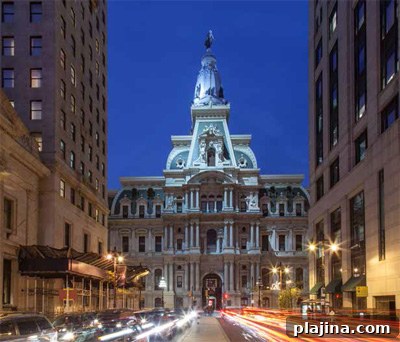
Philadelphia City Hall © PAUL BRADY | DREAMSTIME.COM
Philadelphia supports one of the nation’s largest workforces and is home to more than 25 Fortune 1,000 companies. The city’s East Coast location, short commute times compared with other large metros and relatively low Class A office and industrial rental rates make it attractive for business. More than 40 percent of the U.S. population is reachable within a one-day drive of Philadelphia, a significant advantage for regional operations.
By employment, education and health services dominate the local economy at nearly 30 percent, and the region is positioned for continued growth in health care innovation — more than 2,000 medical technology companies operate in the Greater Philadelphia area. Major employers include American Airlines, Citizens Bank, Comcast, Temple University, Vanguard, GSK, Independence, Wells Fargo and UPS. The metro area also remains a center for higher education, with over 100 degree-granting institutions and around 500,000 full- and part-time students. Greater Philadelphia ranks above the national average for residents with a bachelor’s degree or higher.
Future-focused development includes the Schuylkill Yards project, a $3.5 billion, 14-acre innovation district developed by Drexel University and Brandywine Realty Trust. Promoted as the city’s most ambitious project since the 1950s, Schuylkill Yards aims to create a mixed community of startups, established companies, researchers, artists and residents, with plans to address displacement and other challenges associated with rapid development. With a blend of deep historical roots and forward-looking investment, Philadelphia continues to shape its own path.
SCENIC DRIVES
For a classic view of Philadelphia, drive through Fairmount Park — one of the largest urban parks in the United States — along Kelly and Lincoln Drives. Kelly Drive follows the Schuylkill River, where you’ll see rowers on the water and runners along the shore, and the route leads to the picturesque Chestnut Hill neighborhood. About 40 miles from the city, New Hope, Pennsylvania, offers a charming riverside escape; the drive along the Delaware River passes through country roads, farmland and several towns worth stopping in. On summer weekends, Philadelphians often head “down the shore” to New Jersey beaches; the trip takes roughly 90 minutes and can be made on expressways or via more scenic back roads through southern New Jersey.