
Rain fell in sheets, turning the surrounding rainforest an intense, almost surreal green. Water streamed off the tropical foliage and hammered the bus as it drove from Phuket’s southern beaches toward Elephant Hills, a jungle camp on the edge of Khao Sok National Park.
When the bus pulled up to Elephant Hills’ main lodge it was still raining. The lodge is a large wooden building with high open beams and some open sides. I checked in at the bar and sipped a welcome drink of refreshing tropical fruit juices while a guide gave new arrivals an orientation to the camp.
She introduced herself as Pooh — “easy to remember, like Pooh Bear” — and described the programs and the camp’s guiding philosophy. Elephant Hills positions itself as more than a place for a memorable vacation: it strives to help the endangered Asian elephant survive in the 21st century. Since logging is no longer legal, many mahouts and their elephants have lost traditional livelihoods. By creating tourism jobs that support both the animals and their handlers, the camp aims to provide sustainable income and reduce harmful alternatives.
Elephant Hills also emphasizes environmental responsibility and community support. The lodge employs local people, buys food and supplies from nearby vendors, and sponsors a children’s project that assists area schools. Waste is recycled whenever possible; elephant dung is used as fertilizer; rice and vegetables are grown onsite for guest meals; and guided hikes are kept to established trails to minimize impact on the rainforest.
After the briefing Pooh grabbed a giant umbrella and led me along a path to my tent.
My expectation of a tent did not match what I found. Each unit sits on a concrete slab beneath a tin roof. The “walls” and windows are mesh rather than solid, and the entrance zips closed, but otherwise the structures feel more like cozy cottages. They have electricity, a full bathroom with hot water, and even WiFi — camping by my definition. Tents are spaced well apart, giving each guest a private feel.
By mid-afternoon the heavy rain had eased into a fine mist. Though reluctant to leave my comfortable shelter, I headed to the elephants. A short five-minute ride in an open-air Jeep took me to the elephant camp.
We found six of the camp’s 16 elephants and their mahouts assembled to greet us. With machetes we cut melons, cucumbers, pineapples and other fruits and vegetables to feed the animals. We also wrapped a mixture of sweet tamarind, coarse sea salt and husked rice in banana leaves — an elephant-friendly remedy that helps with digestion. Considering elephants can eat up to 500 pounds of vegetation a day, digestive aids are necessary. Guests offered food, which the elephants deftly grabbed with their trunks and curled into their mouths.
Bath time followed. Elephants enjoy baths and need them to keep skin clean and free of parasites. Bathing an elephant is like washing a very large, slow-moving vehicle: you can lather and hose the parts within reach, then the elephant and mahout move to a muddy pond to finish the job.
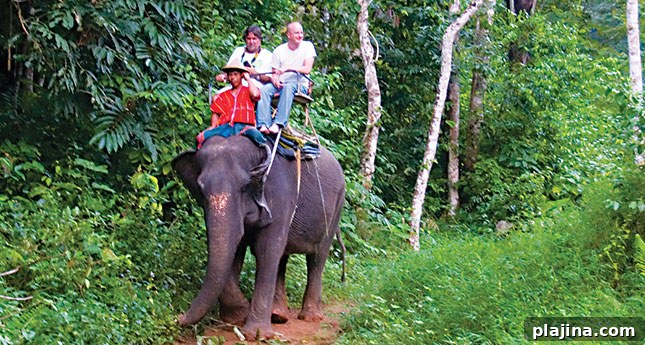
I accepted an offer to ride an elephant back from the bathing pond with a mahout. Although the animal sat to allow me on, I still needed help swinging into place; Pooh provided a forceful push that got me onto the broad back. Riding is easier than mounting — elephants walk with a gentle sway, and from their backs you gain almost a bird’s-eye view of the rainforest, which feels surprisingly comfortable and stable.
Back at the lodge it was cocktail hour. I took a seat at the Jungle Bar, ordered the Elephant Hills version of a mai tai, and watched a short video about elephants with other guests. Dinner was a buffet of Thai and Western dishes served family-style at long tables, which made it easy to chat and mingle. The camp draws an international mix of visitors: I shared a table with a young couple from Germany, two Australian sisters and their teenage daughters, and a retired couple from Washington, D.C.
That night, snug in my bed and protected from insects by the mesh windows, I listened to the rainforest’s nighttime chorus. The unfamiliar sounds were calming, and before long morning arrived. I boiled water in the electric kettle, made instant coffee, and sat on my patio to listen as the jungle woke up.
After a hearty buffet breakfast, a group of us set out for Cheow Larn Lake, swimsuits and towels in hand. The lake stretches more than 35 miles north to south and is framed by limestone mountains and towering cliffs. We skimmed across the water in an open boat, taking in spectacular scenery on the way to Phootawn Raft House for lunch.
Raft houses there are clusters of bamboo huts buoyed by plastic drums and fronted by floating docks. Lodgings are simple, but the setting is stunning, the food filling, and the beer cold. After a basic Thai lunch and a swim, we returned to camp for another elephant ride through the rainforest.
For this outing a raised platform made boarding easy: we climbed aboard bench seats secured to the elephants’ backs and set off. Elephants are ideal rainforest transport because the thick tissue pads on their feet spread with each step, allowing them to move through muddy terrain without becoming stuck. Most elephants strode through the dense foliage with purpose, but one preferred to treat every tree and shrub as an all-you-can-eat buffet. Even the mahout found it hard to hurry him along.
That evening the lodge offered a Thai cooking class, but I chose to relax with a beer on my patio and listen to the jungle. It was my last night in that comfortable tent, and I wanted to savor the sounds and the peaceful setting.
Before returning to Phuket the next morning, I took a final excursion: rafting on the Sok River. Each two-person raft had its own guide, so I could focus on taking photos and enjoying the sunshine. Our guide had an uncanny knack for steering close to riverbanks to point out snakes and tree frogs hidden in the foliage. While I tried to get good shots of these creatures, my rafting companion was less enthusiastic about close encounters with snakes perched in trees.
On the ride back to Phuket I reflected on how places like Elephant Hills provide a hopeful model for protecting Thai elephants: combining conservation, responsible tourism and community support. I also thought about how much I would miss my comfy, jungle-side “tent.”
INFO TO GO
Major airlines fly from the United States to Phuket International Airport (HKT) with one or more stops. Elephant Hills offers pickup from hotels in Phuket, Krabi and Surat Thani. Two- to four-day packages range from $235 to $575 per person, double occupancy.