
When I mention Canada’s Eastern Townships to friends, reactions vary from a puzzled raised eyebrow to an envious smile. Montréalers know this lake-dappled region well — it lies east of the city and north of New Hampshire and Vermont — but many others have yet to discover its charms.
Québec blends French and English cultures with American, Abenaki and Celtic influences, all spoken with a distinct Québécois accent. Loyalists settled here after the Revolutionary War; Americans came for summer retreats after the Civil War; Irish fleeing famine and Scots seeking opportunity arrived early on. History colors the region, but my husband and I return for other reasons: to unwind in a place that soothes the spirit, delights the palate, stimulates the mind and captures the heart.
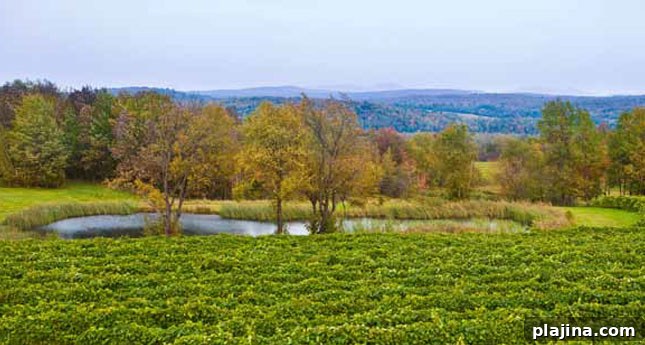
That may sound grand for a relatively small area, yet each visit rekindles our affection for the region’s foods, wines, ice ciders, intimate inns, cozy auberges, Nordic spas and cycling trails. Above all, we love the landscape: intimate in spots and expansive in others, a patchwork of lakes and mountains, farms and forests, vineyards and orchards, heritage villages and market towns. Threading it all together are winding back roads meant for lingering rather than rushing.
Three marked driving routes — the Wine Route, the Townships Trail and the Summit Trail — weave through the countryside. In addition, extensive marked cycling routes, many on paved trails, and local maps highlighting agricultural producers make exploring easy. We use these routes as guides but often detour down quiet lanes, tempted by a farmstead cheese, a chocolate shop, an art gallery or a church steeple peeking above the trees.
Steeples punctuate the skyline, a testament to civic pride and faith that inspired many small villages to build striking churches. A notable exception to the traditional steeple is the architecturally modern Saint-Benoît-du-Lac abbey, founded by French Benedictine monks in 1912 on the shores of Lake Memphrémagog. The abbey delights the senses: we arrived during a Gregorian chant service, an experience that transcended religious boundaries. Afterwards we stocked up on the monks’ cheeses and apple specialties for a lakeside picnic.
Lake Memphrémagog, a 27-mile waterway that straddles Québec and Vermont, offers splendid views of the abbey. Though 80 percent of the lake lies in Canada, most of its inflow comes from U.S. tributaries. The lake even has its share of lore — during Prohibition, smuggling routes ran northward across its waters. We took in the scenery aboard the Grand Cru, an elegant dining cruise operated by Escapades Memphrémagog, pausing on deck between courses to admire shoreline estates, the abbey and distant Owls Head Mountain carved with ski trails.
Borders and buildings blur here: the Haskell Free Library & Opera House sits astride Stanstead, Québec, and Derby Line, Vermont. A line painted on the library floor marks the international divide. Inside, a librarian warned us to exit the same door we entered or risk a border patrol encounter. The library’s stacks are in Canada and the theater’s stage is across the line, a quirky reminder of the region’s cross-border links and a favorite amusing anecdote among locals.
North Hatley, perched at the northern tip of Lake Massawippi, is tiny but enchanting. We debated dining lakeside but instead assembled a light picnic from local markets to save room for dinner at Manoir Hovey, an acclaimed Relais & Châteaux inn with an outstanding dining room on the shore.
Beyond the lakes, rolling hills and broad farms define areas around Compton and Coaticook, often called Québec’s Dairy Bowl. A dramatic contrast to the farmland is the 164-foot-deep Coaticook Gorge spanned by a 550-foot suspension bridge. At Laiterie de Coaticook we sampled maple ice cream that seemed unrivaled, and bought squeaky cheese curds to nibble later. Fromagerie La Station in Compton produces celebrated cheeses such as Alfred Le Fermier, and many local chefs source vegetables and herbs from nearby gardens — the region’s flavor is terroir-driven, literal and delicious.
Magog offers lakeside promenades, paved cycling paths and wide parklands, but just a short walk from downtown you’ll find Le Marais de la Rivière aux Cerises, a peaceful wetland with boardwalks and trails. Birdsong and the soft chorus of frogs accompany gentle strolls through this four-mile network of paths.
Wine, chocolate and farm products are abundant. The 100-mile Wine Route south of Bromont includes 22 wineries producing distinctive regional specialties. At Domaine Les Brome, the hillside views complement tastings of ice wine and maple products. Domaine Pinnacle, near Frelighsburg, is known for a refined ice cider pressed from apples harvested after the first frost. Vignoble Domaine Brésee in Sutton has gained attention for a white wine made from red grapes, an involved process that yields a unique result. We once reserved a vineyard picnic — bread, cheeses, pâtés and sweets — and enjoyed it beside a reflective pond.
The Granby Zoo is one of Canada’s accredited institutions, notable for animal care and education. While a day at the zoo is easy to fill — longer if you include the waterpark — consider the Night at the Zoo program for a memorable alternative. Up to 30 guests can stay in a simple hut in the African pavilion after closing, enjoy an outdoor multicourse African meal, a guided night safari, traditional music and campfire snacks, then wake for a morning visit with the elephants and a light breakfast. Note that some specialized programs are primarily in French, so plan accordingly.
For relaxation the region excels. Our favorite retreat is Balnea, a Nordic spa set within the private Bromont-sur-le-lac Nature Reserve. Nordic spas emphasize cycles of hot and cold followed by rest; Balnea delivers with Finnish saunas, steam baths, cold plunge pools, waterfall showers, hot tubs, a forest pool and lake access. Lounges, dockside chairs, a café for wine and light bites, quiet relaxation rooms and even a small cinema round out the offerings. Add a massage and the temptation to stay forever grows strong.
Info To Go
Montréal–Pierre Elliott Trudeau International Airport (YUL) lies roughly 60 miles from Granby, 77 miles from Sutton, 86 miles from Magog and 95 miles from North Hatley. Renting a car is the most practical way to explore the Eastern Townships.
Lodging
Auberge Ripplecove & Spa
Located on the southern shore of Lake Massawippi, this elegant hotel features lakefront rooms, a full-service spa and an excellent dining room. 700 Ripplecove, Ayer’s Cliff. $$–$$$$
Manoir Hovey
Once a 1900 summer home, this magnificent lakefront inn is an ideal place to relax in refined comfort. 575 Rue Hovey, North Hatley. $$$–$$$$
St-Christophe Boutique Hotel & Spa
With French château–inspired architecture, lakeside location and spa facilities, this boutique hotel offers a sophisticated stay. 255 Rue Denison E., Granby. $$$
Dining
Auberge des Appalaches
Don’t judge by the rustic exterior — the kitchen’s inventive use of local ingredients by chef/co-owner John Kostiuk earns acclaim. 234 Chemin Maple, Sutton. $$–$$$
Le Bocage
Chef/owner François Dubois draws from the expansive gardens surrounding the dining room to create seasonal, garden-forward dishes. 200 Moe’s River Road, Compton. $$–$$$$
Manoir Hovey
The dining room emphasizes local ingredients, an award-winning wine list and a cheese cart featuring regional raw-milk cheeses. Proper dress is requested. 575 Rue Hovey, North Hatley. $$$–$$$$