
Because I lack the gymnastic agility to climb to the top of the camel, the top of the camel must come to me. The Tunisian herdsman utters a guttural command, and the huge animal reluctantly lowers itself to a kneeling position, fixing me with a look that borders on disdain.
I clamber onto the wooden-framed saddle balanced on the peak of the hump. The herdsman calls again and the camel slowly leverages itself up. The saddle lurches forward, then backward, then side to side. I cling tight.
We leave the cooling shade of a date palm grove and strike out across the sun-blasted dunes of the Sahara. From a distance my shadow, grafted to the camel’s, drifts smoothly across waves of sand. Up close the reality is far more turbulent. With every stride I pitch and yaw; the height makes me uneasy, so I avoid looking down and fix my gaze on the undulating horizon.
This is a half-day excursion at walking pace, a dozen camels bearing tourists to the ruins of a distant Roman fort. After a while my muscles ache from the effort of holding myself steady. Were the camel to increase its speed even slightly, I would almost certainly topple. When one of my companions suggests a race, we all laugh nervously.
That laughter brings back a memory from the previous year in Saudi Arabia. While driving across the desert, my vehicle was suddenly flanked by galloping camels ridden by young boys. The camels belonged to a member of the Saudi royal family; the boys waved and smiled as they charged across the sandy plain. Behind the carefree image lay one of the darker realities of the modern age.
The boys were barely six or seven, imported from Pakistan and housed in bleak barracks. They worked in conditions little better than slavery, risking severe injury or worse every day for the sake of a sport prized by wealthy sheikhs: camel racing.
Camel racing has a long tradition, born of Bedouin life and the role camels played in travel and conflict. As the pastime formalized—racetracks were built across the region—owners sought any advantage, including reducing a jockey’s weight to the minimum. Adults were often replaced by children, and healthy meals by starvation rations.
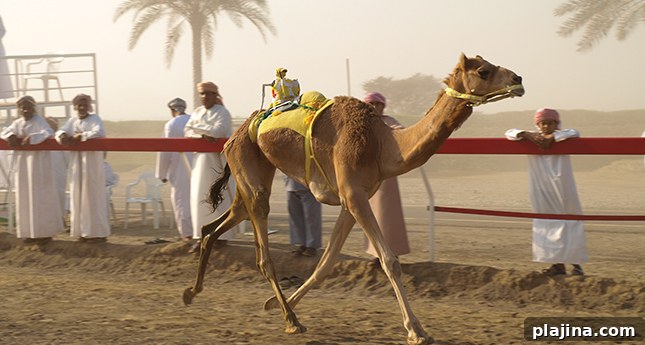
After a high-profile campaign led by UNICEF and others, the use of child jockeys was officially outlawed in 2005. Mechanical, remote-controlled robots were introduced and are now strapped to the camels’ humps. The change addressed an urgent human-rights issue but also deepened the oddity of the spectacle: there is something fundamentally absurd about camels racing at high speed while hundreds of spectators follow in SUVs, horns blaring and dust trailing.
In the Middle East, a typical camel race can cover up to six miles. Betting is not permitted and owners primarily compete for prestige. A very different variation of the sport has developed in the Australian Outback, where races tend to be rowdier, with widespread gambling and drinking, and where jockeys are frequently women.
Back at camp in Tunisia, I am relieved to set my feet on solid ground. Foolishly, I reach out to thank my camel with a pat on its neck. It reacts by scrambling to its feet and careening toward the dunes, chased by three shouting herdsmen. From the shade I watch the animal move—long-legged and strangely elegant as it flees its pursuers. In spite of everything, its gait makes clear that this is an animal born to run.