
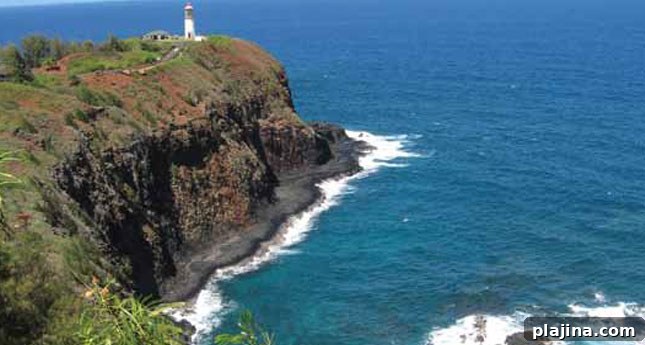
By air, by land and by sea — these were my ways of discovering Kauai’s many wonders. With dramatic mountain cliffs rising from the ocean floor along the Nā Pali Coast, the 14-mile Waimea Canyon (often called the “Grand Canyon of the Pacific”), and verdant landscapes everywhere you look, Kauai reveals a new facet at every turn.
As the oldest of the eight main Hawaiian islands, Kauai’s geological youth on one side is only about 1.5 million years old, yet its history as the first inhabited island gives it a deep cultural presence. Roughly 65,000 people call Kauai home full time, and at any moment tourists can make up about a quarter of that number. Compact and easy to explore, the island stretches about 25 miles north to south and more than 30 miles east to west.
Hurricane Iniki in 1992 reshaped both the island’s landscape and its communities, leaving many without power, cable or water for months and leveling a large portion of housing. Today, Kauai’s natural beauty and resilient spirit have come back strong; each visit yields fresh discoveries.
Weather changes quickly here. The island is notable for dramatic climatic contrasts: the central highlands rank among the wettest places on Earth, while some coastal areas are surprisingly dry. Trade winds and abundant rainfall shape the environment and the plant life. Visiting in July means vivid floral colors and fragrant air, while the north shore is influenced regularly by steady trade winds and significant yearly rainfall.
Over five days, I encountered just one overcast day and filled the rest with contrasting experiences — heart-pounding adventure alongside restorative relaxation. Ziplining above canopies, savoring spa therapies, and enjoying the relaxed pace of life all felt natural in a place where structures don’t rise above mature coconut trees, billboards are absent, and drivers often rely on aloha rather than horns. Whether you’re after adventure, romance, renewal or cultural immersion, Kauai delivers without feeling clichéd.
My exploration began on the North Shore, where rugged mountains give way to broad valleys and the calm waters of Hanalei Bay — a setting recently featured in the film The Descendants.
On Hanalei’s placid water I boarded the 45-foot traditional Hawaiian sailing canoe Kuupaaloa, built and skippered by native Hawaiians. A gentle afternoon sail across a nearly glass-like bay was the ideal prelude to a late-afternoon massage and a first impression of the North Shore’s tranquility as the sun started its descent.
The North Shore also includes the upscale Princeville community, once a coffee and sugarcane plantation and later a cattle ranch. Today Princeville features two resorts, a golf course, homes, shops and restaurants that overlook the peaceful expanse of Hanalei Bay.
From a working cattle farm in Princeville, the Carswell family has run eco-adventures since 1978. Princeville Ranch Adventures offers ziplining, horseback riding and hiking. I hiked to the five-tiered Kalihiwai Falls, ascending Pu’u O’ Henui to drink in sweeping views of the North Shore before trekking through lowland rainforest to reach the upper falls. The sound of cascading water blended with the rainforest chorus.
Despite my reservations about rappelling, I descended a short rock wall to reach the bottom of the falls and back up again without incident. The reward was a brilliant teal-green pool tucked beneath the waterfall — a private, bath-like basin where I ate lunch with my toes in the water, relishing a rare moment of pure connection with the land.
After time on the North Shore I shifted to the South Shore, home to six distinctive beaches: Baby Beach, a sheltered cove; Brennecke’s, popular for body surfing; Mahaulepu, a remote two-mile stretch; Lawai, known for snorkeling; Poipu, one of the nation’s top beaches and a favorite for visitors; and Shipwrecks, where advanced surfers go for strong waves. South Kauai brings golden sands, reef features and some of the island’s best snorkeling and watersports.
Yet I couldn’t stay onshore for long. I took to the sea to experience the Nā Pali Coast, a breathtaking 15-mile stretch of rugged coastline on the northwest side of the island. Accessible only by air, boat or foot, the Nā Pali’s soaring cliffs and emerald waters evoke awe. Early Polynesian settlers lived along these cliffs, leaving behind traces of gardens, irrigation systems and cultural sites.
To savor the coast from the water, I boarded a 60-foot catamaran for a half-day cruise. Strong winds can make sea conditions challenging, but the trip brought powerful scenery, playful spinner dolphins and sea turtles that accompanied us and surfaced alongside our snorkeling spot. Even the choppier return trip could not dim the dramatic vistas.
Back on land, I experienced traditional Hawaiian cuisine and performance at a luau held on a plantation estate. The evening showcased an imu-cooked pig unearthed from an underground oven, along with poi, ono and other native dishes. Hula and fire-knife dancing, plus a dramatic retelling of the first Hawaiians’ voyage from Tahiti, celebrated the island’s history and communal spirit.
The story performed at the luau tells of a father who prayed for guidance before leaving Tahiti to seek a new home. He planted taro, prepared bark cloth, fished and brought new life to the land. When he later called for his daughter to join him, the family reunited, and the celebration of land, love and cultural continuity followed — an emblem of Kauai’s human and natural legacy.
Of all ways to experience Kauai, flying by helicopter revealed the island most vividly to me. A brief helicopter tour gave perspectives that a road trip or boat outing could not: sweeping views into Waimea Canyon and close passes along the rivulets and ridgelines of the Nā Pali Coast brought the topography into sharp, unforgettable focus.
Landing near Manawaiopuna Falls, the famous cinematic waterfall seen in Jurassic Park, was a surreal highlight. The waterfall appeared suddenly as we circled, and stepping down near its base delivered a cinematic sense of scale and wilderness — an experience few other tours can offer.
Flying provided a privileged vantage point that tied together the island’s varied landscapes. Floating above canyons, cliffs and coastlines made clear how dynamic and layered Kauai truly is. Those moments of quiet awe, suspended between sea and summit, felt impossible to capture fully in words.
For anyone planning a visit: Kauai is best discovered from multiple perspectives — by land, sea and air — to appreciate its full range of natural beauty and cultural richness.
INFO TO GO
Many airlines provide nonstop service to Lihue Airport (LIH) from mainland cities; you can also connect through Honolulu (HNL). Taxi service and hotel shuttles serve the airport, and renting a car is the most flexible way to explore the island independently.
Lodging
Grand Hyatt Kauai Resort and Spa
A large resort offering multiple restaurants, pools, beach activities and an 18-hole golf course. 1571 Poipu Road, Koloa $$$
The St. Regis Princeville Resort
Located on the North Shore within the Princeville community, this resort features golf, dining, spa services and sweeping views of Hanalei Bay. 5520 Ka Haku Road, Princeville $$$$
Sheraton Kauai Resort
Recently renovated, this resort on Poipu Beach offers dining and beachfront access. 2440 Hoonani Road, Koloa $$$
Dining
Merriman’s Fish House
Set on a former plantation, the restaurant highlights Hawaiian regional cuisine with a farm-to-table ethos. 2829 Ala Kalamikaumaka St., No. G-149, Koloa $$$
Red Salt
Oceanfront dining with a menu focused on fresh seafood and island produce. Koa Kea Hotel & Resort, 2251 Poipu Road, Koloa $$$
Wahooo Seafood Grill & Bar
Signature seafood dishes feature local flavors and creative preparations in a relaxed setting. 4-733 Kuhio Highway, Kapaa $$$