
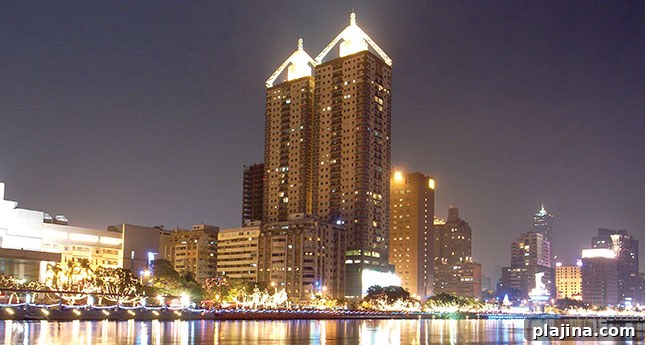
Asked to name an Asian city that ranks among the world’s busiest container ports, is the second-largest city on its island, and hosted the 2009 World Games, many Americans come up blank. Kaohsiung, Taiwan, is a thriving center for shipping, fishing, manufacturing, refining, shipbuilding, technology and other light and heavy industries, yet it retains a relatively low—if growing—international profile.
Protected by the natural breakwater of Cijin Island, Kaohsiung’s seven-mile harbor sits on Taiwan’s southwest coast, about 1,250 miles east of mainland China and roughly 90 miles south of the capital, Taipei. With a metropolitan population of around one and a half million, Kaohsiung (pronounced roughly GOW-SHUNG) is often called Taiwan’s harbor capital. Ferries, freighters, naval vessels and fishing boats crowd the city’s many docks, reflecting its long maritime heritage.
Until recent growth among mainland ports shifted rankings, Kaohsiung was among the world’s top container facilities; as late as 2007 it ranked sixth globally. Its strategic importance dates to the 16th century, when Dutch colonists established Fort Zeelandia at a Ming settlement and opened the area as a trading center for bananas, citrus fruits, fish, peanuts, pineapples, rice and sugar produced on southern Taiwan’s coastal plain. After periods of local and Chinese rule, the Japanese occupied the island from 1895 to 1945 and expanded Takao (the city’s former name) into a strategic base for imperial operations, developing the port and related industries.
After World War II the city returned to Chinese administration. Despite heavy wartime damage, the port was rebuilt and Kaohsiung quickly grew into one of the Republic of China’s major commercial centers. Foreign investment helped the city process local raw materials for export, and industries such as petroleum and sugar refining, fertilizer production, brick and tile manufacturing, steelmaking, shipbuilding, aluminum processing and petrochemicals grew along the waterfront in places like the Linhai Industrial Park. However, rapid industrial expansion brought environmental degradation and urban sprawl.
Starting in the late 1990s, Mayor Frank Hsieh (who later became Taiwan’s premier) led an urban renewal effort guided by the principle of creating an “ecological city.” With coordinated planning, the city overhauled port operations, reclaimed neighborhoods, improved water quality and introduced a rapid transit system. Those changes helped transform Kaohsiung from an industrial sprawl into a more livable modern metropolis.
Opened in 2008, the Kaohsiung Rapid Transit system (KRT) has reduced traffic congestion and connects commuters through spacious, art-filled stations. The Formosa Boulevard station features the massive, colorful Dome of Light mosaic mural, a prominent public artwork. A light rail line encircling the city center has also been approved and is planned for construction.
Perhaps the most visible symbol of the city’s rebirth is the revitalized Love River. Once so polluted that pedestrians avoided its banks, the river has been cleaned and transformed into an urban centerpiece. Today its tree-lined promenade features lawns, bookstores, museums and restaurants, and the river is promoted as a demonstration of citizens’ persistent efforts to improve their environment.
Kaohsiung is also investing to regain shipping prominence by upgrading its harbor and developing free-trade and multifunctional areas. At the same time, city master plans have directed large-scale public investment to shift the economy from traditional canning and heavy manufacturing toward contemporary industries.
On an island that has become a major producer of IT products—home to companies behind popular laptops, components and smartphones—Kaohsiung has cultivated a pro-business environment that supports a Taiwanese high-tech corridor. Science and industrial parks, improved sea-air links, and facilities for biotechnology, optoelectronics and aircraft manufacturing reflect the city’s diversification.
Beyond technology, filmmaking and tourism are increasingly important. To attract filmmakers—Taiwan is the birthplace of director Ang Lee—the city established a production support center offering grants, subsidies, equipment, professional crews, screening resources and post-production facilities.
Kaohsiung’s mild, mostly sunny climate and cool ocean breezes make it attractive to visitors. The city promotes nearby parks, beaches, malls, temples and historic sites, and hosts frequent festivals celebrating lanterns, dragon boats, the ocean, music, film, container art and sculpture, as well as Chinese New Year. Medical tourism is also growing: modern hospitals with spa-like amenities, cafés and salons offer medical treatments and cosmetic procedures to international visitors.
With high-quality location advantages and a skilled workforce, Kaohsiung is positioning itself to be a global city with greater international recognition.
Diversions
Both banks of the Love River bustle throughout the day, and at night the promenades glow with outdoor cafés and tea stands offering rock and jazz music alongside fruit and yogurt concoctions, green tea, Taiwanese “bubble tea,” cocktails, soft drinks and local beers. Several museums sit close to the river, and 60-minute sightseeing cruises on “love boats” are popular with tourists and locals alike.
Night markets are a cornerstone of Taiwanese urban life; Liouhe Night Market (along Liouhe Second Road to Zihi Road) is a lively spot where rows of vendors sell souvenirs and street foods. Local favorites include seafood congee, papaya milk and candied strawberries on a stick.
Modern architecture worth seeing includes the upscale Dali Galleria, whose curved façade houses luxury boutiques and displays a colorful neon light show after dark, and Toyo Ito’s 2009 World Games Main Stadium, noted for its coiled, flowing roof design and integrated solar panels that reflect Kaohsiung’s growing green awareness.
Info to Go
Kaohsiung International Airport (KHH) lies about 20 minutes from downtown and is easily reached by taxi, scooter or the KRT Red Line. Taipei is roughly 90 minutes away via the Taiwan High Speed Rail. The city’s Public Bike Rental System provides convenient short-term bike rentals at subway stations and popular scenic sites.
Lodging
Ambassador Hotel Kaohsiung
Located on the banks of the Love River, the elegant Ambassador blends comfort with recreation. City bicycles are available for rent nearby. 202 MinShen Second Road, tel 886 7 211 5211
Grand Hi-Lai Hotel
Recognized as a top business hotel in Taiwan, this five-star property offers over 540 guestrooms, multiple international restaurants and extensive meeting and banquet facilities. 266 Cheng-Kung First Road, tel 886 7 216 1766
Splendor Hotel Kaohsiung
Occupying floors 37–70 of the Tuntex Sky Tower, this five-star hotel provides sweeping views from guestrooms and an observation deck high above the city. 1 Tzu-Chiang Third Road, tel 886 7 566 8000
Dining
After 1949, chefs from many regions of mainland China helped shape Taiwan’s diverse culinary scene, making the island a renowned destination for a wide range of Chinese cuisines.
Dongpo Drunken Moon
Offers classical Song Dynasty and Yangtze Valley dishes, including Su Dongpo stew and Drunken Moon rice wine chicken. 491 Mingchen First Road, Sanmin District, tel 886 7 397 9397
Toong Mao Chiang Che Seafood Restaurant
Specializes in Chiang Che cuisine; signature dishes include crispy braised crucian carp served with a tangy sauce of vinegar, rice wine, sugar and soy sauce. 2F, 393 Cisian Second Road, tel 886 7 282 626
Wan-san Restaurant
Famous for the original “hundred-dollar stir-fry,” Wan-san serves affordable, delicious small plates such as pan-fried scallops and steam-braised clams—perfect for sampling a variety of flavors. 126 Jhongjihou Second Road, Cijin District, tel 886 7 571 6073