
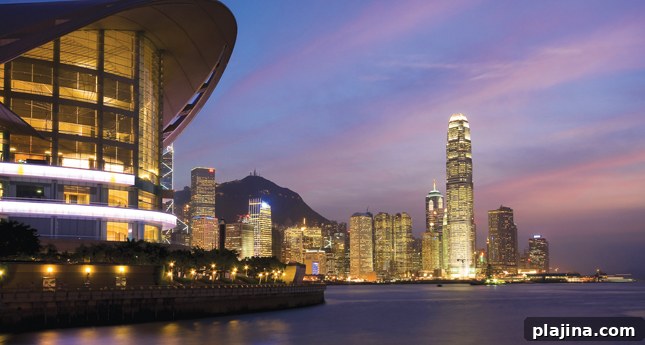
Visiting Hong Kong feels like stepping into a live circuit—vibrant, fast-paced and endlessly stimulating. Comparable in energy to global metropolises like Tokyo, New York and London, Hong Kong pulses with commerce, culture and movement.
Home to about 7 million people within roughly 426 square miles, this subtropical gateway on the South China Sea has evolved from a low-cost manufacturing hub into a major international financial center and a regional base for multinational companies. According to Invest Hong Kong, nearly 6,600 foreign and mainland Chinese firms operate in the city, reflecting its role as a global business crossroads.
Concerns that Hong Kong’s distinct systems would be fully subsumed after the 1997 handover to China have not come to pass. While Beijing handles defense and foreign affairs, the “one country, two systems” framework has largely persisted, allowing Hong Kong significant local autonomy. The city maintains an independent civil service and a judiciary rooted in English common law, and its open-market economy continues to contrast with the mainland’s state-influenced model. Hong Kong’s chief executive is selected by an election committee and approved by China, and the legislature includes members chosen by popular vote.
Culturally and linguistically tied to southeastern China for generations, Hong Kong’s economic links with nearby Shenzhen and Guangzhou (Canton) strengthened after China’s market reforms beginning in 1978. Many Hong Kong manufacturing operations relocated across the border to take advantage of lower costs, contributing to the rise of the Pearl River Delta as a global manufacturing center. Hong Kong plays a crucial role as a major re-exporter of goods and operates one of the world’s busiest deepwater ports. Hong Kong International Airport at Chek Lap Kok has been a key cargo and passenger hub—handling millions of tons of freight and tens of millions of travelers in peak years.
The city’s financial sector remains robust, serving as a gateway for mainland companies seeking international capital through listings on the Hong Kong Stock Exchange, one of the world’s largest. Major local banks such as The Hongkong and Shanghai Banking Corporation and Hang Seng Bank, together with the government’s Exchange Fund, reinforce Hong Kong’s status as a global finance center.
Although the population is overwhelmingly Cantonese-speaking Han Chinese, roughly 560,000 expatriates from countries such as the Philippines, the United States, the United Kingdom, Japan and Australia contribute to Hong Kong’s cosmopolitan atmosphere. Many expatriates work in financial services, hospitality and international trade.
Hong Kong’s long-standing policy of minimal government interference in business has earned it repeated recognition for economic freedom. The striking exception is the government’s role in releasing public land to private developers, a practice that has a major influence on the city’s dynamic real estate and construction sectors.
Iconic skyscrapers anchor the skyline and waterfront. Two International Finance Centre and the International Commerce Centre create twin vertical gateways between Hong Kong Island and Kowloon, while the Kowloon West Cultural District—planned on reclaimed land—aims to become a major performing-arts hub. The former Kai Tak Airport site is also being redeveloped into a mixed-use district with offices, residences and a second cruise terminal, transforming an infamous runway into new urban opportunity.
Hong Kong’s hospitality scene is world-class, with internationally renowned hotels such as The Peninsula, Mandarin Oriental and Shangri-La headquartered in the city. Local hotel groups like Swire Hotels have introduced contemporary boutique and “business lifestyle” properties, such as The Upper House and EAST, catering to both luxury travelers and business visitors seeking modern, design-forward accommodations. High-end hotels continually compete to deliver unique experiences, from sky-high spas and pools to restaurants led by celebrated chefs.
Culinary life in Hong Kong is exceptional. The city offers everything from beloved casual eateries and street food stalls to Michelin-starred hotel restaurants serving Cantonese specialties, pan-Asian innovation and international cuisine. Hong Kong chefs and hotel dining rooms have won numerous accolades, reflecting the city’s reputation as a global food destination.
Shopping remains a major draw, with everything from bespoke tailors and jewelry shops to high-end designer boutiques and large shopping complexes. New retail developments have refreshed traditional shopping corridors, while heritage sites have been revitalized to blend historic architecture with contemporary retail experiences.
Seeking to diversify its economy and attract affluent travelers, Hong Kong abolished wine import duties in 2008, quickly becoming an important market in the global fine-wine trade. High-end wine merchants and exclusive tasting venues have since established a strong presence, and sales of premium wine have surged alongside growing interest across the region.
Info to Go
Hong Kong International Airport (HKG) connects to Kowloon and Central via the Airport Express in about 23 minutes, an efficient option for travelers. Both Airport Express city stations offer airline check-in counters for many carriers. The MTR subway system is inexpensive, clean and easy to navigate with bilingual signage and touch screens. The Octopus Card, a prepaid electronic fare card, is recommended for public transit use.
Diversions
Exploring Hong Kong by public transport is a pleasure: modern MTR trains, vintage double-decker trams, the Peak Tram funicular, London-style double-decker buses and the historic Star Ferry all provide character-filled ways to get around.
Operating since 1888, the Star Ferry remains an iconic, affordable and charming way to cross Victoria Harbour. With terminals in Tsim Sha Tsui, Wan Chai and Central, its green-and-white ferries—complete with reversible wooden benches and hand-operated windows—offer memorable views of the city’s skyline. A morning crossing is refreshing, while an evening ride showcases the harbor lit by neon signs and skyscraper illuminations.
Just the Facts
Time Zone: GMT +8
Phone Code: 852
Currency: Hong Kong dollar (HKD)
Entry/Exit Requirements: U.S. citizens generally need a passport valid for at least one month beyond the period of stay; many visitors do not require a visa for short stays—check current requirements before travel.
Official Languages: Chinese and English
Key Industries: Banking, financial services, shipping, real estate, construction, tourism
Lodging
InterContinental Hong Kong
Spacious, well-equipped rooms and waterside views make this Kowloon classic a standout. 18 Salisbury Road, Tsim Sha Tsui, Kowloon, tel 852 2721 1211, $$$$
Mandarin Oriental, Hong Kong
A refined five-star in the Central district, refreshed and known for outstanding dining and service. 5 Connaught Road, Central, tel 852 2522 0111, $$$$
The Upper House
A contemporary, design-focused hotel occupying the upper floors above JW Marriott, offering large rooms and serene bathrooms. Pacific Place, 88 Queensway, Admiralty, tel 852 2918 1838, $$$$
Dining
Bistro Manchu
A lively spot for Northern-style Asian dishes, with simple, well-executed lamb, beef and noodle plates. 33 Elgin St., Soho, off the Mid-Levels escalator, tel 852 2536 9218, $$
Bo Innovation
Chef Alvin Leung’s inventive kitchen reinterprets Chinese classics with bold, modern techniques in a distinctive setting. Elevator from 18 Ship St., 2nd floor, J, $$$
Café Gray Deluxe
Contemporary European cooking by Gray Kunz with panoramic views from the 49th floor. The Upper House, Pacific Place, 88 Queensway, Admiralty, tel 852 3968 1106, $$$$