In a region inhabited since prehistoric times, Mons, Belgium, has embraced modern mobility and contemporary architecture. In early 2025, world-renowned Spanish architect Santiago Calatrava joined city officials, residents and visitors to inaugurate the new Gare de Mons, a project that reshapes the city’s appearance and public life. Calatrava’s station design influences Mons beyond transportation, acting as a catalyst for urban renewal.
© Oliver Schuh – Palladium Photo Design
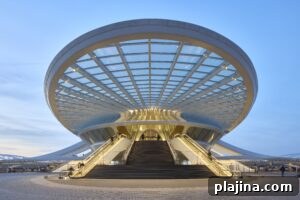
“We are honored to inaugurate this station in the city of Mons, the cultural capital of Wallonia and a European Capital of Culture in 2015,” Calatrava said. “This project goes beyond the technical challenges of a railway station. Conceived as a monumental bridge over the tracks, it sparks a deep transformation in its surroundings.
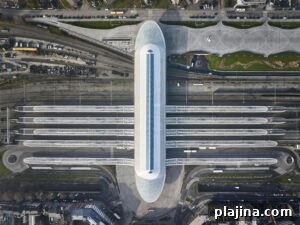
“The station’s Gallery serves as a connector, linking the historic city center to the south with the emerging Grand Prés shopping district to the north. Beneath the structure, integrated underground parking for cars and bicycles and generous public squares contribute to an improved urban fabric.”
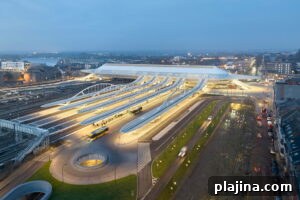
Situated on the international Paris–Brussels line, Gare de Mons is one of Belgium’s larger stations and a key hub for regional transport. The rebuilt station accommodates seven passenger tracks across platforms that stretch 1,148 feet, and it organizes 29 bus stops and multiple taxi stands beneath its roofs to streamline multimodal connections.
© Oliver Schuh – Palladium Photo Design
The Gallery, measuring 541 feet long and 50 feet high, functions as the station’s centerpiece. Its architecture features a rhythmic series of inclined triangular steel trusses, curved glass facades set in wooden frames, and flooring of Belgian blue limestone. The combination of materials produces a warm, human-scaled environment while maintaining a contemporary aesthetic.
Bright and spacious, the Gallery provides direct access to all platforms via stairs, escalators and large elevators. Two elevators serve each platform, and additional vertical circulation connects the Gallery to underground parking and other station levels. The Gallery hosts a variety of retail and passenger services and contains a shared travel center operated by SNCB and TEC to facilitate rail and bus journeys.
The enclosed central Gallery evokes historical covered shopping arcades while functioning as a modern transport hall. A ventilated skylight at the roof apex opens in summer to allow natural ventilation, improving comfort and reducing reliance on mechanical systems.
© Oliver Schuh – Palladium Photo Design
Before the new station, Place Léopold—between the station and the old town—was dominated by intersecting roads and a modest bus terminal. Traffic reorganization has turned Place Léopold into a pedestrian-friendly area that hosts public events and improves connections to the historic center. The station is now accessible from the heart of Mons without crossing busy streets.
To the north, Place de Congrès, a planted square, anchors the growing Grand Prés district, supporting new commercial and civic life. SNCB has begun clearing adjacent parcels to prepare for further urban development on the far side of the tracks, aligning transport investment with longer-term growth plans.
Accessibility was a core objective: the station is designed to serve passengers of all abilities. Twelve elevators connect the Gallery with platforms and parking levels, platforms are raised for barrier-free boarding, and audio systems provide clear announcements and voice alerts. Elevators are large enough to accommodate bicycles, supporting inclusive and multimodal travel.
Mons is an inviting destination for visitors from Paris seeking a short escape. A roughly two-hour train ride brings travelers to a station recognized in 2025 by an international architecture and design jury as one of the world’s most beautiful train stations. Gare de Mons demonstrates how thoughtful design and infrastructure can enhance mobility while reshaping urban life, making the city well worth a one- to two-day visit.