Since opening in 1985, the Queensland Performing Arts Centre (QPAC) has welcomed more than 30 million visitors to indoor performances, free events, workshops and outdoor presentations. Over 33,500 performances have taken place across the Centre’s venues, many featuring world-class artists and major productions.
The newest addition to QPAC is the striking Glasshouse Theatre, which officially opened to the public this March and marks a major milestone in Queensland’s cultural life. With a capacity of 1,500 seats, the new theatre makes QPAC the largest performing arts complex under one roof in Australia and the only venue in the country capable of presenting ballet, contemporary dance, symphony, opera, theatre and musicals at world-class standards within the same building.
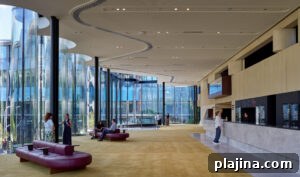
© Christopher Frederick Jones
Located in South Bank, a lively Brisbane precinct, the Glasshouse Theatre is visually arresting with its rippling glass façade and offers exceptional versatility. The design allows the theatre to function as an inviting public presence on the street while supporting high-calibre, technically demanding performances inside.
The theatre was designed by Brisbane-based Blight Rayner Architecture in collaboration with Oslo practice Snøhetta, the team that won an international competition for the project in May 2019. The idea for the undulating glass façade was inspired by a prose-poem by Aboriginal elder and artist Lilla Watson, evoking the ripples of the Brisbane River and the fish that swim beneath its surface.
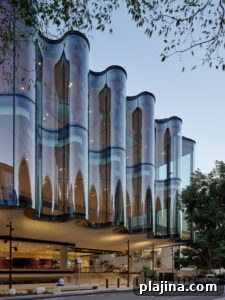
© Christopher Frederick Jones
The architects explain that the transparent façade was conceived as a public stage where people in the foyers can be seen from the street, sometimes clear and sometimes blurred, creating an animated connection between the theatre and the city. The design also intentionally embeds First Nations narratives tied to the local landscape.
One such cultural reference appears in seven roof skylights that symbolize Queensland’s seven watersheds. This concept is complemented by Floriate, a sculptural work by Torres Strait Islander artist Brian Robinson, which features seven native flowering plants significant across the state.
Inside, the airy, light-filled foyers contrast with an auditorium designed as a cocoon: dark grey ironbark walls and rainforest-green carpet create an intimate, focused environment for audiences and performers alike. The furthest seat is only 90 feet from the stage—roughly nine feet longer than a half-Olympic pool—while wrap-around balconies enhance sightlines and foster a close connection between performers and the audience.
“From its stunning architecture and enhanced technical capabilities to its breathtaking façade, Glasshouse Theatre is a game-changer that will put Queensland on the map as a major drawcard for tourists, performers and productions,” said John-Paul Langbroek, Minister for the Arts.
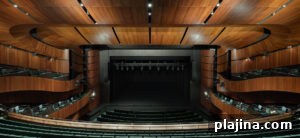
© Christopher Frederick Jones
The auditorium spans two levels, with 1,000 seats in the stalls and 500 in the balcony. The fly tower contains 100 fully automated fly bars engineered for safe, efficient scene changes to support complex productions. An in-house digital broadcast suite allows live performances to be streamed to regional towns and cities across Australia, offering 4K HDR livestream production with Dolby Atmos sound quality to reach audiences beyond the theatre.
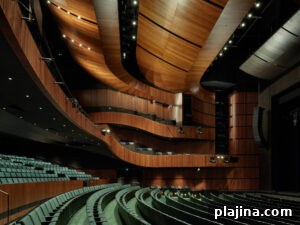
© Christopher Frederick Jones
By bringing together exceptional architecture, Indigenous cultural storytelling and advanced technical infrastructure, the Glasshouse Theatre strengthens QPAC’s role as a national cultural hub and expands Brisbane’s capacity to host ambitious international and local productions.