
Powered originally by oars and sails, the world’s first seafaring vessels produced virtually no emissions. That began to change in the 18th century when engineers adapted the steam engine for maritime use and later introduced diesel propulsion. Over time, ocean-going ships became increasingly dependent on fossil fuels.
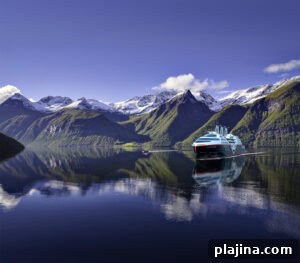
PHOTO:
© HURTIGRUTEN GROUP
Today, as scrutiny of cruise ships’ environmental impact intensifies, ship designers and cruise lines are investing heavily in technologies that reduce emissions while preserving safety and passenger comfort. Norway-based Hurtigruten — known for atmospheric voyages through fjords, islands and coastal villages — was among the first operators to prioritize sustainability. In 2019 the company launched MS Roald Amundsen, the first hybrid cruise ship in its fleet, which uses electric propulsion and other innovations to lower fuel consumption and reduce CO2 emissions by roughly 20 percent.
In 2023, more than two centuries after engines became standard, Hurtigruten announced an ambitious plan to develop the world’s first zero-emission cruise ship, targeting a 2030 debut under the Sea Zero initiative.
“We are developing the concept for a very innovative cruise design and researching to find the optimal design methods suitable for zero-emission ships,” said Henrik Burvang, manager of Research and Innovation at VARD, the design and shipbuilding firm responsible for the concept visuals. “In the process, we are developing new design tools and exploring new technologies for energy efficiency.”
The proposed vessel combines large-capacity, cobalt-free rechargeable batteries — rated at 60 megawatts and capable of traveling up to about 350 nautical miles between charges — with three 164-foot-tall wing-rig sails. These wing-rigs are fitted with retractable solar panels so the ship can generate electricity during Norway’s long daylight months. Additional efficiency features include retractable smart propellers, a low-friction hull coating and an AI-driven guidance system that draws on 130 years of experience sailing the Norwegian coast to plot routes that minimize resistance. Passengers will be able to monitor and control in-suite energy use and ventilation through a mobile app.
One standout feature of the Sea Zero concept is a dramatically smaller bridge. Thanks to the AI-based navigation system and advanced automation, the bridge footprint can be reduced to a cockpit-sized area, which Hurtigruten intends to reconfigure so guests can enjoy nearly 360-degree views from a premium forward vantage point.
Luxury expedition line PONANT is pursuing similar goals with its Swap2Zero program and plans to launch a new vessel in 2030. That design will integrate multiple decarbonization technologies: sail assistance, organic photovoltaic materials embedded in the ship and sails, low- and high-temperature fuel cells that recover heat and water, onboard carbon capture to reduce exhaust emissions, and a customized energy management system that distributes power without relying on traditional generators.
“PONANT is a company of sailors focused on exploration and innovation, and it is this pioneering spirit that is inspiring the whole Swap2Zero programme,” said Hervé Gastinel, CEO of PONANT. “This is much more than a new ship. We want to offer a new mode of navigation and actively contribute to decarbonization of the maritime sector. Our in-house R&D team has brought together the best specialists in shipbuilding and renewable energy to imagine and develop an energy model that aims at zero emissions. With Swap2Zero, we are building a French technological showcase to convince other stakeholders to commit to carbon neutral navigation.”
Orient Express has set 2026 as the target launch for Silenseas, a 720-foot sailing vessel billed as the world’s largest sailing ship. Its SolidSail system features three rigid, tilting sails on 330-foot masts that can provide up to 100 percent of propulsion in favorable conditions.
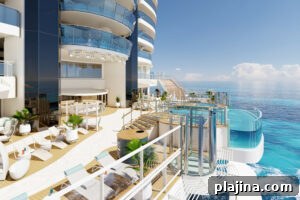
PHOTO: © PRINCESS CRUISES
Advances in ship technology are also reshaping onboard experiences. Princess Cruises’ Sun Princess, scheduled to debut in 2024, demonstrates how contemporary design merges spectacle with functionality. At 857 feet, the ship features two distinctive glass domes — one atop the vessel and another projecting like a panoramic bay window.
Inspired by Santorini terraces, The Dome is the first true enclosed glass dome built on a cruise ship. By day it serves as an indoor/outdoor pool area; by night the space transforms into a performance venue with acrobatic shows produced in collaboration with Cirque Éloize. A separate Princess Arena offers more than 1,000 configurable seats and a flexible in-the-round stage. The three-story sphere extending from the ship houses The Piazza, an airy suspended lounge with panoramic ocean views.
Families will be drawn to Park19, an onboard activity zone featuring the Sea Breeze Rollglider, the first roll glider at sea that travels around an elevated track. The attraction is ADA-accessible, making it available to a broad range of guests.
Celebrity Cruises’ newest ship, Celebrity Ascent, debuted with multiple tech-forward entertainment features, including Le Petit Chef — a dining experience that pairs animated table projections with a curated menu — and immersive theatre technology combining floor projections with a 110-foot LED screen encircling the stage.
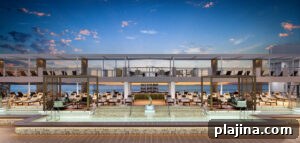
PHOTO:
© SILVERSEA CRUISES
Silversea Cruises’ Silver Nova employs an asymmetrical design that creates novel outdoor spaces: an outward-facing pool deck, an open-air sky bar and an infinity-edge whirlpool cantilevered over the port side. Quiet hybrid propulsion enables flexible cabin placement and a more horizontal ship layout. Silver Nova is also positioned to become one of the industry’s lowest-emission ships by combining fuel-cell technology that produces zero local emissions while in port.
Royal Caribbean’s Icon of the Seas, set to debut in 2024, and Silver Nova will both use Royal Caribbean Group’s pioneering waste-to-energy system. This system converts solid waste into synthesis gas that can be used directly as fuel, while onboard AI systems adjust food production in real time to reduce waste.