
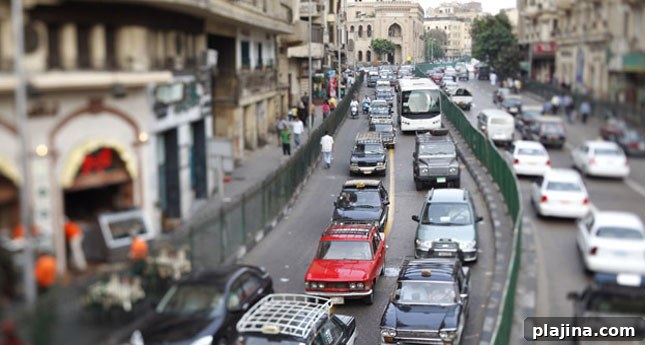
Dawn does not arrive quietly in Cairo, Egypt. As one of the largest and most densely populated cities in the world, the metropolis springs to life with the rising sun. By the time sunlight reaches the pyramids on the Giza Plateau to the west, many residents have already answered the first of five daily calls to prayer and begun navigating the city’s notorious traffic.
As our driver threaded through Cairo toward Giza, it became clear why visitors are discouraged from renting cars. Roughly 8 million people live in the city — about twice the population of Los Angeles but in roughly half the space — and nearly 20 million live in the greater metropolitan area. With some 7 million cars competing alongside buses, trucks, motorcycles and taxis, streets often become stop-and-go gauntlets with vehicles passing mere inches apart.
Despite congestion, Cairo exudes an unmistakable energy, brimming with productivity and potential. The city generates about two-thirds of Egypt’s gross national product. As the largest city in Africa and a major Middle East hub, Cairo offers a modern international airport, international hotel chains, skyscrapers with global company logos, and an endless variety of restaurants, shops and entertainment venues. Much of Egypt’s film and publishing industries operate here, and the city hosts top universities and leading hospitals.
Most residents work in the service sector — government, finance and commerce — but household incomes are strained by high unemployment and persistent poverty. Nearly half of the country’s population lives below the poverty line. Still, start-ups surged by almost 20 percent during the previous summer, generating new jobs. The General Authority for Investment reports strong investor interest in agriculture, along with programs to train farmers in modern land management. Although 30 percent of Egypt’s workforce is employed in agriculture, many rural workers remain impoverished due to inefficient land use.
Egypt’s economy relies heavily on three pillars: the Suez Canal, oil and tourism. Security is tight along the canal because of its strategic importance, yet November 2012 recorded exceptional traffic and revenue. Mohab Mamish, head of the Suez Canal Authority, credited the gains to flexible marketing and ongoing canal development.
According to the U.S. Energy Information Administration, Egypt is a significant oil producer and a rapidly expanding natural gas producer. The Suez Canal and the Sumed Pipeline form critical transit corridors for Persian Gulf oil shipments, making Egypt important to global energy markets. Natural gas is expected to drive growth in Egypt’s energy sector for the foreseeable future.
Tourism is the third economic pillar and a vital source of foreign exchange, thanks to Egypt’s wealth of historic sites and Red Sea and Mediterranean resorts. Tourism revenues dropped dramatically after the 2011 revolution that removed President Hosni Mubarak, but figures began to rebound. In the first half of 2012, tourism rose about 23 percent over 2011, with most visitors coming from Europe and the Middle East.
I met with Minister of Tourism Hisham Zaazou in Cairo to discuss the industry and the role of American travelers. He explained that a widely publicized demonstration at the U.S. Embassy had created a perception of anti-American sentiment, which he described as misleading. “A small group took violent action,” he said, noting that recent political openness has led to clashes but that these are generally peaceful and reminiscent of protests seen in other major capitals.
Zaazou noted that American arrivals fell sharply after the unrest. “In 2011 we had half the number of American visitors we had in 2010,” he said. Early 2012 brought hope for recovery, but many Americans canceled trips after the embassy demonstration. The ministry remains optimistic, however, and emphasizes that Egyptians value their American visitors.
American tourists tend to stick to classic cultural itineraries: the pyramids of Cairo and Saqqara, the Valley of the Kings and Valley of the Queens, and the temples of Luxor, Karnak and Abu Simbel, often combined with a Nile cruise. Zaazou stressed the importance of American visitors to local economies in Luxor and Aswan, noting that Americans traditionally spend more on hotels, dining and local services than many other markets.
Rebuilding tourism is a priority for President Morsi’s administration. The government’s long-term goal is to attract 30 million tourists annually by 2020. Visitor numbers were about 14.5 million in 2010, 9.8 million in 2011, and an estimated 9 to 12 million in 2012.
Several major projects aim to enhance the visitor experience. A redevelopment near the Museum of Egyptian Antiquities in Tahrir Square will replace a burned government building with a memorial to the revolution and a riverside sculpture garden. Work is also advancing on the Grand Egyptian Museum next to the Giza pyramids, which, when it opens, will be substantially larger than the downtown museum and will display artifacts not previously exhibited. The new museum will make day trips from Mediterranean cruise ports more attractive, allowing visitors to see the pyramids and museum without enduring Cairo traffic.
Zaazou also highlighted the reopening of 10-night Nile cruises from Cairo to Aswan, a route restored to offer a fuller experience of sites between Cairo and Luxor. Beyond infrastructure, the government is training locals in hospitality and visitor interactions to reduce aggressive vending near tourist sites. “Vendors need to realize they will make a better living if they do not pressure visitors,” Zaazou said. Youths will be taught to serve as proud ambassadors for their country.
CHECKING IN WITH NAHED SAMIR
Vice President of Operations and Business Development, Sonesta Middle East
WHAT DOES THE FUTURE HOLD FOR EGYPTIAN TOURISM?
Tourism has weathered highs and lows, but it will recover. Egypt’s ancient civilization and iconic monuments are embedded in global imagination, and many travelers still dream of seeing the pyramids in person.
WHAT SHOULD THE NEW GOVERNMENT DO TO PROMOTE TOURISM?
Marketing needs to be targeted to different source markets. Americans typically seek cultural and historical tours, while many Europeans favor beach holidays and all-inclusive packages. Reopening the long Nile cruises is a significant step, allowing visitors to fly into Cairo, visit the pyramids and museum, and board a ship rather than flying to Luxor or Aswan. Proper site organization at the pyramids and respectful traffic enforcement in the city will also improve the visitor experience. The Grand Egyptian Museum will be a major draw when completed.
WHAT IMPACT DID THE REVOLUTION AND POLITICAL UNREST HAVE ON CAIRO HOTELS AND NILE CRUISES?
The aftermath of the revolution brought challenges, but occupancy began to recover in mid-2012. Sonesta properties and ships saw occupancy rise to about 85 percent, and Americans made up a growing share of cruise passengers.
INFO TO GO TO CAIRO, EGYPT
Cairo International Airport (CAI) is about nine miles from the city center and serves as a hub for EgyptAir. Taxis into the city can be negotiated for 45 to 70 Egyptian pounds (roughly $7–11), or travelers can hire a limousine service at a fixed price of 65 to 80 Egyptian pounds (about $10–13).
FACTS ABOUT CAIRO, EGYPT
Time Zone: GMT +2
Phone Code: Country code: 20, City code: 2
Currency: Egyptian pound
Entry/Exit Requirements: U.S. citizens need a valid passport with a blank page for the entry visa; a 30-day renewable visa is available on arrival at Cairo International Airport for approximately $15.
Official Language: Egyptian Arabic, though many tourism professionals speak English and other languages.
Key Industries: Suez Canal, tourism, oil and petroleum products, agriculture, textiles
IN CAIRO: THINGS TO DO, DIVERSIONS
At the heart of Cairo, adjacent to Tahrir Square, the Museum of Egyptian Antiquities houses more than 120,000 artifacts spanning over 5,000 years. Highlights include the King Tut galleries and the mummy rooms, along with stunning sarcophagi, statuary and papyrus scrolls.
A short distance from Cairo, the ancient city of Memphis dates to around 3100 B.C. and served as an early capital. Though little of the city remains, the open-air museum displays important statues, including those of Ramses II. Nearby Saqqara served as a burial ground for millennia and contains 11 pyramids and hundreds of tombs. The Step Pyramid of Djoser, built of limestone around 2650 B.C., is a milestone in ancient architecture.
The Giza Plateau remains a bustling tourist magnet. Beyond the vendors and camel rides, the Great Pyramid of Khufu dominates the landscape, with the slightly smaller Pyramid of Khafre and three smaller pyramids for royal consorts nearby. The Sphinx, carved from bedrock during Khafre’s reign, guards the eastern approach.
Within the modern city, the Mohamed Ali Alabaster Mosque in the Citadel of Salah El Din is notable for its sweeping domes and sweeping city views. For a lively sensory experience, explore the Khan el-Khalili bazaars, a maze of narrow alleys filled with shops where bargaining and local expertise add to the fun.
CAIRO-AREA LODGING
Four Seasons Hotel Cairo at Nile Plaza — Spacious rooms with Nile and city views. 1089 Corniche El Nil, Garden City.
JW Marriott Hotel Cairo — Family-friendly amenities including a water park, health club and multiple dining options. Ring Road, Mirage City.
Sonesta Hotel, Tower & Casino Cairo — Comfortable guestrooms and well-regarded dining. 3 El Tayaran St., Nasr City.
CAIRO-AREA DINING
Abou El Sid — A colorful, authentic Egyptian restaurant popular with locals and informed visitors. 26 July Street, Zamalek.
La Gondola — Italian dining with live entertainment in a candlelit setting, located in the Sonesta Hotel, 3 El Tayaran St., Nasr City.
Rossini Seafood Restaurant and Piano Bar — Mediterranean-style dining that is romantic and memorable. 66 Omar Ibn El Khattab St., Heliopolis.