No sooner had my husband and I left Juan Santamaría International Airport than we nearly ran over a family crossing the Pan-American Highway.
“Look out!” I screeched as he stomped on the brakes and swerved into the right lane.
The four Ticos dropped their shopping bags in the middle of the road and ran back to the safety of the median. When we checked the rearview mirror, they were laughing good-naturedly, apparently unaware they had almost been flattened by our two-door Suzuki. It was not an auspicious start to our road trip around the country.
We were headed for the Monteverde Cloud Forest Biological Reserve, about a three-hour drive northwest of San José via notoriously rough access roads. “Only four-wheel drive,” said the agent at Dollar Rent a Car when we asked what type of vehicle to rent for the trip.
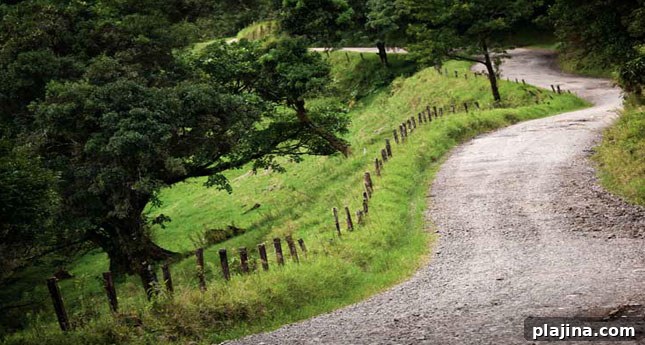
While most Costa Rican communities welcome paving, the isolated towns of Monteverde and Santa Elena lobbied to keep their winding dirt roads—riddled with potholes—to avoid overdevelopment. It seems to have worked: as my husband navigated the last 20 miles of steep, rocky track, I admired rolling green hills unblemished by condominiums and resort complexes.
Our first stop was El Sol, a pair of log cabins built by a German family on a 30-acre farm outside Santa Elena. We stayed two nights in the smaller cabin, tucked away down a grassy path on a secluded hillside. Walking into the rustic, one-room space with rough-hewn furniture, we felt a little like the Quakers who settled Monteverde in the 1950s.
Drawn by the area’s ideal climate for cattle grazing and by Costa Rica’s abolition of its military (Quakers are devoted pacifists), 11 Quaker families emigrated from the United States during the Korean War. They founded a quiet community of dairy farmers on the “Green Mountain” and, to protect the watershed, preserved the mountaintop rainforests above the 3,000-acre plot. Despite the regular stream of tourists with telephoto lenses, the two towns remain close-knit communities of artisans and cheesemakers.
Because the cabin had a kitchen, we drove 10 minutes into Santa Elena to pick up supplies at the local grocery. Laden with tortillas, cilantro, goat cheese and chicken, we discovered we had parked the tiny SUV on an incline that dropped into a small ravine. We gunned the engine, but the 2,000-pound Suzuki spun its wheels, unable to gain traction.
Luckily, a group of Ticos sitting outside the store saw our predicament and rushed to help, pushing the front end of the car as we reversed uphill. Relieved and embarrassed, we thanked them. They laughed. “¡Pura vida!” one man said with a grin.
That evening we watched the sun set over the valley while enjoying tacos and Imperial beer on the porch. All around the cabin the sounds of tree frogs, rustling bushes and other unidentifiable nighttime noises rose to a deafening chorus as darkness thickened. Enormous moths flapped fruitlessly against the windows until we finally turned out the lights and tried to sleep.
The next morning we headed for the Cloud Forest Reserve, hoping daylight would reveal some of the creatures that had disturbed our slumber. Although the reserve attracts nearly 200,000 visitors annually, we saw few other people on its forested paths and canopy bridges.
Unfortunately, we saw few animals. The resplendent quetzal—the bird that turned Monteverde into an ecological destination in the 1980s—was nowhere to be found. It wasn’t until we returned to the visitors center hours later that we spotted a few monkeys near the entrance. Despite the lack of visible wildlife, the day wasn’t a total disappointment: we looked forward to the decidedly un-Quaker comfort of El Sol’s handbuilt sauna.
The following day we drove back to San José, traded the pint-sized Suzuki for a more practical Peugeot, and set off for the Caribbean coast. As expected during the rainy season, the sky opened up soon after we left the city, dumping sheets of rain onto the road and splattering mud across the windshield. We pulled over to wait out the deluge at a roadside stand where an elderly Tica was dishing up gallo pinto, Costa Rica’s ubiquitous rice-and-beans dish.
We arrived in Puerto Viejo de Talamanca, at the southern end of the Caribbean coastline, well after dark. Once a one-road town and still laid-back, Puerto Viejo has become more popular each year. It can no longer be called Costa Rica’s best-kept secret, but its beaches remain among the country’s most beautiful. The renowned breaks at Salsa Brava and Playa Cocles attract surfers, while a string of half-empty beaches stretches east to Manzanillo.
Surfers hit the beach © Allison Voigts
We checked into a forest bungalow far enough from town to muffle reggaeton beats but close enough to bike to the beach. By breakfast the next morning the wind had whipped up the waves at Playa Cocles, and I spent an hour struggling against the surf before finding a sheltered break on the west side of town where the locals were paddling out.
After regaining my strength with fresh ceviche, I cycled east along the palm-lined road toward Manzanillo. The roughly eight-mile stretch includes a wildlife refuge that limits development, so the sandy paths to the shore remain mostly empty except for a few wooden houses and simple soda restaurants.
Every stretch of fine white sand looked more deserted and inviting than the last, and I found myself chaining the bicycle to a palm tree and testing the water at each turnoff. At Punta Uva I found a steep-banked beach jutting into the clear, deep ocean. A local woman picnicked on the sand while her two little boys dove for shellfish nearby. I bobbed in the warm water and watched an afternoon storm roll in.
Reluctantly, we left a day later for San José, following the coast with the windows down and the floorboards full of sand. I suddenly felt the urge to drive. As soon as we turned west into the mountains, however, the rain clouds burst, sending steam up from the asphalt and small rivulets of water down the hillsides.
“Don’t get too close to the edge,” my husband warned.
“Of course,” I said—just before careening around a tight curve and nearly hydroplaning into a logging truck. We agreed I should return to navigating.
Street performer on Avenida Central © Allison Voigts
After dropping off the car in San José, we walked Avenida Central, the pedestrian thoroughfare at the heart of the city. We bought ice cream cones and wandered past street performers and women selling churros around the National Theater and the Gran Hotel Costa Rica. As we stretched our legs in the sunshine, a small SUV full of foreigners slowed nearby and a blonde woman stuck her head out.
“Hey!” she called. “How do we get to the Pan-American Highway?”
Costa Rica Info to Go
Juan Santamaría International Airport (SJO) is about 12 miles west of San José in the suburb of Alajuela. Several rental agencies operate at the airport; expect to pay roughly $450 a week for a four-wheel-drive vehicle with unlimited mileage, plus a 12 percent airport fee. Agencies require a valid driver’s license or International Driving Permit and basic insurance, which typically adds about $15–20 per day.