
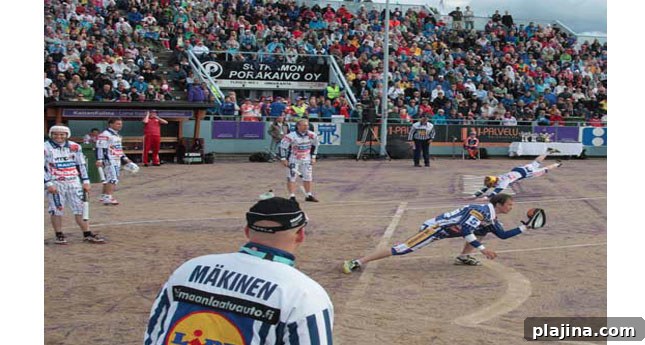
What is the national sport of Finland?
If you have followed this column’s coverage of that northern European nation, the question may cause a little unease. Finland is a place that has produced swamp soccer and competitive wife‑carrying. It’s a region where, under the guise of sport, people attempt to cross partially frozen lakes on snowmobiles and have adapted playground swings for 360‑degree rotation.
For many outside Finland, the answer will be unfamiliar: the national sport is pesäpallo.
So what exactly is pesäpallo?
It is not baseball, though the resemblance can be misleading. A couple of years ago I heard two American students on the express bus from the airport to Helsinki spot a match on a school field and announce, “Hey, they play baseball here.” The game flashed by at 70 mph, and at first glance it’s easy to see why they were confused. Yet a closer look reveals a different game entirely—one with distinctive rules, field layout and tactics.
Pesäpallo, often shortened to pesis, was invented in 1922 by Lauri Pihkala, a former Olympic athlete. He wanted a team sport that blended elements of baseball with traditional Finnish bat‑and‑ball games. Whether his main aim was to refine baseball or to create lively summer entertainment, the result is a uniquely Finnish hybrid.
One of the most striking changes from baseball is the pitching. In pesäpallo the pitcher stands at the home plate, face to face with the batter. Instead of a horizontal, high‑speed throw, the pitcher tosses the ball upward. The batter strikes it as it falls, while the pitcher withdraws to a safe distance. The presentation looks unfamiliar to anyone used to the American pitching style—hence the passengers’ likely exclamation: “What in the name of Walter Johnson does that pitcher think he’s doing?”
Another key difference: a ball hit out of the field is not celebrated as a home run but considered foul. The batter’s objective is to keep the ball in play, directing it into open spaces between fielders so teammates can advance on the bases.
Base running in pesäpallo follows an unconventional route. After a successful hit the batter runs left to first base, then turns sharply right to reach second, then left to third, and left again back to home. Anyone switching from baseball to pesäpallo might appreciate a diagram or map to get their bearings.
The distinctive field layout encourages a tactical game. Managers on the sidelines use fans of brightly colored sticks to send coded signals to their players, adding a theatrical and strategic layer to matches.
Like baseball, pesäpallo is played across levels from grassroots leagues to the top tier, Superpesis. Interestingly, the premier teams tend to come from small towns and villages across Finland’s wide rural landscape. Big matches can draw crowds that sometimes rival or exceed the local population, highlighting the sport’s strong community appeal.
After a match, players and spectators often play mölkky, another Finnish spin on a popular pastime. Mölkky resembles ten‑pin bowling but with notable quirks: there’s no bowling ball; instead players throw a wooden pin to knock over numbered target pins. Each toppled pin adds its number to the score, and the goal is to reach exactly 50 points—no more, no less.
For visitors, pesäpallo and mölkky serve as small windows into Finnish character: familiar elements rearranged in surprising ways. They feel at once oddly recognizable and refreshingly different—sports that reflect the country’s inventiveness, communal spirit and taste for playful variation.