
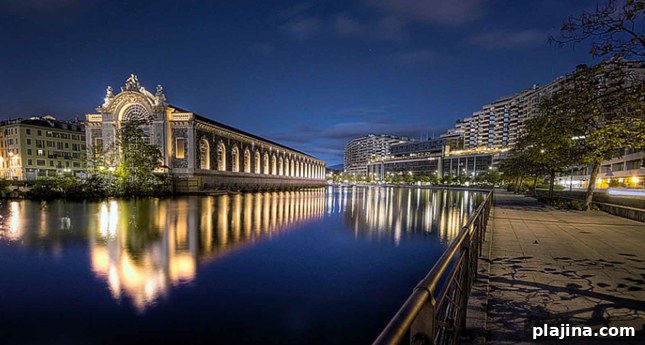
Known for decades as the “Capital of Peace,” where nations negotiate trade agreements, sign treaties and discuss pressing global issues, Geneva could equally be called the “City of Acronyms.” The initials of more than 80 international organizations based here — among them ILO, UNHCR, WHO, WMO, WTO, ICRC and CERN — are as familiar to locals as the names of family members.
Nearly surrounded by France, Geneva’s streets flow seamlessly across the border. With residents from about 190 countries making up roughly 40 percent of the population, Geneva often strikes a cosmopolitan tone that blurs a single Swiss identity. Historically, France annexed Geneva in 1798 and retained control until the city rejoined the Swiss Confederation 16 years later. Today, French remains the dominant language in daily life and local media, and the city’s cuisine and fashion often feel more Parisian than Swiss. Thousands of people commute from French suburbs, and Mont-Blanc — the snow-capped peak that defines much of Geneva’s skyline — lies in France.
At the same time, Geneva is unmistakably Swiss. The city sits at the edge of Lake Geneva, Europe’s largest freshwater lake, and is crossed by two rivers, with the Alps and the Jura Mountains as an impressive backdrop. Switzerland’s banking and tax systems attract international corporations and high-net-worth individuals, contributing to Geneva’s reputation as one of the world’s wealthiest cities. The city ranks among the highest globally for millionaires per capita, following Zürich and Monaco. Despite occasional criticism that Geneva is elitist, it won “Europe’s Leading City Break Destination” at the World Travel Awards, beating destinations such as Paris, London and Rome.
To welcome visitors, Geneva offers practical perks like the Geneva Transport Card with hotel stays, complimentary city bike rentals and extensive free WiFi — measures designed to ease the cost of visiting. The city also supports a diverse economy: traditional businesses, innovative startups and a large meetings industry coexist here. More than 900 multinational firms maintain offices in the region, and four major conference centers host international events. Geneva continually invests in infrastructure and public transport to serve about 195,000 city residents plus some 700,000 people living in surrounding Swiss and French suburbs.
Nevertheless, transport remains a challenge. Geneva’s compact layout, split by a lake and two rivers and dotted with hills, makes large expressways and ring roads impractical. Swiss environmental priorities and a desire to preserve neighborhoods and green spaces have kept large-scale road expansion at bay, but those same choices contribute to heavy rush-hour congestion. With only a few narrow bridges linking districts, many residents doubt that adding bridges or a tunnel under Lake Geneva would significantly ease traffic.
The Hans Wilsdorf Bridge, built in 2012, spans L’Arve River. © Ron Bernthal
Hope for relief rests with CEVA (Cornavin–Eaux-Vives–Annemasse), a major rail project that links Swiss and French rail networks and creates a roughly 10-mile semicircular line connecting the city’s north and south banks. Begun in 2011, the project includes seven new stations and is largely underground, which will preserve surface greenways for pedestrians and cyclists. CEVA is also expected to stimulate new residential neighborhoods, commuter parking, and commercial districts around modern stations.
Because central Geneva has a limited supply of affordable housing, the CEVA line has already encouraged plans for reasonably priced residential developments. One sustainable project proposed for the Vernets neighborhood aims to add about 11,000 housing units near two CEVA stations, with design features that emphasize green space, renewable energy and limited residential car use.
Geneva’s proximity to France affects its housing market uniquely. Strict Swiss zoning and permitting regulations have pushed much development into adjacent French communities, where permits are easier to obtain and costs are lower. Towns like Ferney-Voltaire, Gex, Divonne, Annemasse and Saint-Julien now house many Geneva commuters who seek more affordable rentals and property.
New hospitality offerings this year include Float Inn, a luxury five-cabin catamaran available for overnight stays or short lake cruises on Lake Geneva.
Dining and nightlife are abundant, and rooftop venues have proliferated. Notable spots include IZUMI on the Four Seasons Hotel des Bergues and Rooftop⁰42 on Rue du Rhône, both offering attractive views and a lively atmosphere. In summer, the Swissôtel Métropole’s 5 Rooftop Lounge/Bar/Restaurant opens for alfresco dining and panoramic views.
Things to Do in Geneva
Geneva’s neighborhoods each have distinct personalities and plenty to explore. On the Rive Gauche (Left Bank), Old Town forms the historic core with narrow cobbled streets and centuries-old architecture. Rest on the Promenade de la Treille, home to the world’s longest wooden bench, and stroll through Eaux-Vives for lakeside views, parks and shops. Plainpalais, near the university, hosts a large flea market and cultural venues; the Patek Philippe Museum showcases Geneva’s watchmaking heritage. The recently expanded Musée d’ethnographie de Genève now occupies a striking modern building. La Jonction, between the two rivers, has been revitalized with new shops and restaurants.
Lavaux Vineyards on the north shore of Lake Geneva © RegisColombodiapo.ch
On the Rive Droite (Right Bank), Pâquis — near Gare Cornavin, the central train station — blends international eateries, shops and a small legal red-light district. Quartier des Grottes and Saint-Gervais, perched on the hills above the station, offer local dining and distinctive architecture, including colorful apartment buildings with curved facades. The International District houses the Palais des Nations (UN Office), the International Red Cross and Red Crescent Museum, and the “Broken Chair” sculpture, a monument drawing attention to the victims of land mines.
South of the city on the Left Bank, Carouge charms visitors with Mediterranean-style streets, bougainvillea, citrus trees and a village atmosphere full of boutiques, cafés and markets.
The Jet d’Eau fountain, which shoots water about 420 feet into the air from the lakeshore, is Geneva’s signature landmark and can be seen from most parts of the city. For panoramic views, take the Mont-Salève cable car just outside Geneva for a quick ascent and sweeping vistas of the region.
CHECKING IN WITH BERTRAND STAEMPFLI
Press Officer, Genève Aéroport
Considering Genève Aéroport borders France, what arrangements allow easy passenger access between France and the airport?
The airport expanded into French territory in 1956 under an agreement that created a dedicated French sector. Flights to French airports operate as domestic French flights from that sector. Passengers can access the French sector from the Swiss terminal by passing through French customs, or reach it directly from France via a road connected to Ferney-Voltaire.
Does the airport maintain special security to handle diplomatic flights and dignitaries who transit here?
Given Geneva’s international role, airport security includes federal and cantonal police and, when needed, military support. An Airport Protocol Office manages operations for heads of state, diplomats and other dignitaries, handling thousands of welcome operations each year.
Being three miles from the center of Geneva, how does the airport balance business, tourism and environmental concerns?
Originally built in a quieter area, the airport is now surrounded by roads, railways, industrial zones, an exposition center and neighboring towns. Public transport links the center in under seven minutes, but growth has pushed development to its limits. The airport enforces a strict night ban (12:29 a.m.–5:59 a.m.) and prioritizes environmental measures, including financial support for sound insulation in affected housing and ongoing dialogue with residents’ groups.
Where would you take visitors around Geneva?
A walk through Old Town highlights the cathedral and historic architecture, followed by shopping along the Rues Basses and a visit to Bains des Pâquis on the lake. For a memorable meal, head a short drive to Onex to enjoy local fish specialties at Les Fourneaux du Manège.
Geneva: Just the Facts
Time Zone: GMT +1
Phone Code: Country code: 41 City code: 22
Entry/Exit Requirements: U.S. citizens need a passport issued within the last 10 years and valid at least three months after departure; no visa required for stays up to 90 days.
Currency: Swiss franc
Official Language: French (English is widely spoken). Italian, German and Romansh are also national languages.
Key Industries: Information and communication technologies, watchmaking, banking and finance, commodity trading, fragrances, life sciences and biotechnology, international organizations, tourism
Geneva Info to Go
Geneva International Airport is about three miles from the city center, with frequent trains (roughly six minutes), buses and taxis to Geneva-Cornavin station. Terminal 1 has been modernized and features dining options with views of the tarmac and surrounding mountains.
View of Geneva from Four Seasons Hotel des Bruges © Four Seasons Hotel des Bruges
Where to Stay in Geneva
Four Seasons Hotel Des Bergues An elegant lakeside landmark since 1834, this five-star hotel offers refined rooms, a full-service spa and distinguished dining. 33 Quai des Bergues $$$$
InterContinental Genève Hotel A redesigned five-star property near the United Nations, with lake and Mont-Blanc views, an outdoor pool and business facilities. 7–9 Chemin du Petit Saconnex $$$$
La Réserve Genève Hotel and Spa Set on expansive grounds by the lake, this five-star hotel provides private surroundings, indoor and outdoor pools, spa amenities and dining options. 301 Route de Lausanne $$$$
Restaurants in Geneva
Le Flacon A small restaurant that earned a Michelin star shortly after opening. The menu du jour offers exceptional flavors and good value. 45 Rue Vautier, Carouge $$$–$$$$
IZUMI A rooftop venue at the Four Seasons serving Japanese-Nikkei fusion cuisine with views of the lake and Mont-Blanc. Reservations recommended. Four Seasons Hotel des Bergues, 33 Quai des Bergues $$$$
Restaurant Le Cigalon Chef Jean-Marc Bessire specializes in fish dishes paired with local Swiss wines; features a chef’s table and summer courtyard dining. 39 Route d’Ambilly, Thônex $$$$
Read more about Geneva’s diplomatic solutions.