A cluster of women gathered around the juice bar, sipping vividly colored fruit drinks and chatting as their children called for attention nearby. One mother told a humorous story that had the others slapping their legs and laughing until they doubled over. It could have been a scene at any health club—except that every woman was completely naked.
I was at Dragon Hill Spa, one of Seoul’s many jjimjilbangs, or public bathhouses, which serve as important hubs of Korean social life. Women of all ages scrubbed each other’s backs, splashed with their children in the pools and lingered in long conversations while stretched out on warm marble slabs.
Out of Midwestern modesty, I tried to take the provided towel into the wet area, but a no-nonsense attendant promptly took it and handed me a rough pink washcloth, motioning me to the showers. I learned quickly that thorough washing before entering the pools is essential etiquette.
After paying $15 for a vigorous scrub by a professional using a coarse bath mitt, I rejoined my husband in the coed section, where families, couples and groups of friends lounged on heated floors in loose spa uniforms. Dry saunas of varying temperatures—some reaching 200 degrees—promised extravagant health benefits: one sign claimed the Charcoal Room “neutralizes acidified human organs,” while another boldly promised it “stops bleeding.”
Jjimjilbangs were introduced during Japan’s colonial period in the 1920s but boomed toward the end of the 20th century when bathhouses added modern amenities like movie theaters, restaurants, arcades and even golf driving ranges. On Dragon Hill Spa’s top floor we found an “Indian Barbeque Village,” complete with life-size totems and wigwam replicas serving fried chicken and Cass beer.
“These days, Korean people are too busy to talk with their neighbors and friends,” said DoolHwa Lee, who sometimes comes to the spa with her college-age daughter. “But in the jjimjilbang we can stay for hours—up to 12—and talk freely about everything.”
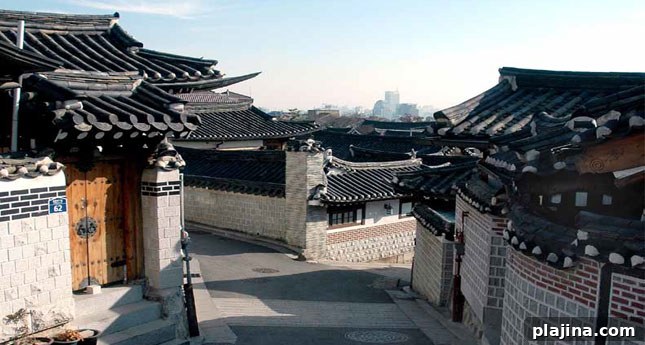
Refreshed and clean, my husband and I explored Bukchon, a neighborhood that contrasts sharply with Seoul’s flashier districts like Itaewon or Gangnam. Tucked between two restored royal palaces, Bukchon is rich with tradition and home to nearly 1,000 hanok—traditional houses with patterned windows and tiled roofs.
Wandering along narrow alleys and high walls revealed quiet teahouses, small Buddhist temples and public foot baths. We stopped for hearty dumpling soup at a busy spot where two elderly women sat on low stools, spooning leek-and-pork filling onto dough squares and pinching the corners closed with practiced speed. One of them invited us in with a quick nod.
Several hanok in Bukchon have been converted into guesthouses where visitors sleep on floors warmed by underfloor heating. We stayed in a detached sarangchae—the former study room—at a traditional guesthouse. Its delicate paper doors and mountain views felt a world away from Seoul’s high-rise apartments; at night a neighbor’s rooster crowed, reinforcing the impression of being removed from the city’s bustle.
The next morning we boarded a United Service Organizations tour bus bound for the Demilitarized Zone (DMZ), roughly 35 miles north of downtown Seoul. In the weeks before our trip, tensions had risen with nuclear threats from Kim Jong-un, but local residents we spoke to advised us that the tour was safe.
“It’s just North Korea’s way of communicating,” a Korean friend told us.
At Panmunjom, the village where the 1953 armistice was signed, the mood felt solemn. The DMZ has remained largely untouched for decades, turning parts of it into a refuge for wildlife such as the Manchurian crane. Rolling green hills and rising pheasants, however, hide a dangerous reality: unexploded mines scattered through the terrain, one reason guided tours are mandatory.
“If you choose to defect today to North Korea, I’m not going to be responsible for you,” Pvt. Mitchell, a U.S. Army soldier who guided our group inside the Joint Security Area, warned. A few tourists laughed nervously, but the warning was serious—history includes incidents like the 1984 Soviet defector who ran across the line and triggered a deadly exchange.
Pvt. Mitchell led us through a doorway into bright sunlight, and we saw a North Korean soldier standing less than a hundred yards away, binoculars raised as he watched us. We returned the stare through telephoto lenses while three South Korean privates stood behind conference buildings, their hands clenched at their sides in a tae kwon do stance.
The low conference buildings that straddle the demarcation line had recently been repainted a robin’s-egg blue; workers had tied themselves to ropes when crossing into the North in case of abduction attempts. Other than the hum of cicadas, the area was silent.
Inside a room where talks between the two Koreas had been held, our group gathered around a table wired with recording microphones. The interior was spare, and there was no obvious marker to show where one nation ended and the other began.
“Excuse me,” I asked Pvt. Mitchell, “but where exactly is North Korea?”
He pointed to the floor beneath my feet. “You’ve been standing there for the past five minutes,” he said.
INFO TO GO
Incheon International Airport is linked to Seoul by a dedicated airport railroad. Express trains to Seoul Station take about 40 minutes and cost roughly $7, while deluxe airport limousine buses run to major hotels for about $12 and take closer to 80 minutes depending on traffic. Gimpo International Airport, located closer to the city, handles most domestic flights and connects to Seoul by subway.
Where to Stay in Seoul
Grand Hyatt Seoul Located in Itaewon, the Grand Hyatt is popular with business travelers and families, offering amenities like a pool and ice rink. 322 Sowol-ro, Yongsan-gu $$$$
Lotte Hotel Seoul Notable features include a women-only floor, a Korean tourism museum and renowned fine dining. 30 Eulji-ro, Jung-gu $$$$
RakKoJae Seoul A high-end hanok where guests can enjoy traditional meals, a mud-walled sauna and housemade spirits. 218 Gahoe-dong, Jongno-gu $$$
Restaurants in Seoul
Maple Tree House Helpful English-speaking staff and a broad selection of meats make Korean barbecue accessible for first-time diners. 31-1 Itaewon-dong, Yongsan-gu $$
Min’s Club Housed in a restored 1930s hanok, this venue offers afternoon tea with locally grown leaves and classic pastries. 66-7 Gyeongun-dong, Jongno-gu $$
Pierre Gagnaire à Séoul Michelin-starred French cuisine with an extensive wine list and panoramic views of the city skyline. Lotte Hotel Seoul, 30 Eulji-ro, Jung-gu $$$$
Read more about Seoul’s cat cafés.