
He didn’t know what we know as he climbed the same rocky mountainside, wilting under the same heat and rasping for breath in the thinning air. The year was 1881, and Karl Sester, a German engineer, saw Mount Nemrut simply as a convenient vantage point from which to survey potential transport routes through the Anti-Taurus range in eastern Turkey.
We follow a winding path. Sester had to make his own way to the summit, clambering over boulders and crunching across brittle, sun-parched vegetation.
We pause for a brief rest. Perhaps he did the same. From this height the panorama of pale hills stretches away, an expanse that feels like the middle of nowhere. We are far from any major city. So why are we here?
Answering that takes us back to Karl Sester. As he neared the top, he realized there was something not quite natural about the mountain’s summit. It leveled into two flat terraces separated by the 150-foot rocky cone that forms the peak. The peak looked a little too regular, almost too deliberate, to be the product of geology alone.
When he reached the terraces and saw what lay there, was he excited or frightened? In this remote spot he found himself eye to eye with a series of giant stone heads, each almost his size.
The passing of time and the accumulation of archaeological knowledge have not diminished the site’s impact. When we first encounter the statues, our reaction echoes Sester’s: a mix of excitement and unease.
Eastern Turkey can be disorienting. Getting here required an international flight to Istanbul and a subsequent domestic hop to Gaziantep. From the airplane window the terrain toughened as we flew east; the traces of human habitation grew sparser.
On landing, it’s easy to assume we’ve reached a backwater. In reality, we are in a region that helped shape the modern world.
Gaziantep is among the oldest continuously inhabited cities on Earth. Strip back the layers and you find traces of Ottomans, Byzantines, Romans, Macedonians, Persians, Babylonians, Assyrians and Hittites, among others.
Geography drives history. Locate Gaziantep on a map and its strategic importance becomes clear: it sits at a crossroads between East and West, between the Mediterranean and the Black Sea, between deserts and mountains, and within reach of the Euphrates and Tigris. For early humans this area was effectively the center of the world.
The city reflects that complexity. It is at once European and Asian, ancient and modern. Tinted glass façades of new office blocks mirror tile-roofed houses and minarets. Almost every time ground is broken for a new development, workers unearth fresh evidence of the past; new chapters are constantly being added to the story.
One notable discovery occurred during construction of the Birecik Dam, 28 miles east of Gaziantep. Intensive excavations at sites threatened by flooding, including the ancient city of Zeugma, revealed an extraordinary collection of remarkably preserved mosaics dating back two thousand years.
Gypsy Girl mosaic found during the Zeugma excavations © Creapictures | Dreamstime.com
The finds were so extensive they prompted construction of a 323,000-square-foot museum to display them. The Zeugma Mosaic Museum, opened in Gaziantep in 2011, became the world’s largest mosaic museum. Its star is the beguiling Gypsy Girl mosaic, often called the “Mona Lisa of the ancient world.”
The region’s layered history is not only preserved in museums. Early in our visit we hunt out one of the city’s famous bakeries. Baklavacı Güllüoğlu Mahmut Güllü has been operating at the same bazaar location since 1870, serving the local take on the sweet pastry baklava.
As we bite through crisp layers of pastry and pistachio, it feels less like indulgence and more like essential field research. Baklava is itself a product of the multicultural mix that has characterized this region for millennia.
Even with museums and bakeries helping to stitch together a narrative, eastern Turkey’s history resists tidy summarization. The time scale is vast, and the reach of the past extends beyond the horizon. Professional archaeologists, too, have been confounded by some recent discoveries.
We drive east for two hours on a road that sometimes runs within 15 miles of the troubled Syrian border. Eventually we reach Urfa—officially Şanlıurfa, “Glorious Urfa,” though locals use the shorter name—reputed to be the birthplace of the prophet Abraham. The biblical era feels recent compared with an enigmatic site unearthed nine miles from downtown.
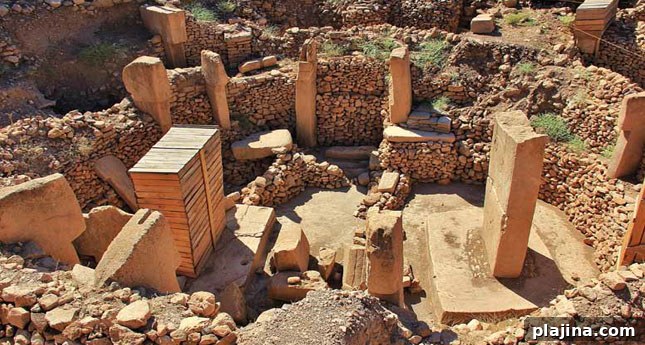
Göbekli Tepe was first discovered nearly 50 years ago, but only since 1994 have archaeologists begun to grasp its importance. Excavations have revealed concentric stone circles, some stones carved into T-shapes, others bearing intricate bas-reliefs of animals.
What sets Göbekli Tepe apart is its age. Current estimates date its construction to around 11,000 years ago—more than 6,500 years older than the Great Pyramids or Stonehenge.
At the time it was built, people were thought to be hunter-gatherers. How such communities created something so elaborate remains one of archaeology’s great questions. With roughly 95 percent of the site still unexcavated, researchers hope further digging will shed light on its purpose.
We drive northward, wondering what else is buried beneath fields and hills. Some secrets, however, are lost forever. The Atatürk Dam, completed in the 1990s, blocked the Euphrates and flooded 315 square miles of countryside. Countless historic sites were submerged and 55,000 people were relocated as valleys filled with water.
Arriving at Nemrut Dağı feels like vaulting across millennia from Göbekli Tepe. Agriculture and settled life had by then reshaped societies. Great civilizations rose and fell. This mountain marks the center of the Kingdom of Commagene, a small realm caught between Persian and Roman influences roughly 60 years before the birth of Christ.
On the late-afternoon climb above the tree line, we try to imagine the landscape during the reign of King Antiochus of Commagene, who chose the summit for his tomb.
In truth the landscape likely looks much as it did then. Far from modern roads, there are few reference points to anchor us in the 21st century. It is easy to let the imagination carry us back to the Commagenes’ heyday or to Karl Sester’s 19th-century discovery.
The path flattens and delivers us to the stone processional road laid by the Commagenes, leading to the eastern terrace. Here several stone torsos sit with their backs to the conical peak. Their magnificently carved heads—removed from the bodies at some unknown point in history—lie aligned in front: eagles, lions, Greek gods and King Antiochus himself.
When Karl Sester first encountered them he had no context for what he’d found. The sculptures feel both Greek and Assyrian in inspiration. Like baklava, they are neither wholly European nor wholly Asian but a blend that unites influences across the region.
We circumnavigate the peak and reach the western terrace in time for sunset. Another set of stone heads gazes blindly toward the rosy horizon. We look out over rugged mountains and shadowed valleys and, for a moment, lose track of exactly where—or when—we are.
Turkey Info to Go
International flights arrive at Istanbul or Ankara, with domestic connections to airports in eastern Turkey, including Gaziantep and Urfa. Independent travel is possible by rental car or public transport, though joining an organized tour often saves time. Organized itineraries commonly include Nemrut Dağı, Göbekli Tepe, Urfa and Gaziantep, with varying durations and price points.
For background reading, Gaziantep’s culinary and archaeological attractions offer a vivid introduction to the region’s long and complex history, from ancient mosaics to centuries-old pastry traditions.