Our first sign this would be more than a routine snowmobile outing came on the drive up to the Mýrdalsjökull Glacier, when the Super Jeep ahead of us stalled in knee-deep snow. The next hint arrived at base camp, where we signed waivers and spent half an hour suiting up in snow boots, insulated coveralls, balaclavas, helmets and thick gloves. We snapped pictures of one another in the bulky gear — silly, perhaps, but fitting for the alien landscape ahead.
After a concise safety and navigation briefing — including practice of the essential butt-shifting move used to correct a skidding craft — we set out to explore the snowcap of Mt. Katla, one of Iceland’s higher peaks and an active volcano.
On the first leaning curve I fought the instinct to gun the throttle past the slower rider ahead and instead kept both hands steady on the controls, eyes fixed on the near horizon as the terrain shifted between hard ice, soft snow and ice-glazed drifts.
The view from the volcano was unforgettable: intermittent sun breaking through low clouds as glaciers and powdered snow whipped around us. Our insulated suits, heated seats and warm grips made the ride comfortable, but this was not a manicured ski trail. A glacier demands respect.
After about 30 minutes of racing across ridges and bowls that felt like the summit of the world, we reached an overlook with a view toward Eyjafjallajökull — the volcano that famously grounded European air traffic in 2010. Clouds hid much of the vista, and my compact camera had frozen, but the place still felt extraordinary.
The return trip felt less daring now that we knew what to expect. Back at camp we shed our borrowed gear, warmed up and enjoyed a surprisingly tasty Mediterranean-style meal in a snug cabin. On the ride back to town in the Super Jeeps we stopped briefly at one of Iceland’s many dramatic waterfalls for photos.
Fire and ice are Iceland’s defining contrasts, and they create a natural playground for adventure. A Super Jeep — a heavily modified, high-clearance 4×4 that carries up to 10 passengers, fords rivers, crawls through deep snow and rolls over jagged lava — paired with a glacier snowmobile excursion is among the more approachable options for thrill-seekers.
The island spans just over 100,000 square miles, much of it sparsely populated and connected by a single ring road and, for those in a hurry, helicopter services. That accessibility makes it possible to sample dramatic extremes in a short time: glaciers, volcanoes, fissures and geothermal pools often lie within a day’s reach of one another.
Surprising to some, diving and snorkeling are popular here. Iceland straddles the boundary between the North American and Eurasian tectonic plates, and where the plates pull apart the land fractures into fissures. Silfra, in Thingvellir National Park, sits between the plates and is famed among divers for its extraordinary water clarity and unique geology. The same fissure is also a prime site for snorkeling year-round.
Snorkeling in icy waters © ElliThor.com for Arctic adventures
Silfra’s waters are crystal clear but icy — roughly 35°F — and deceptively deep: about 60 feet at the shallowest sections and reaching up to 200 feet in places. Thermal wetsuits make snorkeling tolerable, and the sensation of weightlessness amid glassy water and dramatic underwater rock formations quickly distracts you from the cold.
A typical Silfra snorkeling excursion lasts around 45 minutes, long enough for the cold to set limits but ample to drift through the fissure, pass the rock enclave known as the Cathedral and finish in a sheltered lagoon. Because of the conditions and depth, guided trips are recommended over attempting the experience alone.
Many adventure packages pair Silfra with caving. Iceland’s landscape contains numerous lava tubes — tunnels carved by flowing lava and preserved as hollow passages. Exploring these tubes involves bending, crouching and sometimes crawling while wearing a helmet with a headlamp. Guides often switch off lights briefly so the group can experience true darkness, a rare sensation that emphasizes the absence of light. These tours are not for the claustrophobic.
Options to engage with Iceland’s volcanic side are varied. Super Jeep excursions traverse rugged approaches to volcano bases, while hikes over fresh lava fields lead to some of the youngest craters in the country. For the ultimate aerial perspective, helicopter tours fly over volcanic landscapes, newly formed coastal islands, lava beds and black ash deserts. On clear days, the central highlands, including the colorful rhyolite mountains of Landmannalaugar, offer breathtaking views and exceptional photo opportunities.
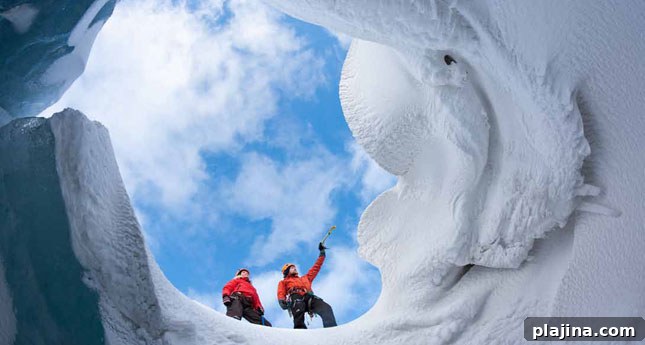
Ice climbing and glacier hiking are widely available year-round. Tour operators supply gear such as crampons, harnesses, ice axes and helmets, and after a brief skills lesson you can head onto the ice. A popular route takes adventurers onto Sólheimajökull, an outlet glacier with striking ice formations, crevasses, sinkholes and razor-edged ridges, and offers supervised opportunities to try climbing.
After active days in the cold, the Blue Lagoon remains an essential stop. Iceland’s largest and most visited geothermal spa sits in a seafloor-like expanse of warm, mineral-rich water. A soak in the milky-blue pools — especially on a crisp day — eases sore muscles and restores energy. The complex also offers in-water massages and spa treatments for a fuller recovery.
INFO TO GO
International flights arrive at Keflavík International Airport (KEF), about 31 miles southwest of Reykjavík. Arcanum Glacier Tours runs two-hour snowmobile excursions on Mýrdalsjökull year-round. Arctic Adventures organizes outings ranging from half-day snorkeling trips to multi-day itineraries that include glacier hiking, caving and ice climbing. Luxury Adventures creates custom packages for travelers seeking tailored experiences. Iceland’s location — roughly five hours from the northeastern United States and only a few hours from many European gateways — makes it an efficient stopover, with the Blue Lagoon and other attractions conveniently close to Keflavík Airport.