
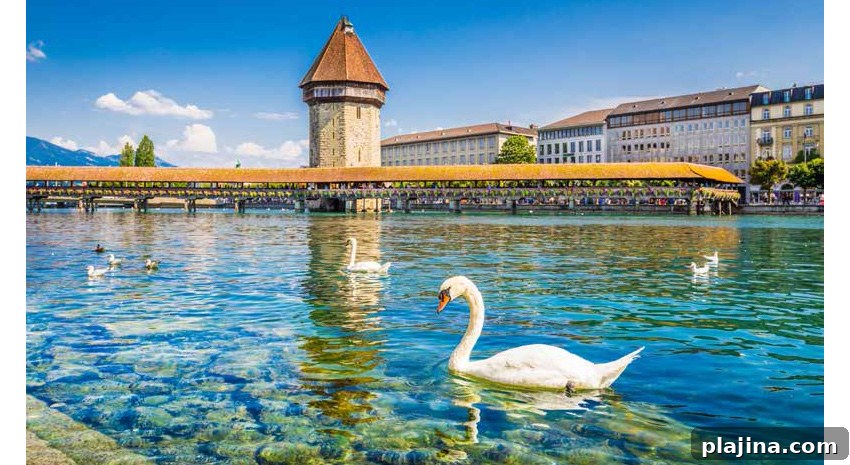
Lucerne is a city built on tourism. British expatriate and author Diccon Bewes, who writes about his adopted homeland, calls Lucerne Switzerland’s prettiest city. Every year visitors from Japan, China, Europe and North America disembark tour buses and stroll the cobblestone streets with cameras at the ready.
Lucerne’s history is distinctly Swiss and comparatively stable after the fall of the Roman Empire in the early sixth century. By the middle of the ninth century the settlement was known as Luciaria, when Germanic Alemannic peoples established roots in the region. Lucerne declared itself an independent city in 1178 and, thanks to its strategic position on the Gotthard trade route, became largely self-sufficient by the late 13th century. Around that time King Rudolph I von Habsburg expanded into the area, prompting Lucerne and neighboring towns to join forces in the pursuit of independence as part of the Swiss Confederacy, or Eidgenossenschaft.
Lucerne’s victory at the Battle of Sempach in 1386 weakened Habsburg influence and set the stage for regional growth. From then on, the city’s path diverged from the frequent warfare that marked much of Europe’s history. Aside from Napoleon’s brief reorganization of Swiss territories in 1798 and the subsequent Act of Mediation in 1803, which restored canton autonomy, Switzerland and Lucerne experienced relatively peaceful development. Today, the country’s long stability is evident in the many intact historic buildings, and Lucerne remains committed to preserving its cobbled pedestrian plazas rather than surrendering them to car traffic.
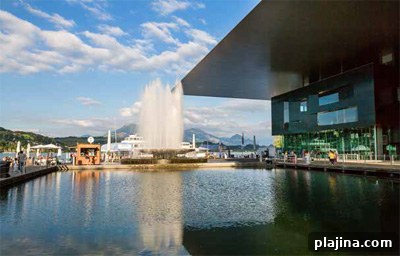
View of the KKL and the Wagenbach fountain in Lucerne © OSCITY | DREAMSTIME.COM
Lucerne embraces modern architecture and cultural life as well. The Kultur und Kongresszentrum Luzern (KKL) opened in 2000 and houses a congress center, an art museum and a renowned concert hall. Designed by architect Jean Nouvel and situated where the Reuss River meets Lake Lucerne, the KKL’s cantilevered roof and adjacent Wagenbach fountain on Europlatz provide striking waterfront sights where locals and visitors alike relax amid classic Swiss scenery.
The KKL is within easy walking distance of several hotels and directly across from Lucerne Bahnhof, the city’s central train station. Most travelers arrive by train from Zürich Airport, Switzerland’s largest international airport and the primary hub for Swiss International Air Lines. The journey from the airport takes about 60 minutes, with at least one direct train per hour. Choosing accommodation within walking distance of the station is wise, since Lucerne is best explored on foot.
Near the KKL you’ll find a range of hotels that suit both business and leisure travelers, including Radisson Blu, Hotel Alpina, Hotel Luzern, Renaissance Lucerne, AMERON Hotel Flora Luzern and Monopol. Many establishments offer conference facilities, WLAN and business services. Some properties promote modern meeting rooms and flexible event spaces to support presentations and corporate needs.
A short stroll from the station brings you to Lucerne’s historic bridges, most notably the Kapellbrücke (Chapel Bridge). Built in 1333, this covered wooden pedestrian bridge is known for its 17th-century interior paintings, several of which were damaged in a 1993 fire and subsequently restored. The Kapellbrücke is recognized as one of Europe’s oldest wooden covered bridges and a surviving example of medieval truss construction.
Crossing the Kapellbrücke over the Reuss River leads to several well-regarded hotels and dining options, including Hotel des Balances, Zum Weissen Kreuz, Hotel des Alpes and the late-19th-century Grand Hotel National Luzern. Hotel des Balances is praised for its Swiss cuisine and business-friendly atmosphere, with a riverside patio that offers attractive views of the Reuss and Lake Lucerne—ideal for breakfast, lunch or dinner.
Dining and nightlife in Lucerne cater to varied tastes. Most four- and five-star hotels provide on-site restaurants and private meeting rooms, and the city’s compact center means it’s easy to find late-night drinks or relaxed bars. For a classic pub experience try the Shamrock Irish Pub in the heart of the city. For a broader beer selection, Bar Bei Miguel on Bruchstrasse features bottled beers from around the world.
For a traditional Swiss finale, visit Wirtshaus Taube for a hearty rösti—crispy grated potatoes formed into a patty and often served with cheese, ham, tomato and a fried egg in a cast-iron pan. Whether you seek historic charm, modern culture or reliable business amenities, Lucerne blends preserved heritage with contemporary comforts to satisfy a wide range of visitors.