
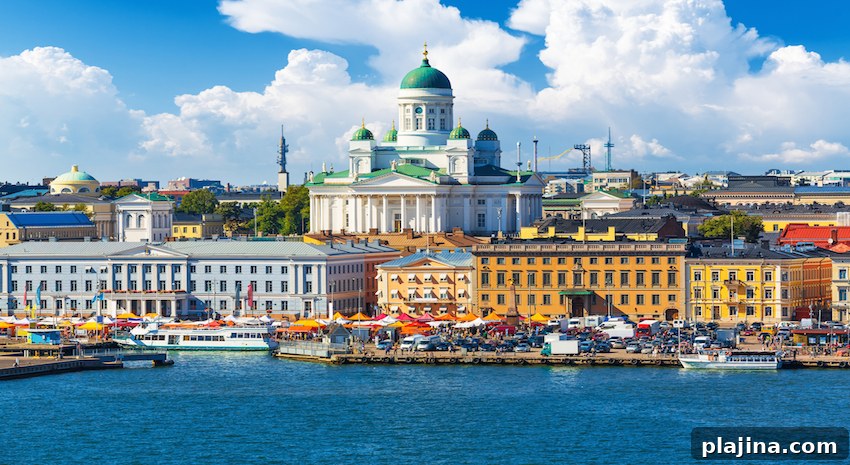
This year’s Lux Helsinki light festival — the ninth annual edition — will trace a new route around the Helsinki Cathedral. Held January 5–9, 2017, the event is complemented by Lux In, a light art exhibition at the Cable Factory running January 1–10, 2017. During the festival, many of the city’s historic façades and beloved public spaces are illuminated, including City Hall, the Supreme Court, the Presidential Palace and the Swedish Embassy. The route places special emphasis on the Kruununhaka district, following Mariankatu from the Market Square past the University of Helsinki’s Topelia building and into the courtyard of the National Library.
Fifteen installations by light, media and visual artists from Finland, the Netherlands, Mexico and other countries will be on display. A central piece, Domus 360° by Tarja Ervasti, will illuminate all four sides of Helsinki Cathedral. Other highlights include Flowers of Life, a composition of floating patterns projected onto the exterior of the Topelia building at the University of Helsinki; Veljekset by designer Maija Louekari, which projects motifs inspired by Finnish folklore onto the Bank of Finland; and Light Pipes by artists Rölli Ridanpää and Tero Laine, an interactive urban installation built from copper pipes and valves that control a cluster of lamps.
Installations are lit each evening from 5:00 to 10:00 p.m., allowing visitors to follow the trail of light across the city. The festival’s program covers a range of approaches — from architectural projections to interactive works — offering both large-scale spectacles and smaller, intimate moments. The focus on Kruununhaka brings fresh attention to this historic neighborhood and connects familiar landmarks with contemporary art in public space.
Lux Helsinki combines local and international artists to present new takes on illumination, projection and spatial experience. The mix of permanent landmarks and temporary artworks encourages exploration on foot, with opportunities to discover unexpected views of well-known buildings. With carefully designed projections and responsive installations, the festival highlights how light can reshape perception of urban architecture and public squares.
Visitors seeking practical information will find details about the route, participating artists and individual installations on the festival’s official site and event materials. The festival’s evening schedule and concentrations of works make it suitable for both short visits and longer walks through the illuminated city center. Whether viewing large-scale façades or engaging with interactive pieces, attendees can expect a varied program that celebrates light as a medium for art, storytelling and place-making.